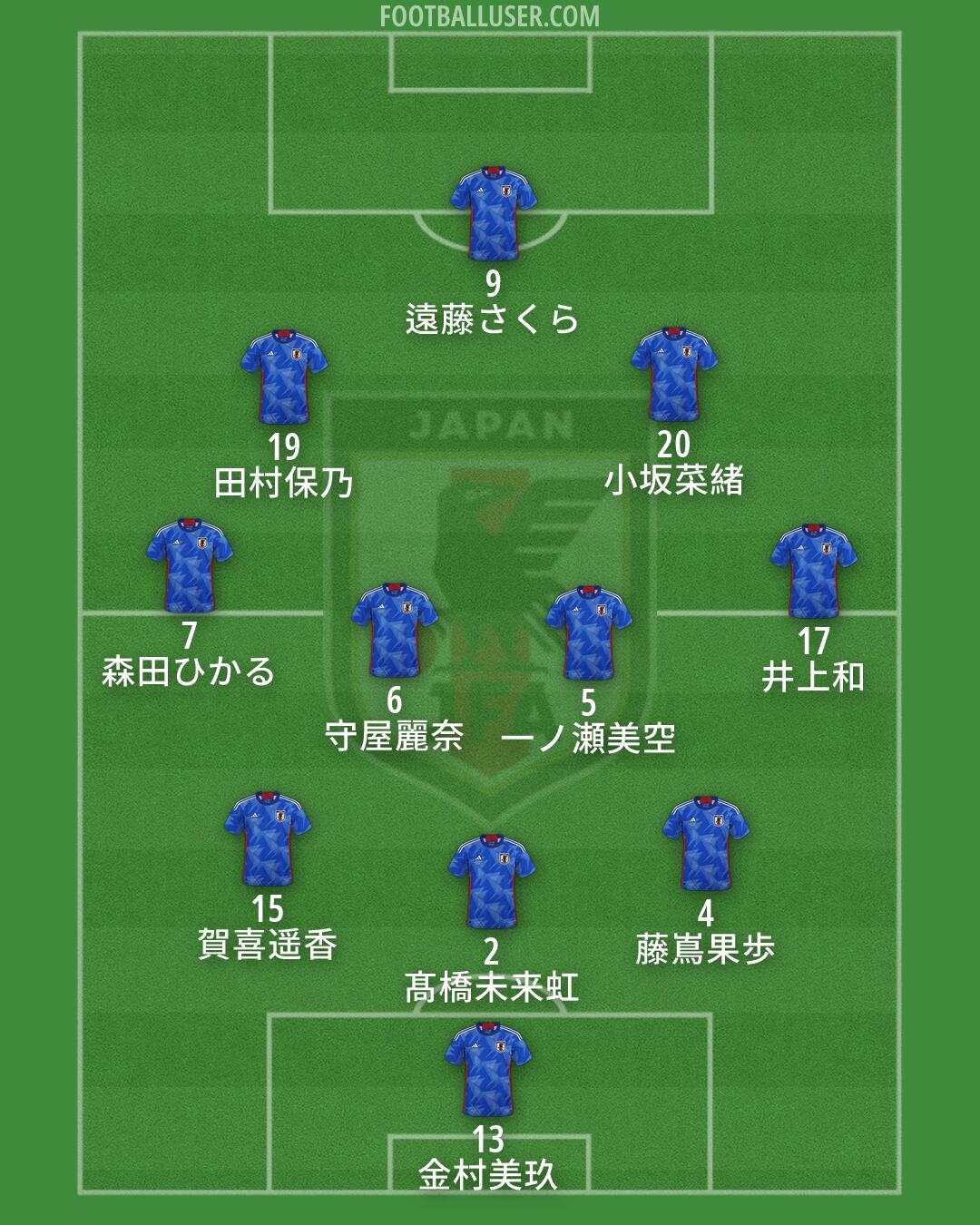

Japan National Football Team Formation
 June 27, 2026


Starting Lineup
9 (遠藤さくら)19 (田村保乃)
20 (小坂菜緒)
7 (森田ひかる)
6 (守屋麗奈)
5 (一ノ瀬美空)
17 (井上和)
15 (賀喜遥香)
2 (髙橋未来虹)
4 (藤嶌果歩)
13 (金村美玖)
Focusing on directness and overwhelming the opponent in the final third, Japan employs an extremely aggressive attacking style. This team uses a 2-4-4 formation to pin the opposition in their own half and hunt for goals immediately. The lineup is built to play a heavy high press, aiming to win the ball back high up the pitch to launch rapid attacks.
The goalkeeper 9 sits behind a very thin defensive line of only two players. The central defenders, 20 and 19, must maintain a very high line to squeeze the space and set the offside trap. Both 20 and 19 are required to step up and intercept long balls while covering the massive gaps behind them. The defensive unit works as a narrow block that relies on the speed of the two defenders to track back if the press is broken.
The midfield consists of a central pairing and two wide midfielders to bridge the gap between the defense and the attack. 6 and 5 act as the engine room, with 6 tasked to shield the defense and 5 working to carry the ball forward into the attacking third. To provide width, 7 and 17 occupy the left and right channels, helping to spread wide and recycle possession. This group must work to compress the midfield and pick up runners to prevent the opposition from playing through the lines.
The attack features a front four to stretch the defence and create chaos. 4 and 15 play as wide wingers who aim to get to the byline and deliver crosses into the box. In the center, 2 and 13 operate as a strike partnership. One of these players will often act as a pressing centre-forward to force a long ball from the opponent, while the other looks to receive the ball in the box or make runs in behind. The movement of 4 and 15 is vital to isolate wide players in one on one situations.
This formation offers the strength of overwhelming numerical superiority in the final third. By committing four players forward, Japan can create wide overloads and force the opposition into errors. Another advantage is the ability to press high in coordinated waves, which forces the opponent to play under intense pressure. The Samurai Blue can use these waves to win the ball back high up the pitch and spark quick transitions.
The 2-4-4 formation is a daring tactical choice that prioritizes goal scoring over defensive stability. It is most effective when the team faces an opponent that struggles to play out from the back or when they need to break down a low block with sheer numbers.