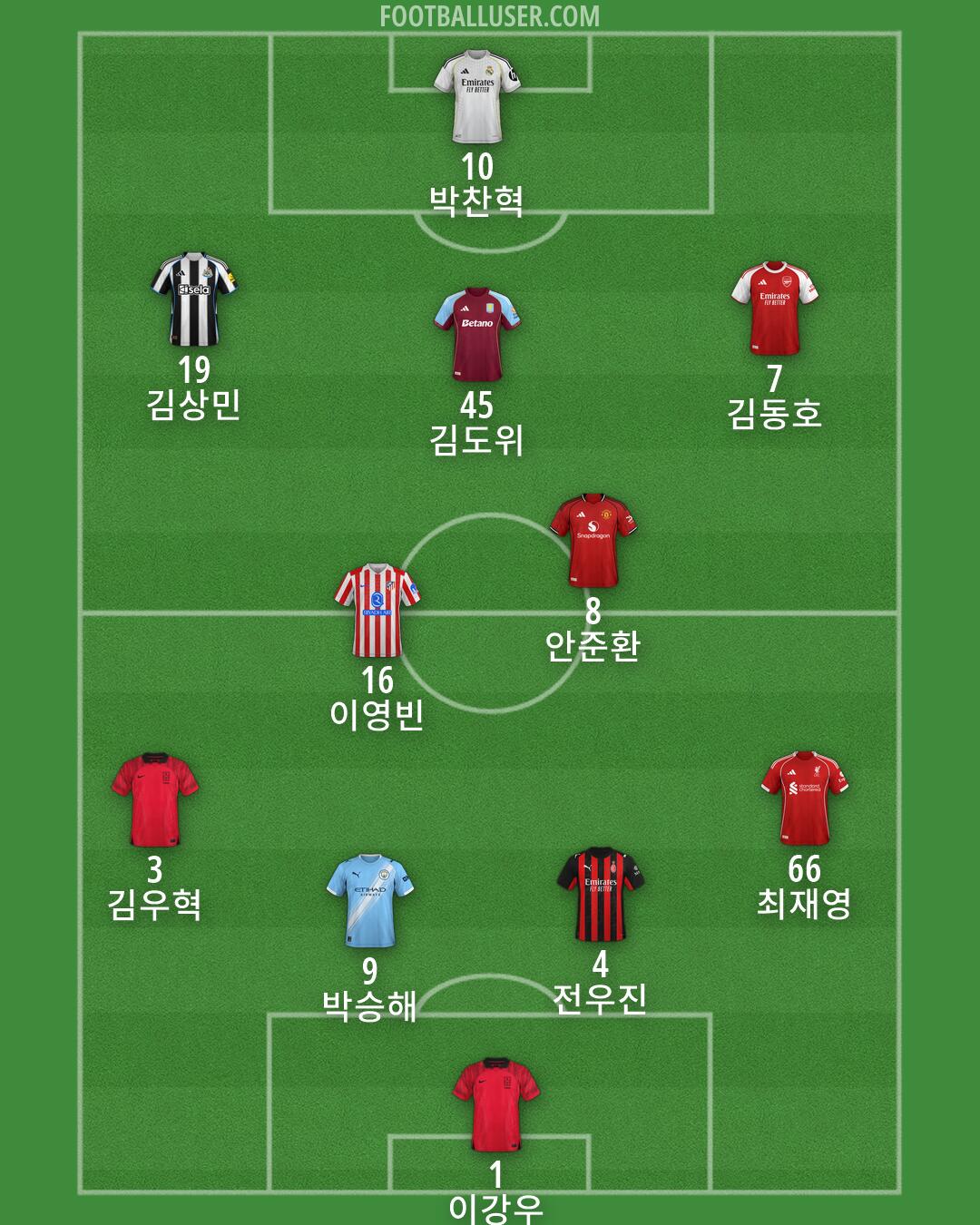
Custom Team Football Formation
 June 28, 2026
 준홬


Starting Lineup
10 (박찬혁) (Real Madrid)45 (김도위) (Aston Villa)
7 (김동호) (Arsenal)
19 (김상민) (Newcastle)
8 (안준환) (Man Utd)
16 (이영빈) (Atlético)
1 (이강우) (South Korea)
66 (최재영) (Liverpool)
4 (전우진) (Milan)
9 (박승해) (Man City)
3 (김우혁) (South Korea)
Focusing on a defensive identity, this team utilizes a 5-4-1 formation to remain difficult to break down. The lineup is built to sit deep and absorb pressure before looking to spring quickly on the break. By packing the central areas, the side intends to deny space to the opposition and force them into less dangerous areas.
The defensive unit begins with 10 in goal to organize the line. A back five provides massive coverage, with 45, 16, and 8 forming a central block to win headers and clear the lines. The wide defenders are tasked with maintaining a narrow defensive block but must transition to attacking wing backs when the ball is won. 19 operates as the right wing back to provide width, while 7 acts as the left wing back to support the flank. This group works to hold the line and prevent any runs in behind.
In the middle of the pitch, a flat four-man midfield works to compress the midfield and protect the back five. 4 and 9 act as the central pair to shield the defence and win the second ball. To provide width in the middle third, 66 and 3 operate as wide midfielders who must track back to help the wing backs. These players help to bridge the gap between the defensive block and the lone striker, ensuring the team stays compact when the opposition has possession.
The attacking phase relies on a lone striker, 1, who must hold up the ball to allow the rest of the team to move up the pitch. Because the team is built to play on the break, 1 often finds himself isolated and must work to pin the last defender. When the team wins the ball, 19 and 7 push up to provide the width needed for crosses. The midfielders 66 and 3 join the attack to create combinations in tight spaces or support 1 in transition to hit the opposition on the break.
One major advantage of this formation is the compactness when defending, as it is very hard for opponents to play through the lines. The presence of three central defenders like 45, 16, and 8 makes the team incredibly strong in aerial duels. Additionally, the wide players 19 and 7 can create wide overloads once the team transitions from a low block into an attacking phase.
This 5-4-1 formation is a resilient setup designed to frustrate dominant sides. It is best suited for matches against heavy possession teams where the goal is to sit deep and counter at pace.