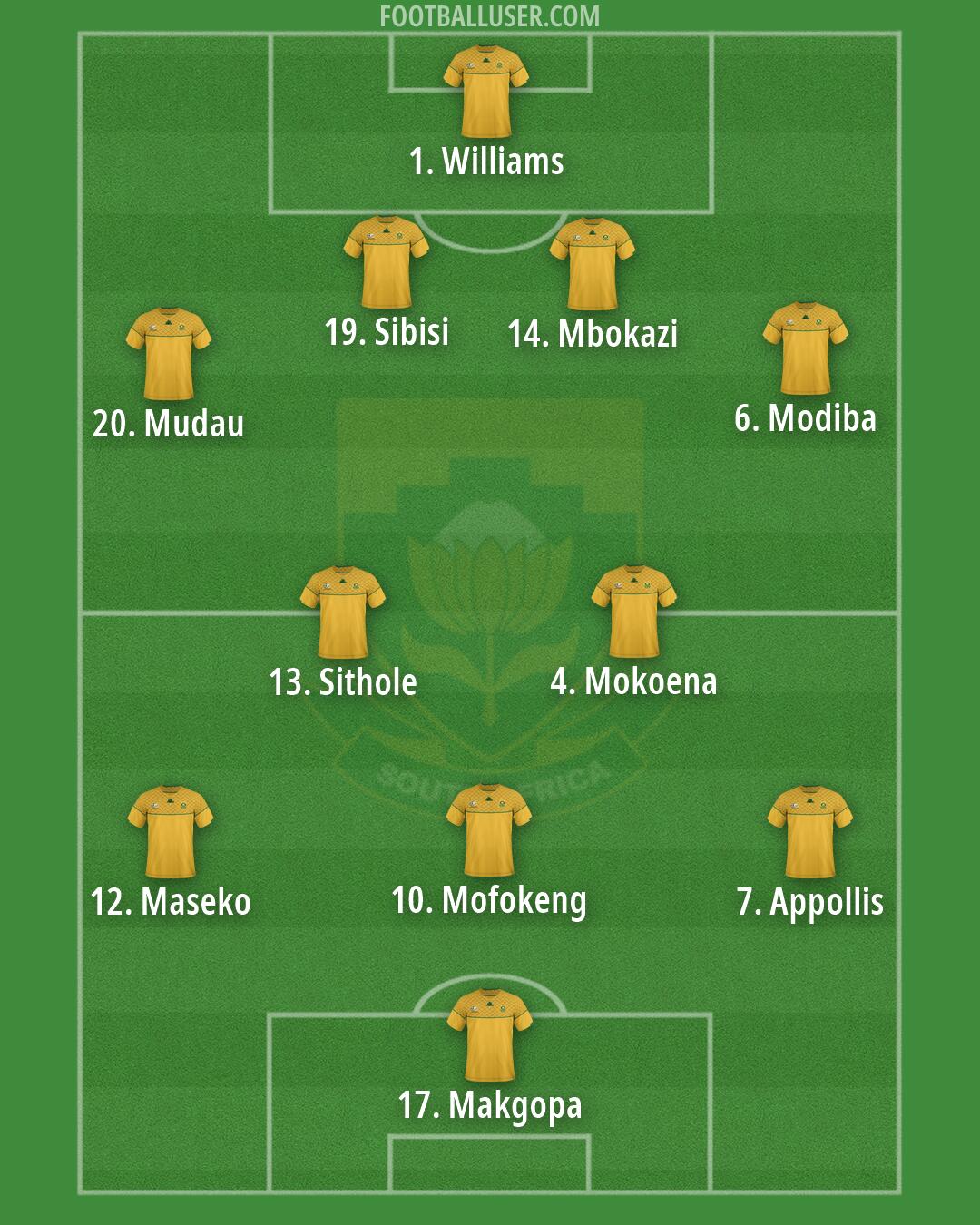

South Africa National Soccer Team Formation
 June 28, 2026


Starting Lineup
1. Williams20. Mudau
6. Modiba
19. Sibisi
14. Mbokazi
13. Sithole
4. Mokoena
12. Maseko
10. Mofokeng
7. Appollis
17. Makgopa
A vertical and direct style of football defines South Africa as they utilize a 4-2-4 formation. The team aims to push numbers forward to pin the opponent in their own half. This lineup focuses on quick transitions to catch the opposition out of position.
Williams stands between the posts to direct the defensive unit. The back line functions as a flat back four to maintain a compact defensive block. Mudau operates as a right back to defend the wide channel, while Modiba provides cover as the left back. Sibisi and Mbokazi form the central pair, with Sibisi acting to cover the space behind the line while Mbokazi stays firm to win headers. The defenders work together to keep the team compact and deny space between the lines.
The midfield consists of a double pivot that provides the necessary link between defence and attack. Mokoena and Sithole operate in the centre of the pitch to shield the defence. Mokoena works to win the second ball and recycle possession, while Sithole looks to carry the ball forward into the attacking third. They must drop deep to pick up runners and ensure the team does not get bypassed in the middle.
An aggressive front line defines the attacking phase. Maseko and Appollis act as wide wingers, with Maseko hugging the touchline to stretch the defence and Appollis ready to cut inside into the half spaces. Mofokeng and Makgopa operate as a central partnership. Makgopa uses his presence to hold up the ball, while Mofokeng looks to make runs in behind the centre backs. The four players work together to press the opposition back line and force errors.
This formation provides a significant advantage in terms of attacking pressure. The high number of forwards allows the team to pin the last defender and create constant threats in the box. South Africa also benefits from speed of transition, as the players can move from a defensive block to an attacking phase in seconds. This allows the team to hit in behind on the transition and isolate defenders in one on one situations.
This 4-2-4 formation is built for high intensity and direct attacking play. It is most effective when facing opponents who struggle to manage wide overloads or when the game requires an immediate increase in offensive numbers.