
Austria National Football Team Formation
 June 29, 2026


Starting Lineup
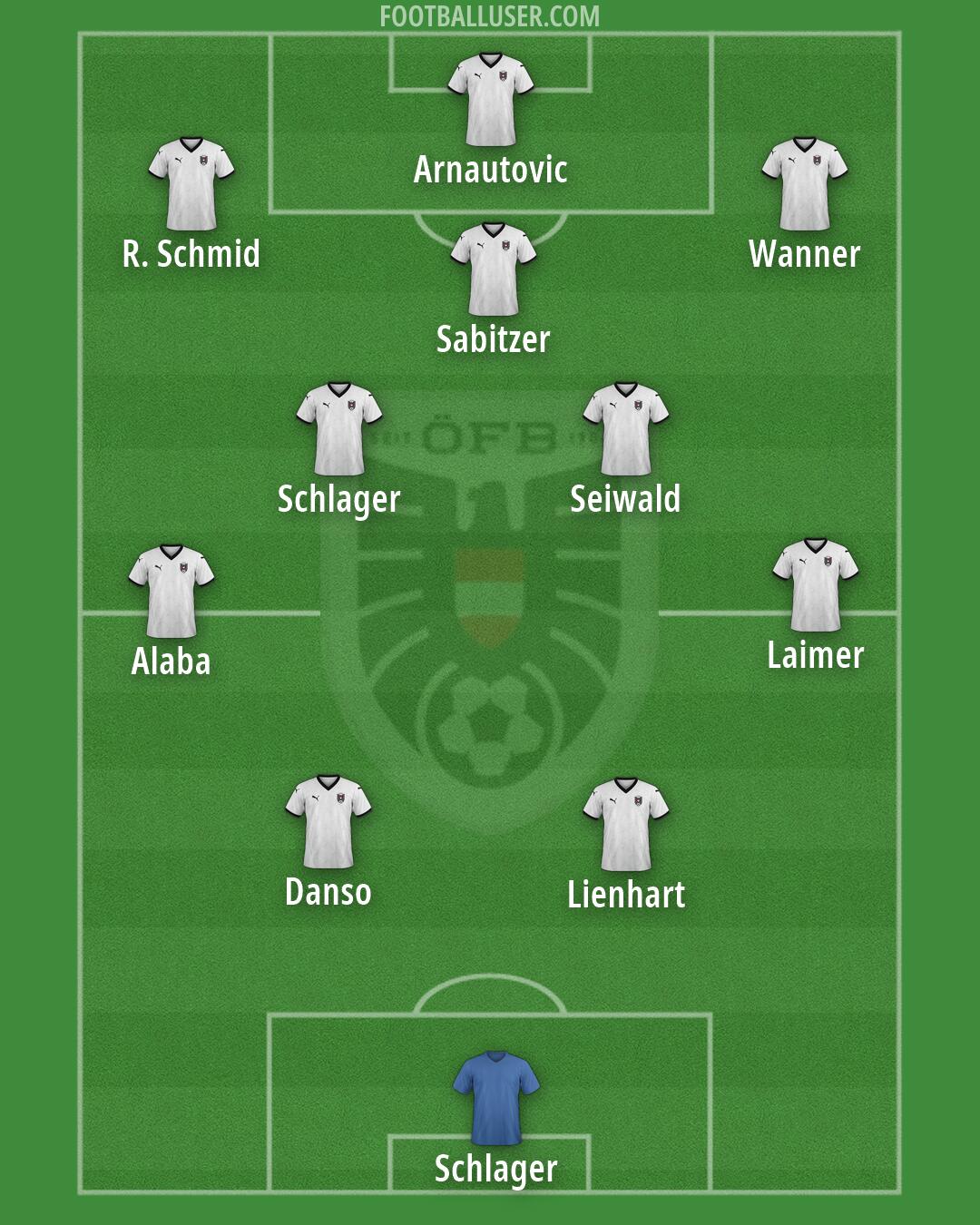
Alaba · Laimer · Danso · Lienhart · Arnautovic · Schlager · Seiwald · Sabitzer · R. Schmid · Wanner · SchlagerAustria aims to dominate the center of the pitch through heavy pressure, operating within a 2-5-3 formation. This lineup is built to control possession and win the ball back high up the pitch. By spreading the width through the midfield and the front line, the team works to stretch the defence and create space for central combinations.
Schlager operates between the posts to manage the defensive unit. The back line relies on a narrow pair of central defenders in Lienhart and Danso. Lienhart uses his aerial strength and composure to play out from the back, while Danso uses his physical presence to win the header and cover the space behind a high line. Because there are only two defenders, they must hold a compact block and rely on the midfield to block passing lanes.
The midfield is the core of the Austria lineup, featuring a five man block. Alaba acts as a deep lying playmaker, using his passing range to distribute the ball and recycle possession. Beside him, Laimer provides pressing intensity to win the second ball and disrupt the opponent. The central roles of Schlager and Seiwald allow the team to control the tempo, with Seiwald working to intercept passes and protect the defensive line. Sabitzer plays as an attacking ten, looking to arrive late into the box and carry the ball forward.
In the attacking third, the team uses three attackers to pin the opposition back line. Arnautovic acts as a target man, using his strength to hold up the ball and find the feet of the striker. R. Schmid and Wanner occupy the wide areas, with Wanner looking to cut inside to create room for others. The team aims to break quickly in transition, using the width to spread wide before playing through the lines to create scoring chances.
A major tactical advantage of this formation is the numerical superiority in midfield. By packing the central zone, Austria can squeeze the space and make it difficult for opponents to progress through the thirds. Another strength is the ability to press high in coordinated waves, using the front three to trigger a press and force a long ball. This pressure allows the team to win the ball back high up the pitch and attack immediately.
This formation creates an aggressive identity focused on central dominance and high intensity. It is best suited for matches against teams that play a slow build up and can be overwhelmed in the middle of the pitch.