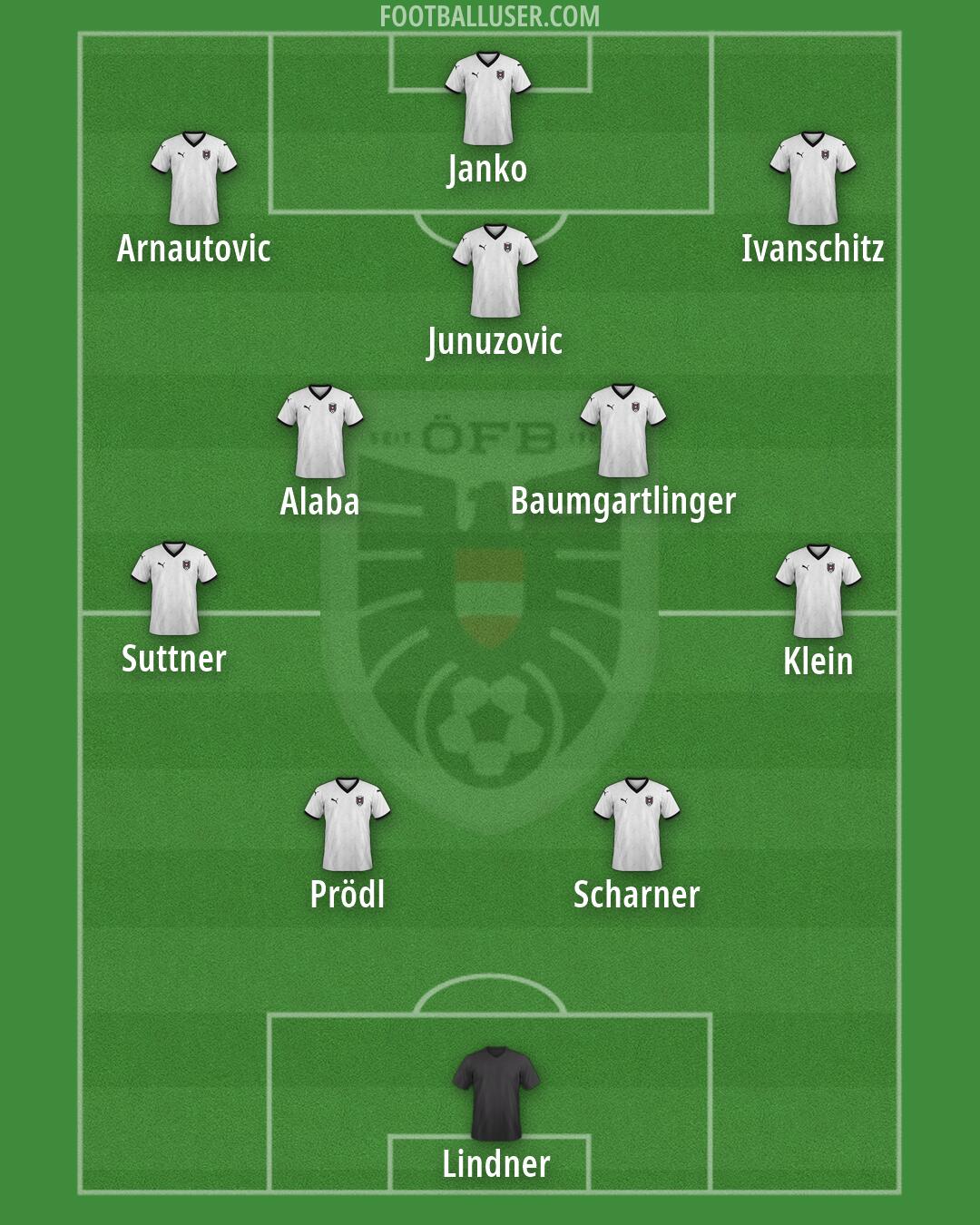

Austria National Football Team Formation
 June 29, 2026


Starting Lineup
Janko · Alaba · Baumgartlinger · Junuzovic · Ivanschitz · Suttner · Klein · Prödl · Scharner · Arnautovic · LindnerAustria plays a 2-5-3 formation that prioritizes aggressive attacking intent and central dominance. This lineup is built to play a vertical game, looking to push high up the pitch and squeeze the space in the opponent's territory. By flooding the central areas, the team aims to control the tempo and dictate how the match is played.
Lindner acts as the lone goalkeeper to protect the net. Scharner and Prödl operate as the two central defenders in a high line. These players must be ready to step up to intercept play or sweep behind the defense to cover for the high position of the unit. They must hold a compact formation to ensure they are not bypassed by quick transitions.
The midfield consists of five players working to control the center of the pitch. Klein and Suttner operate as a double pivot to shield the defense and win the second ball. In front of them, Alaba plays as a left central midfielder, using his passing range and set piece delivery to progress through the thirds. Baumgartlinger provides extra cover in the middle, while Junuzovic acts as an attacking ten to connect the midfield to the forwards. This heavy midfield presence allows Austria to recycle possession and find ways to break the line.
The front line uses three attackers to keep the defense stretched. Janko serves as the central striker to lead the press and hold up the ball. On the wings, Ivanschitz stays wide to provide width, while Arnautovic plays on the left. Arnautovic often cuts inside to use his physical strength and pressing intensity to trouble defenders. The team relies on link-up play to create runs in behind.
A key advantage of this formation is the numerical superiority in midfield, which makes it hard for opponents to find passing lanes. Dominating possession allows the Austrian national team to press high up the pitch. Speed of transition is another benefit when the ball is won back by the midfield unit, allowing for quick attacks on the wings or through the middle.
This 2-5-3 formation is defined by its heavy central presence and aggressive pressing. It is best suited for games where the team needs to break down a deep defense through central overloads.