
Brazil National Football Team Formation
 June 29, 2026


Starting Lineup
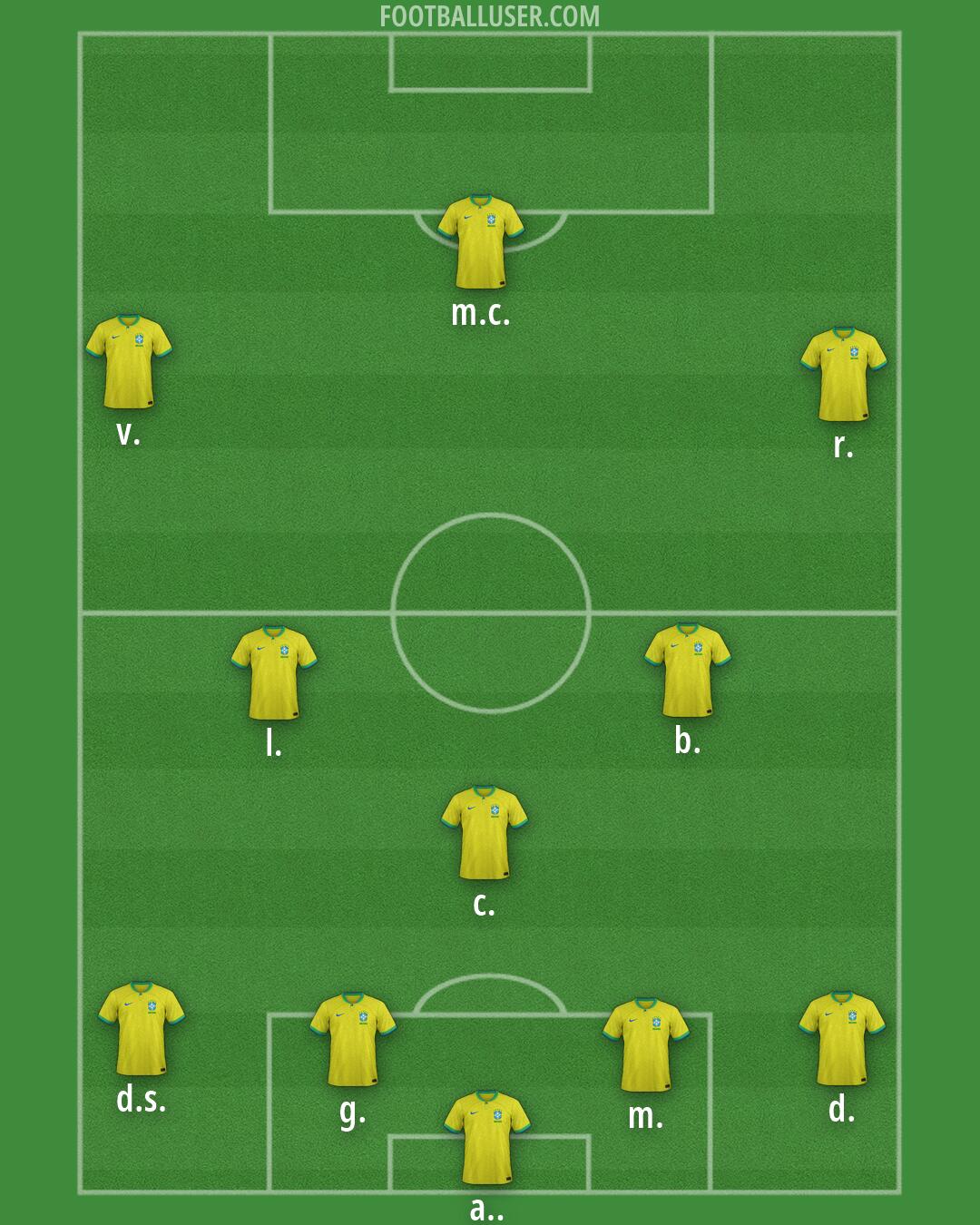
a.. · d. · m. · g. · d.s. · c. · b. · l. · v. · m.c. · r.Brazil plays with a heavy high press in a 4-3-3. The lineup is built to control the tempo of the game and use the width of the pitch to stretch the defence. The Seleção seeks to win the ball back high up the pitch to launch immediate attacks.
a.. acts as the goalkeeper to organize the back line. The defense operates as a flat back four with d. at right back and d.s. at left back. m. and g. occupy the central roles as the right and left centre backs. The defensive unit works to hold a high line and set the offside trap to keep the opposition pinned back. The central pair look to win the header and clear the lines when under pressure. The full backs are ready to overlap the winger to provide extra support in the wide areas.
A single pivot controls the middle of the pitch. c. sits in the defensive midfield role to shield the defence and protect the centre backs. l. and b. operate as the two advanced midfielders who link the defensive line to the forward players. These two move to receive on the half-turn and carry the ball forward into the attacking third. c. often drops between the centre backs to help play short from the back and recycle possession. This midfield group aims to compress the midfield and deny the turn to opposition players.
The attacking unit consists of three players working to penetrate the opposition box. m.c. plays as a pressing centre forward to lead the front line. r. and v. act as wide wingers to provide width. r. stays wide to stretch the defence, while v. will cut inside to find space in the channels. The goal is to create runs in behind and allow m.c. to hold up the ball and lay it off for players to arrive late into the box. The team looks to break quickly when they win the ball in the middle third.
One major advantage for Brazil is the ability to create wide overloads. When d. and d.s. push up, they create numerical superiority against the opposition wingers. The team also benefits from the ability to press in coordinated waves to force a long ball from the opponent. This constant pressure makes it hard for the other team to progress through the thirds.
This 4-3-3 formation is a potent attacking system built for high ball retention and intense pressing. It is best suited for situations where the team needs to dismantle a team that sits deep in a low block.