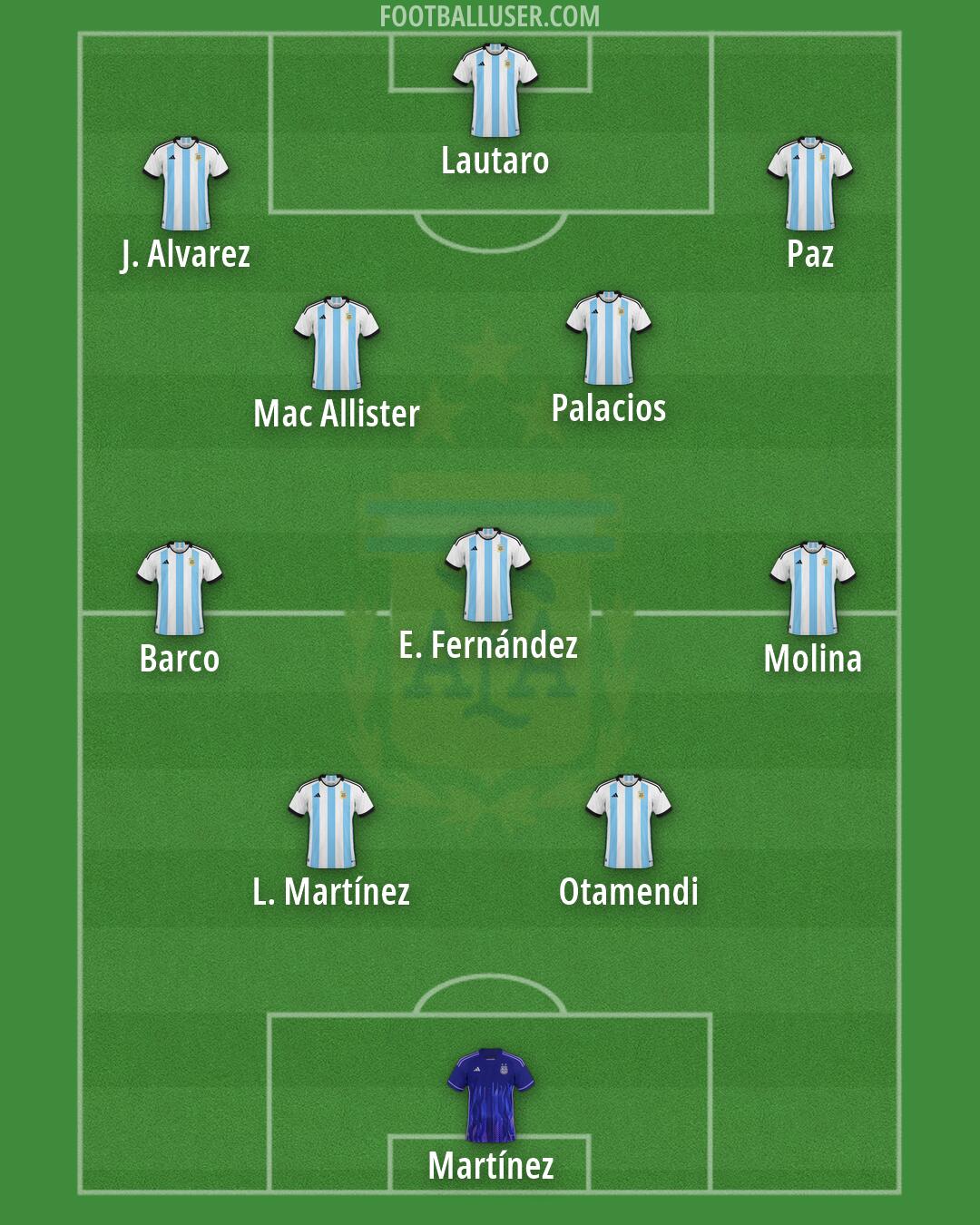

Argentina National Football Team Formation
 June 30, 2026


Starting Lineup
Lautaro · Paz · J. Alvarez · Mac Allister · Palacios · E. Fernández · Barco · Molina · L. Martínez · Otamendi · MartínezArgentina focuses on a high press and rapid transitions using a 2-5-3 formation. This lineup is built to squeeze the pitch and win the ball back high up the pitch to catch the opposition out of position. The team wants to dominate the center of the pitch and use their numbers to control the tempo of the game.
Emiliano Martínez stays between the posts to command his area. Behind him, L. Martínez and Otamendi operate as a central pair in a narrow defensive block. They must be ready to step up and play out from the back while also being prepared to cover wide areas when the midfield is bypassed. These two center backs must be dominant in the air and quick to intercept passes to prevent long balls from breaking the line.
The midfield is extremely crowded to ensure control over the center. Enzo Fernández acts as the anchor to shield the defense and recycle possession. He works alongside Molina and Barco who provide the engine in the middle. Mac Allister and Palacios occupy the half spaces to connect the midfield to the attack. Mac Allister has a great passing range to find teammates in tight spaces, while Palacios works to carry the ball forward. This heavy midfield presence allows the team to win the second ball and maintain pressure.
In the final third, the team uses three attackers to stretch the defence. Lautaro acts as the central striker, often looking to find the feet of the striker or make runs in behind. J. Alvarez and Paz provide width by operating as wide attackers. J. Alvarez is known for his high pressing intensity to force a long ball from the opposition. The attack relies on quick combinations to split the defence with a through ball or to create a one on one wide.
Argentina gains a significant advantage through numerical superiority in midfield. By packing the center, they can press in a mid-block or trigger a press high up the pitch. This creates wide overloads when the midfielders shift to support the wingers. The speed of transition is a major threat, as they can move from a winning tackle to an attacking move in seconds.
This formation is designed to dominate games through intense pressing and central control. It is best suited for facing teams that try to build play slowly from the back.