
Inter Football Formation
 Today, June 30, 2026


Starting Lineup
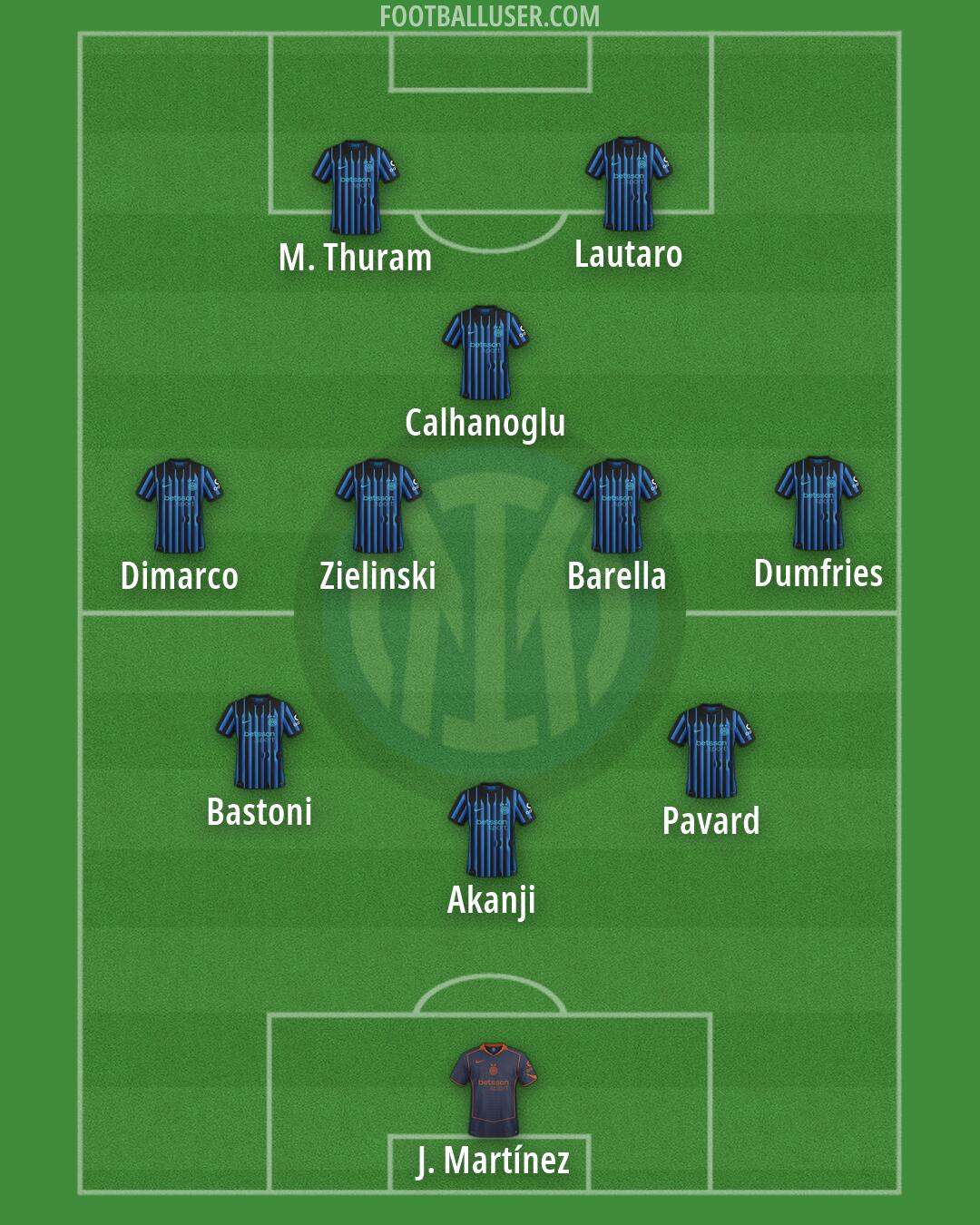
Akanji · Bastoni · Pavard · Dimarco · Dumfries · M. Thuram · Lautaro · Zielinski · Barella · Calhanoglu · J. MartínezControlling the game through central dominance and vertical transitions is the main goal for Inter, utilizing a 3-5-2 formation. This lineup is built to exert pressure in the middle and use the width of the pitch through very active wing backs. The team aims to recycle possession quickly to find openings in the opposition defence line.
J. Martínez starts the build up from the back as the goalkeeper. The defensive unit operates as a back three, featuring Pavard as the right centre back and Bastoni as the left centre back, with Akanji positioned in the center. Bastoni acts as a ball playing defender who can move out of the line to progress the ball. Pavard is known for his strong positional sense and ability to defend man to man. The back three works to maintain a high line to squeeze the space and keep the team compact while defending.
The midfield is built around a central trio that connects the defence to the attack. Calhanoglu plays as an advanced playmaker, looking to split the defence with a through ball or deliver long passes. Barella functions as a carrier who can drive forward with the ball and uses his high pressing intensity to win the ball back high up the pitch. Zielinski connects the lines, providing support in the half spaces to move the ball between the midfield and the forwards. Dimarco and Dumfries act as attacking wing backs, pushing high to provide width and support the attacking moves.
In the final third, Inter employs two forwards in a partnership. Lautaro works as a mobile striker who can drop into the hole to link up play between the lines. M. Thuram provides a presence to hold up the ball and press the opposition back line. The width comes from Dimarco and Dumfries, who seek to get to the byline and whip it in to the strikers. This creates constant movement with runs in behind and allows the forwards to combine in tight spaces to create chances.
A significant advantage of this formation is the ability to create wide overloads from the overlapping wing backs. When Dimarco and Dumfries push up, they force the opposition to shift, which creates space for Barella or Zielinski to arrive late into the box. The team also benefits from numerical superiority in the central midfield, making it hard for opponents to bypass the midfield. The speed of transition allows the team to hit in behind on the transition before the opposition can reset.
This 3-5-2 formation is a powerful way to control the tempo and stretch the opposition wide. It is best used against teams that play in a narrow formation and struggle to track runners in the half spaces.