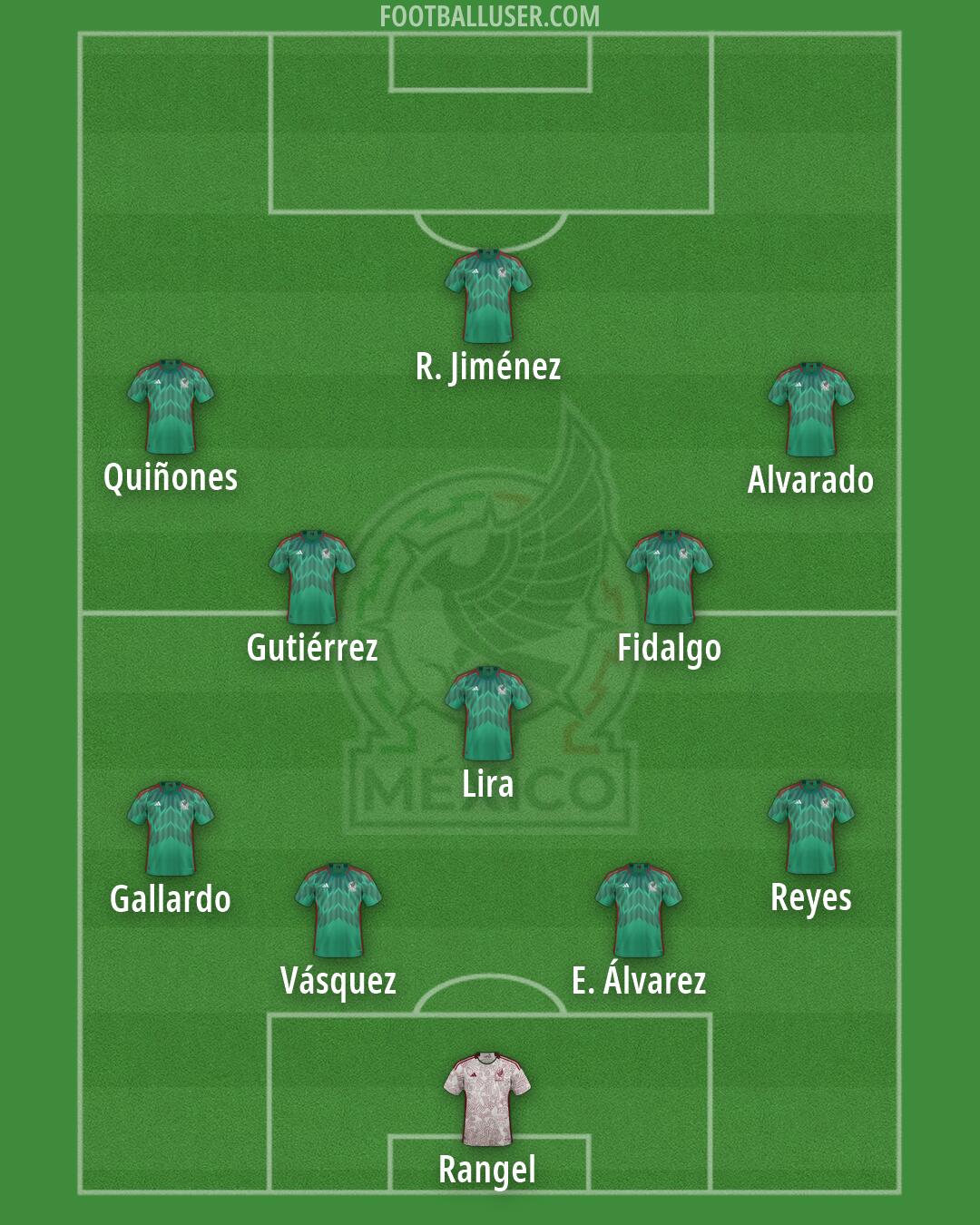

Mexico National Football Team Formation
 June 30, 2026


Starting Lineup
Rangel · Reyes · E. Álvarez · Vásquez · Gallardo · Lira · Fidalgo · Gutiérrez · Quiñones · Alvarado · R. JiménezMexico focuses on a direct and vertical style of play through a 5-2-3 formation. This lineup aims to absorb pressure before hitting opponents in transition. The team relies on quick forward movements to exploit the space left behind by an advancing opposition.
Rangel guards the goal while the defensive unit sits in a narrow defensive block. The back three consist of Lira, E. Álvarez, and Vásquez. Lira acts as the central anchor, while E. Álvarez and Vásquez cover the wide channels to provide defensive cover. Reyes and Gallardo act as attacking wing backs, pushing high to provide width but tracking back to form a five man line when defending. The defenders work to win the second ball and clear the lines to prevent sustained pressure.
The midfield operates as a double pivot consisting of Fidalgo and Gutiérrez. These two players must work hard to shield the defence and prevent the opposition from playing through the lines. Gutiérrez often works to connect the defensive and attacking lines by receiving the ball from the back three. Fidalgo is tasked to carry the ball forward and drive into the half spaces to link the play. This duo must be disciplined to avoid leaving the central defenders exposed during transitions.
In the attacking phase, Mexico utilizes three attackers across the front. R. Jiménez acts as the main striker, tasked to hold up the ball and find the feet of his teammates. Quiñones and Alvarado operate as wide wingers, with Quiñones cutting inside to create goal scoring chances and Alvarado looking to stretch the defence by hugging the touchline. The wingers press from the front to force a long ball from the opposition. This front line looks to break quickly and deliver early crosses into the box.
A primary strength of this Mexico lineup is the ability to create wide overloads when Reyes and Gallardo push forward. This forces the opposition to pull defenders out of position. Another advantage is the compactness when defending in a low block, which makes it difficult for opponents to find space between the lines. The team is also very effective at hitting in behind on the transition once the ball is won.
This formation is designed for a team that wants to remain defensively solid and strike with speed. It is best suited for games against dominant sides where Mexico can sit deep and exploit space on the counter.