Arsenal Football Formation
 July 1, 2026


Starting Lineup
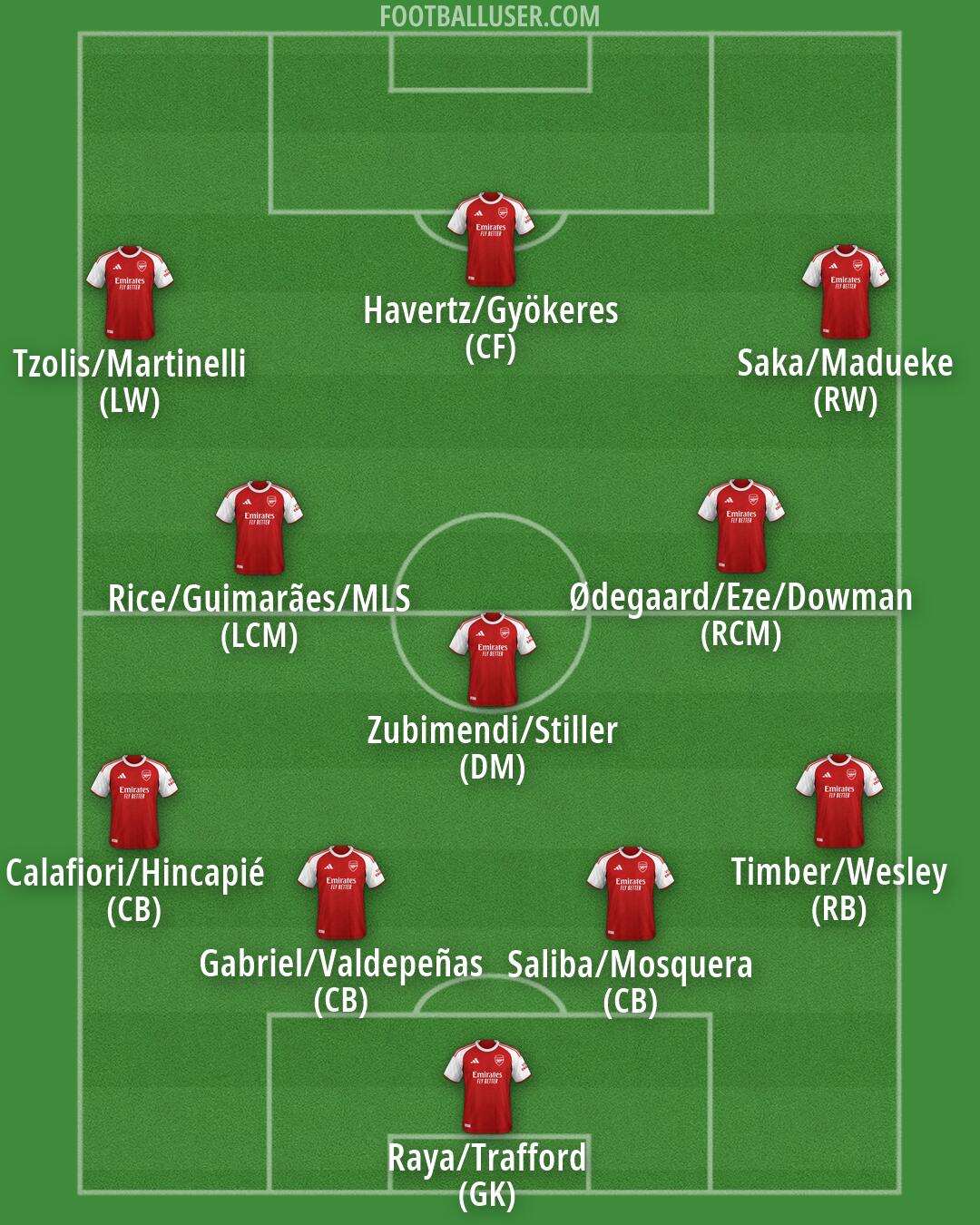
Raya/Trafford (GK) · Calafiori/Hincapié (CB) · Gabriel/Valdepeñas (CB) · Timber/Wesley (RB) · Zubimendi/Stiller (DM) · Rice/Guimarães/MLS (LCM) · Ødegaard/Eze/Dowman (RCM) · Saka/Madueke (RW) · Tzolis/Martinelli (LW) · Havertz/Gyökeres (CF) · Saliba/Mosquera (CB)Arsenal focuses on high pressing and quick ball movement, using a 4-3-3 formation to control the tempo of the game. This lineup is built to squeeze the pitch and win the ball high up the pitch to create immediate scoring chances. By maintaining high intensity, the club aims to dominate territory and dictate how the match is played.
David Raya operates between the posts to start the build up from the back. A flat back four provides the foundation, with Saliba and Gabriel acting as the central defensive pairing. Saliba is known for his recovery pace and composure on the ball, while Gabriel provides immense aerial strength when defending crosses. Timber acts as the right back to provide stability, whereas Calafiori functions as the left back to help the team progress through the thirds. The unit works together to maintain a high line and set the offside trap.
A three-man midfield controls the central area of the pitch. Zubimendi plays as a single pivot to shield the defence and recycle possession. To his side, Declan Rice operates as a left central midfielder to carry the ball forward and win the second ball. Martin Ødegaard plays as the right central midfielder, using his passing range to find teammates in tight spaces. This midfield trio connects the defensive unit to the front line, ensuring the team can move from a mid-block to an attacking stance quickly.
The attacking line uses three players to stretch the defence. Kai Havertz plays as the lone striker, often dropping into the hole to link up play between the lines. On the flanks, Bukayo Saka operates on the right as an inverted winger who cuts inside to threaten the goal. On the left, Gabriel Martinelli provides pace and stretches the opposition. These attackers work to press the opponent's back line, creating space for late runs into the box from the midfielders.
This formation offers several tactical advantages for Arsenal. The team creates numerical superiority in midfield when the full backs push high, allowing the players to control the center of the pitch. The high pressing coordination in waves makes it difficult for opponents to play out from the back. Additionally, the ability to isolate Saka in one on one situations on the wing provides a constant threat during transitions.
The 4-3-3 formation is built for a side that wants to dominate possession and press aggressively. This setup is best suited for matches against opponents who struggle to play under pressure or those who defend in a low block.