Arsenal Football Formation
 July 1, 2026


Starting Lineup
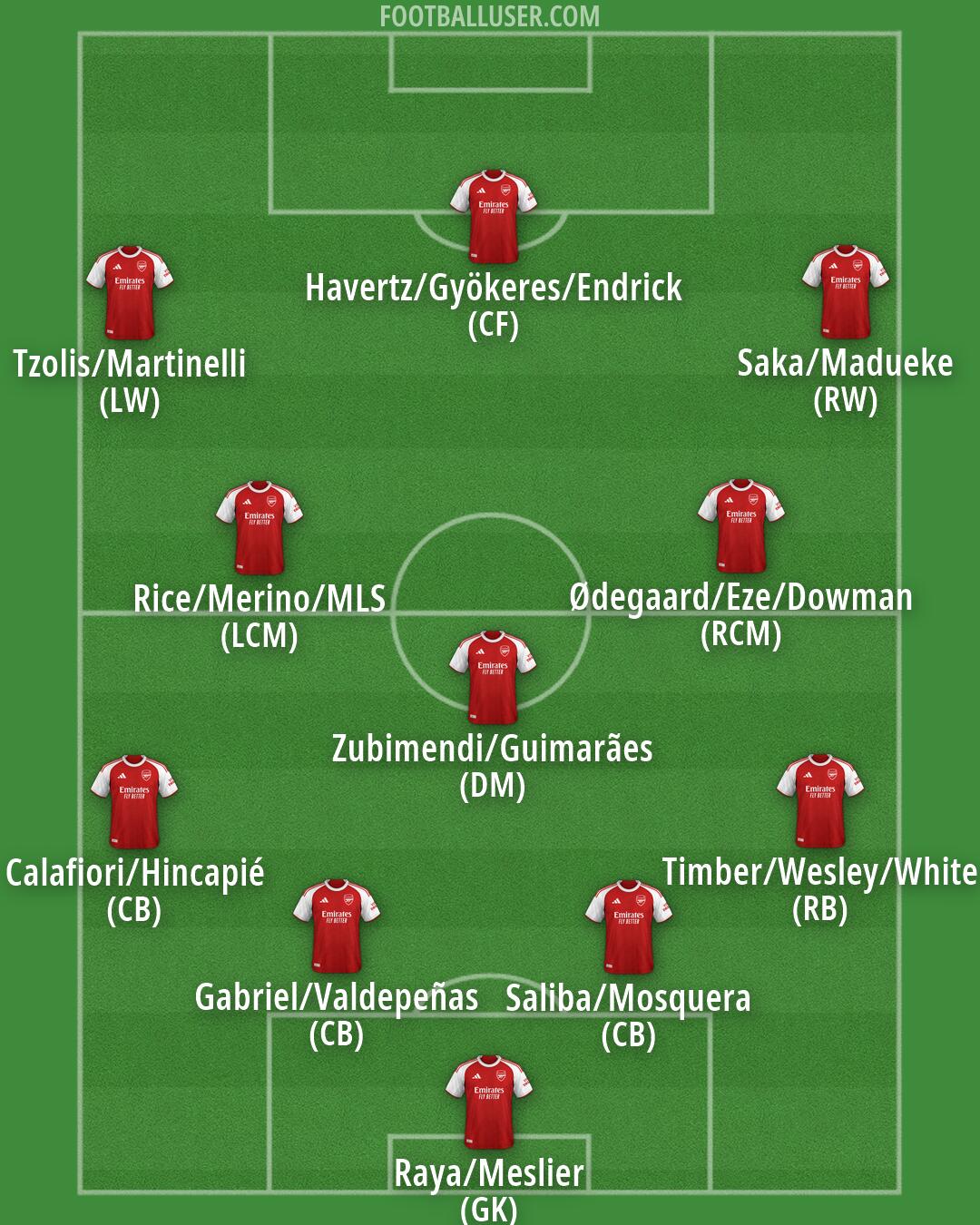
Raya/Meslier (GK) · Calafiori/Hincapié (CB) · Gabriel/Valdepeñas (CB) · Timber/Wesley/White (RB) · Zubimendi/Guimarães (DM) · Rice/Merino/MLS (LCM) · Ødegaard/Eze/Dowman (RCM) · Saka/Madueke (RW) · Tzolis/Martinelli (LW) · Havertz/Gyökeres/Endrick (CF) · Saliba/Mosquera (CB)Arsenal rely on a high press and verticality in this 5-2-3 formation. The lineup is built to win the ball high up the pitch and strike quickly before the opposition can settle. By utilizing five defenders, Arsenal can maintain a compact block while leaving enough bodies forward to overwhelm the defense during transitions.
David Raya plays between the posts to organize the back line. The defense uses a back three consisting of Saliba, Gabriel, and Zubimendi. Saliba acts as a ball playing defender while Gabriel provides aerial strength and dominance in the air. Zubimendi sits in the middle to sweep behind the line and provide cover. On the flanks, Calafiori operates as a left wing back to provide width, while Timber acts as an attacking wing back on the right side to push high up the pitch. The defensive unit works together to compress the space and force the opponent into wide areas.
The midfield features a two man unit that connects the defense to the attack. Rice operates as a carrier in the left central midfield role, using his work rate to press aggressively and win the ball back. Ødegaard plays in the right central midfield position to create from deep and find the feet of the striker. This pairing ensures that the team can control the center of the pitch while allowing the wing backs to push forward. Rice and Ødegaard must work to pick up runners and ensure the team stays compact when the opposition tries to bypass the midfield.
In the attacking phase, the team uses three attackers across the front. Havertz leads the line as a pressing centre forward who can hold up the ball and link up play. Tzolis stays wide on the left to stretch the defense, while Saka plays as an inverted winger on the right to cut inside and threaten the box. This setup creates constant movement, with Saka and Tzolis looking to find space behind the defensive line. The movement of Havertz allows the wide players to make runs into the channels or arrive late into the box to finish crosses.
This formation offers significant advantages in terms of defensive stability and offensive width. The back three provides a strong base to defend against counter attacks, while the overlapping runs from Timber and Calafiori create wide overloads. Arsenal can also use the high press from Havertz, Saka, and Tzolis to win it back high up the pitch and exploit disorganized defenses.
The 5-2-3 formation provides Arsenal with a robust defensive foundation and a potent way to attack through the wings. This lineup is best suited for facing teams that play with a high line or those that struggle to handle intense pressure in their own half.