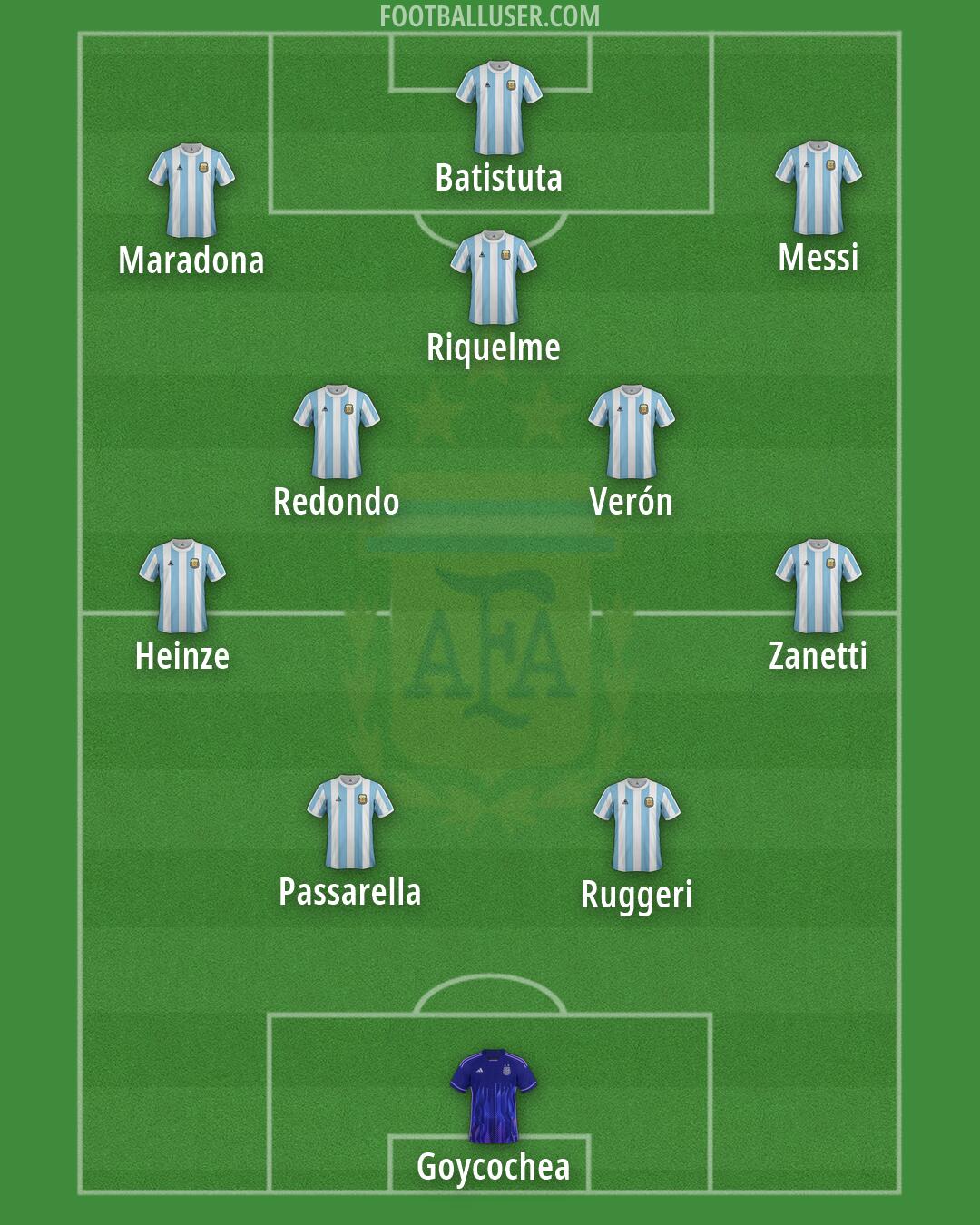

Argentina National Football Team Formation
 July 1, 2026


Starting Lineup
Batistuta · Riquelme · Maradona · Messi · Redondo · Verón · Zanetti · Heinze · Passarella · Ruggeri · GoycocheaArgentina plays with a heavy focus on controlling the ball and dominating the center of the pitch through a 2-5-3. This lineup is built to overwhelm the opposition in the middle of the park. The team looks to use a massive midfield presence to dictate play and create numerous chances for the forwards. This is a highly vertical lineup that seeks to move the ball quickly to the front three.
Goycochea stays in goal to command the area and organize the back line. The defense relies on a very aggressive back two consisting of Ruggeri and Passarella. Without any full backs, Ruggeri and Passarella must hold the line and defend zonally to stop runners in behind. They need to be dominant in the air and quick to cover the wide spaces left behind. The defensive unit functions by staying compact and relying on the midfield to protect the defenders.
The midfield is the heart of the Argentina lineup. Zanetti and Heinze act as a double pivot to shield the two centre backs. Redondo plays as a carrier, using his passing range and composure to progress through the thirds. Verón works alongside him to play through the lines with his passing range. Riquelme operates as the attacking ten in the hole to connect the lines and find the forwards. This five man midfield allows the team to recycle possession and control the tempo of the game.
The attack features three attackers across the front. Batistuta acts as the central target man, using his aerial strength and powerful finishing to pin the last defender. Maradona and Messi operate from wide positions but behave like inverted wingers who cut inside. Maradona will look to combine in tight spaces and dribble, while Messi will drop deep or pull wide to isolate defenders in one on one situations. The team builds play through the center, looking to hit in behind on the transition or whip it in for Batistuta to win the header.
This formation offers huge tactical advantages. The primary strength is the numerical superiority in midfield, which makes it difficult for opponents to win the second ball. The team can also press high in coordinated waves to win it back high up the pitch. This density allows Argentina to squeeze the space and force a long ball from the opposition.
The 2-5-3 formation is a high risk and high reward system built on technical control. It is best used against teams that sit deep in a low block and struggle to handle intense central pressure.