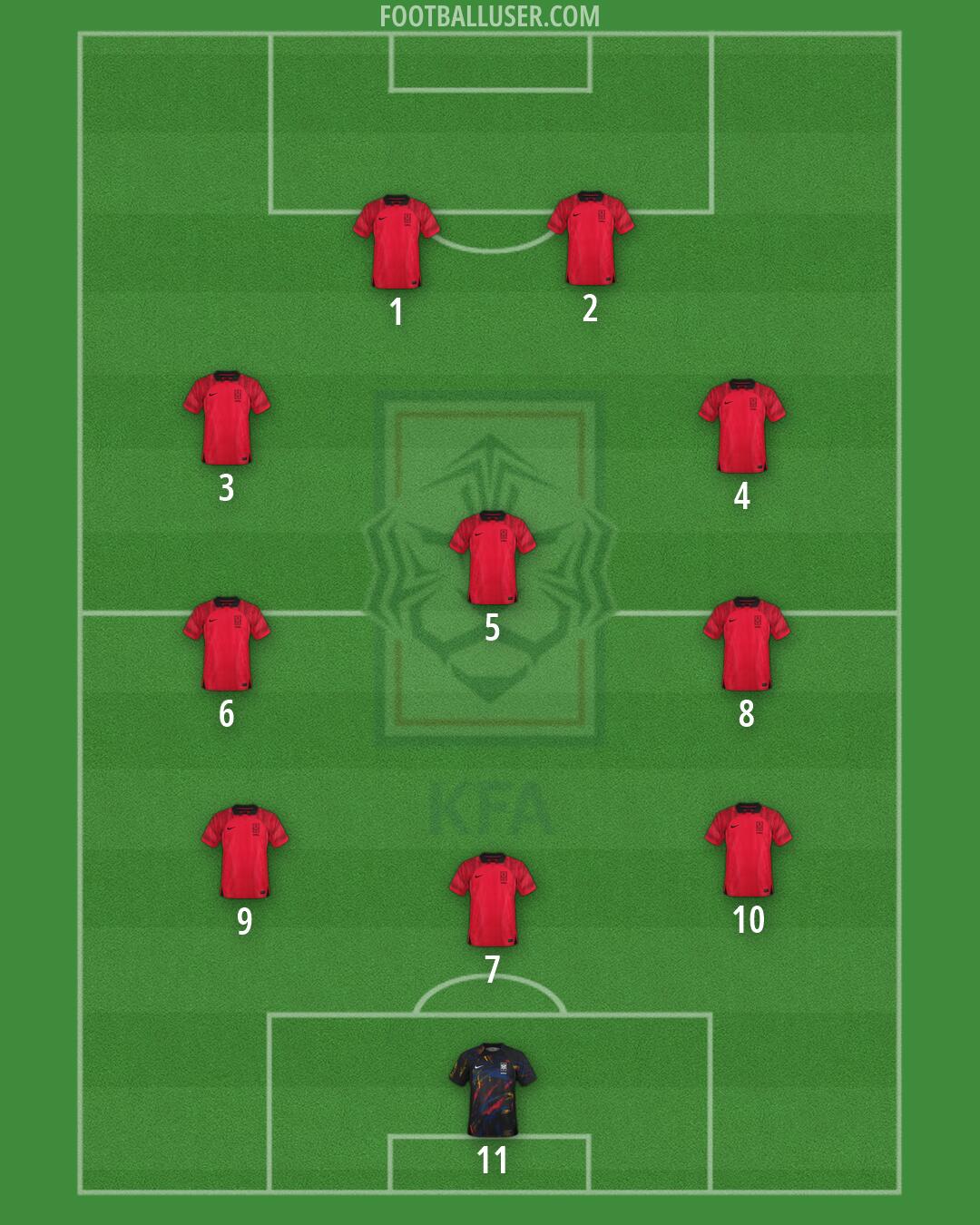

South Korea National Football Team Formation
 Today, July 2, 2026


Starting Lineup
12
3
4
5
6
7
8
9
10
11
South Korea focuses on winning the ball high up the pitch and playing through the lines with speed. The team uses a 3-5-2 formation to dominate the central areas of the pitch. This lineup is built to control the tempo and punish opponents during transitions.
Between the posts, 11 acts as the last line of defence. The back three is composed of 7, 9, and 10. The wide centre-backs 9 and 10 are tasked to step up into the midfield to squeeze the space, while 7 stays central to cover the gaps. This trio maintains a compact formation to defend zonally and deny the turn of any incoming attackers.
The midfield works as a powerful engine to drive the play. A double pivot featuring 6 and 8 sits deep to shield the defence and protect the back three. The player 5 connects the defensive and attacking lines, often dropping between the centre-backs to receive and then carrying the ball forward. Further up, 3 and 4 operate in the half-spaces to create chances and arrive late into the box. They press in pairs to trigger a press and win it back high up the pitch.
The attack is led by two forwards in a partnership. 1 and 2 work together to stretch the defence and pin the last defender. 1 often holds up the ball to find the feet of 2, who looks to make runs in behind. They combine in tight spaces to break the line. When the team loses possession, 1 and 2 press from the front to force a long ball and win the second ball.
One main advantage is the numerical superiority in the midfield. With five players in the middle, South Korea can compress the midfield and cut off the passing lane to the opposition. The ability to use 3 and 4 to attack the half-spaces creates wide overloads when the full-backs push up. The team also benefits from a quick speed of transition when they win the ball.
This formation is a heavy, midfield-centric system designed to dominate possession and press intensely. It works best against teams that struggle to play through a crowded centre.