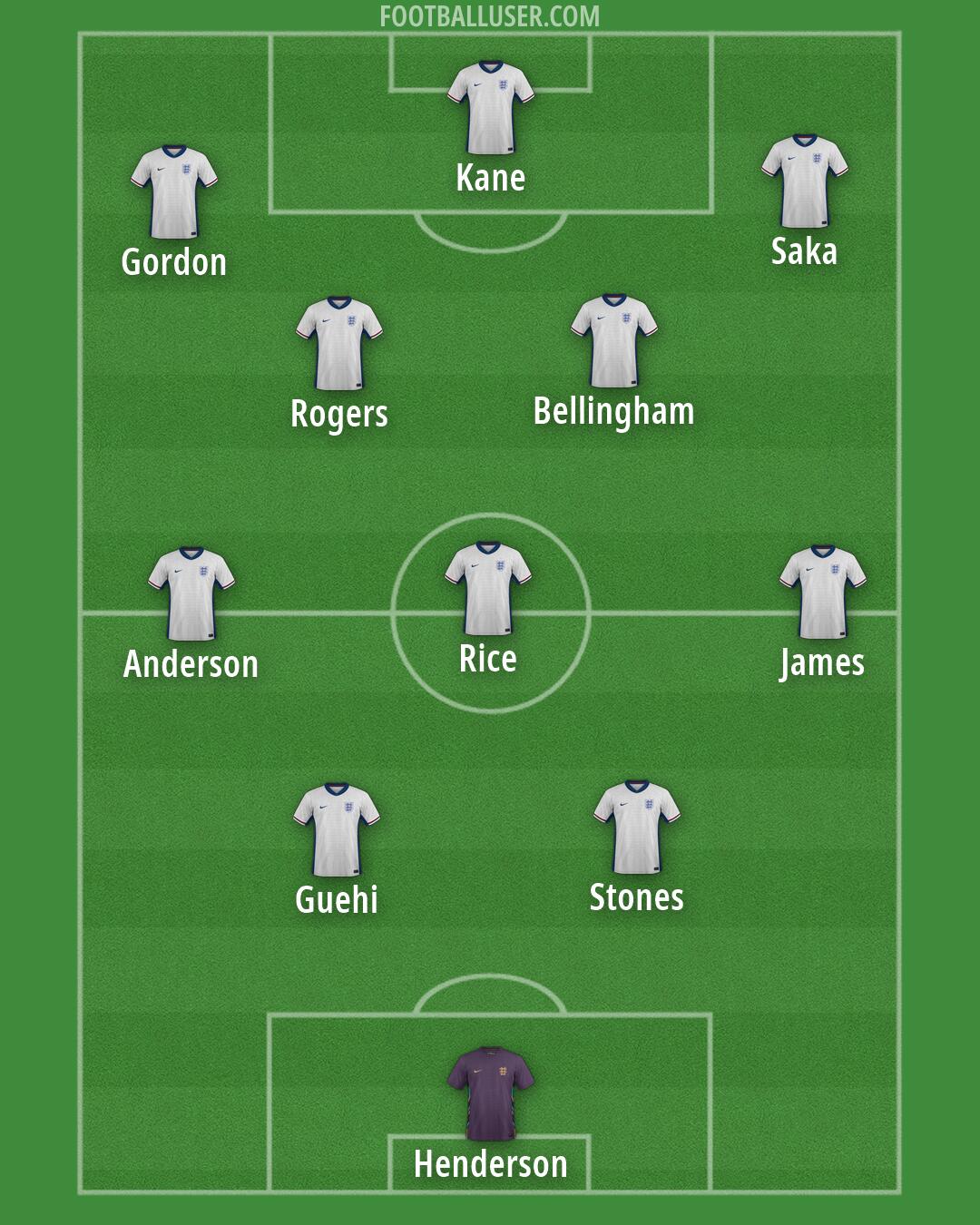
England National Football Team Formation
 July 3, 2026


Starting Lineup
Kane · Gordon · Saka · Rogers · Bellingham · Rice · Anderson · James · Guehi · Stones · HendersonEngland looks to win the ball back high up the pitch and play with a direct, vertical intent using a 5-2-3. This formation builds a team capable of controlling large areas of the pitch through quick transitions and heavy pressure. By using a back five, the Three Lions aim to secure the middle while looking to strike fast once possession is regained.
Henderson stays between the posts to organize the back line. The defensive unit operates with a back three comprising Rice, Stones, and Guehi. Rice acts as a central defender who can step into midfield, while Stones and Guehi provide coverage to sweep behind a high line. On the flanks, James and Anderson act as attacking wing backs who push high to provide width, while Rice and the other center backs defend zonally to keep the unit compact.
The midfield relies on a two man central pairing of Rogers and Bellingham. Bellingham uses his driving runs to carry the ball forward and link the defense to the attack. Rogers works to connect the lines and move the ball into the final third. This duo must cover a lot of ground to protect the center when the wing backs push up, ensuring they can win the second ball and immediately look to spread wide.
In the attacking phase, England uses three attackers across the front. Kane acts as a central presence to hold up the ball and find the feet of his teammates, often dropping deeper to link play. Saka and Gordon operate as wide attackers who look to cut inside and create chances. The wingers press from the front to force a long ball from the opposition, while Kane pins the last defender to create space for Saka and Gordon to make runs in behind.
One major advantage for England is the ability to create wide overloads as James and Anderson overlap the winger. This forces the opposition to defend deep and stretches the defense horizontally. Another strength is the capacity to press high in coordinated waves, using the front three and the midfield to squeeze the space and win the ball in dangerous areas.
This 5-2-3 lineup is built to punish teams that struggle with transition play. It is best suited for matches against sides that hold onto possession but lack the speed to deal with rapid counter attacks.