Custom Team Football Formation
 July 3, 2026


Starting Lineup
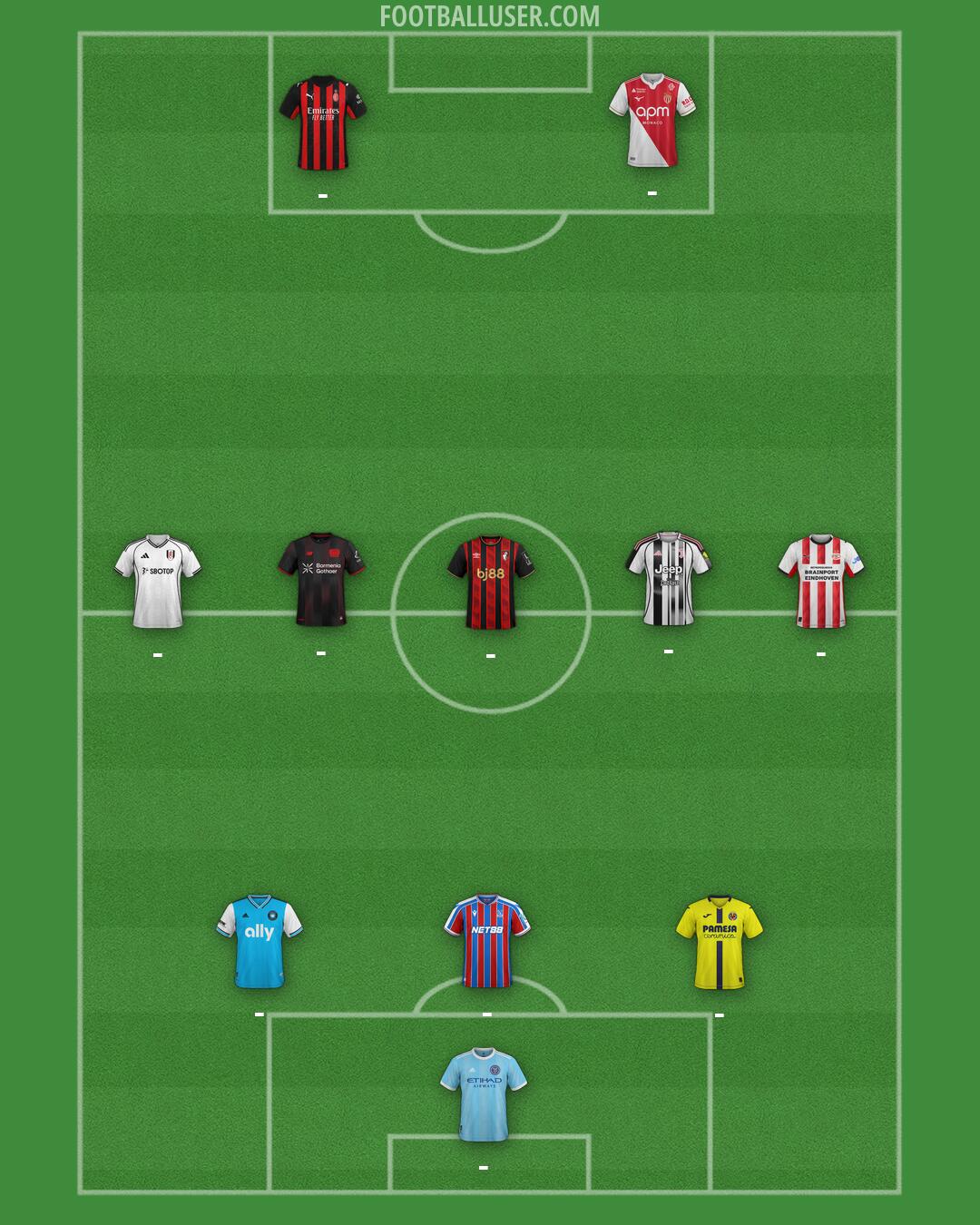
- (New York City) · - (Charlotte FC) · - (Crystal Palace) · - (Bournemouth) · - (Fulham) · - (Villarreal) · - (Bayer Leverkusen) · - (PSV) · - (Juventus) · - (Milan) · - (Monaco)A heavy focus on controlling the center of the pitch and playing through the lines defines this 3-5-2 formation. The lineup is built to dominate territory by creating a central overload, allowing the team to sustain pressure in the final third. This formation relies on high intensity to win the ball back quickly and use a compact middle to deny passing lanes to the opposition.
The goalkeeper sits behind a narrow defensive block consisting of three central defenders. The RCB, CB, and LCB form a solid line to defend the middle, with the CB acting as the central anchor to sweep behind the line when the team pushes up. These defenders must be ready to step up to trigger a press or drop back to cover runs in behind. The unit works as a cohesive block to win the second ball and clear the lines when under pressure.
In the middle of the pitch, a three-man midfield provides the engine for this lineup. The LCM and RCM operate as a double pivot to shield the defense, with one player often dropping deep to help play out from the back while the other looks to drive forward with the ball. Flanking them, the LM and RM act as wide midfielders who provide the necessary width. These wide players must track back to support the defense but also push high to overlap the midfield and stretch the defense when attacking.
The attacking unit utilizes two forwards in a partnership to pin the last defender. The LS and RS work in close combinations, often playing one-two passes to break the line or using link-up play between the lines to pull defenders out of position. When the team moves into the final third, the LM and RM provide width to allow the LS and RS to occupy central spaces. This setup creates constant threat through runs in behind and allows the forwards to press from the front to force a long ball from the opponent.
One major strength of this formation is the numerical superiority in midfield, which allows the team to control the tempo and recycle possession easily. The wide midfielders also create effective wide overloads when they combine with the central players to overload the flanks. This ability to compress the midfield makes it very difficult for opponents to find space between the lines, forcing them to play around the block rather than through it.
This formation is designed for teams that want to dominate the center of the park and control the rhythm of the game. It is best suited for facing opponents that play with a narrow midfield or those who struggle to deal with constant pressure in the central channels.