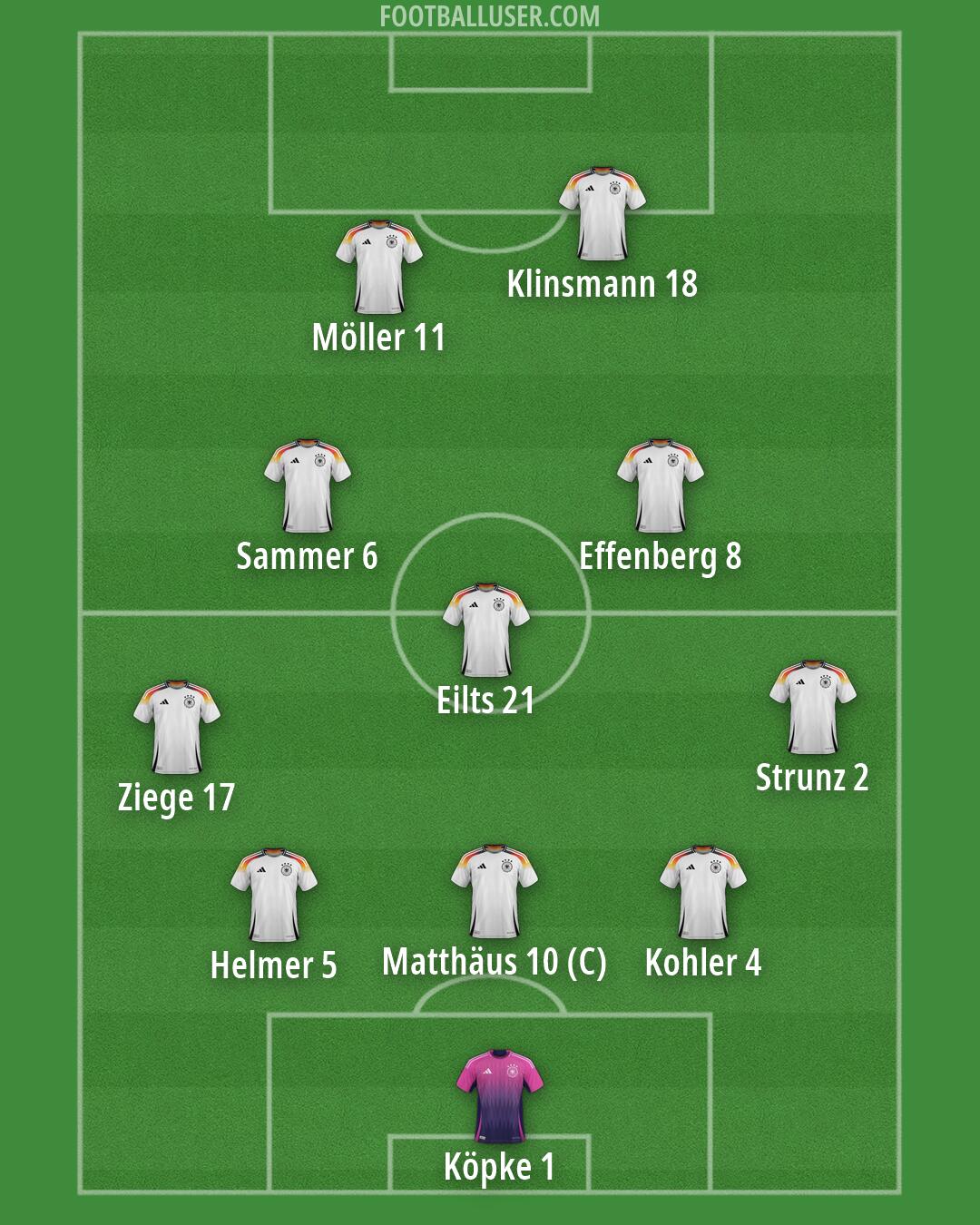

Germany National Football Team Formation
 July 3, 2026


Starting Lineup
Matthäus 10 (C) · Köpke 1 · Helmer 5 · Kohler 4 · Ziege 17 · Klinsmann 18 · Möller 11 · Eilts 21 · Strunz 2 · Sammer 6 · Effenberg 8Germany plays a direct and high intensity game with a 3-5-2 formation. The lineup focuses on winning the second ball and using physical presence to dominate the middle of the pitch. This setup allows the team to push players forward quickly to exploit gaps in the opposition defense.
Köpke starts in goal to organize the back line. A back three consists of Helmer, Kohler, and Matthäus 10 (C), the captain. Matthäus 10 (C) acts as the central leader in the defensive unit, while Helmer and Kohler cover the wider channels. This defensive unit is designed to stay compact and win headers during set pieces. The defenders are tasked to stay close together to deny the turn to any oncoming strikers and clear the lines when under heavy pressure.
The midfield relies on a three man midfield with a carrier and wide players. Eilts acts as the central engine to connect the defense and attack, while Ziege and Strunz provide the wider presence to help the defensive unit. Sammer plays as a left attacking midfielder to find space between the lines, and Effenberg operates on the right to drive the ball forward. This midfield group works to press in a mid-block to force a long ball from the opponent.
Germany uses two forwards in a partnership to lead the attack. Möller and Klinsmann operate as the front two, looking to run in behind the opposition defense. Möller works to link up play between the lines, while Klinsmann uses his movement to find space in the box. The attackers press from the front to trigger a press, forcing the opposition to play under pressure. This attacking unit aims to hit in behind on the transition to catch the opponent out of position.
This formation offers the advantage of numerical superiority in midfield, allowing Germany to control the center of the pitch. The presence of Sammer and Effenberg in the half spaces creates problems for the opposition, while the two strikers pin the last defender. The team can also shift quickly to defend or attack, providing a strong balance between solid defending and rapid counter attacks.
Germany utilizes this lineup to dominate physical battles and exploit spaces through quick transitions. It is best suited for games against opponents who struggle to handle high pressure and rapid vertical play.