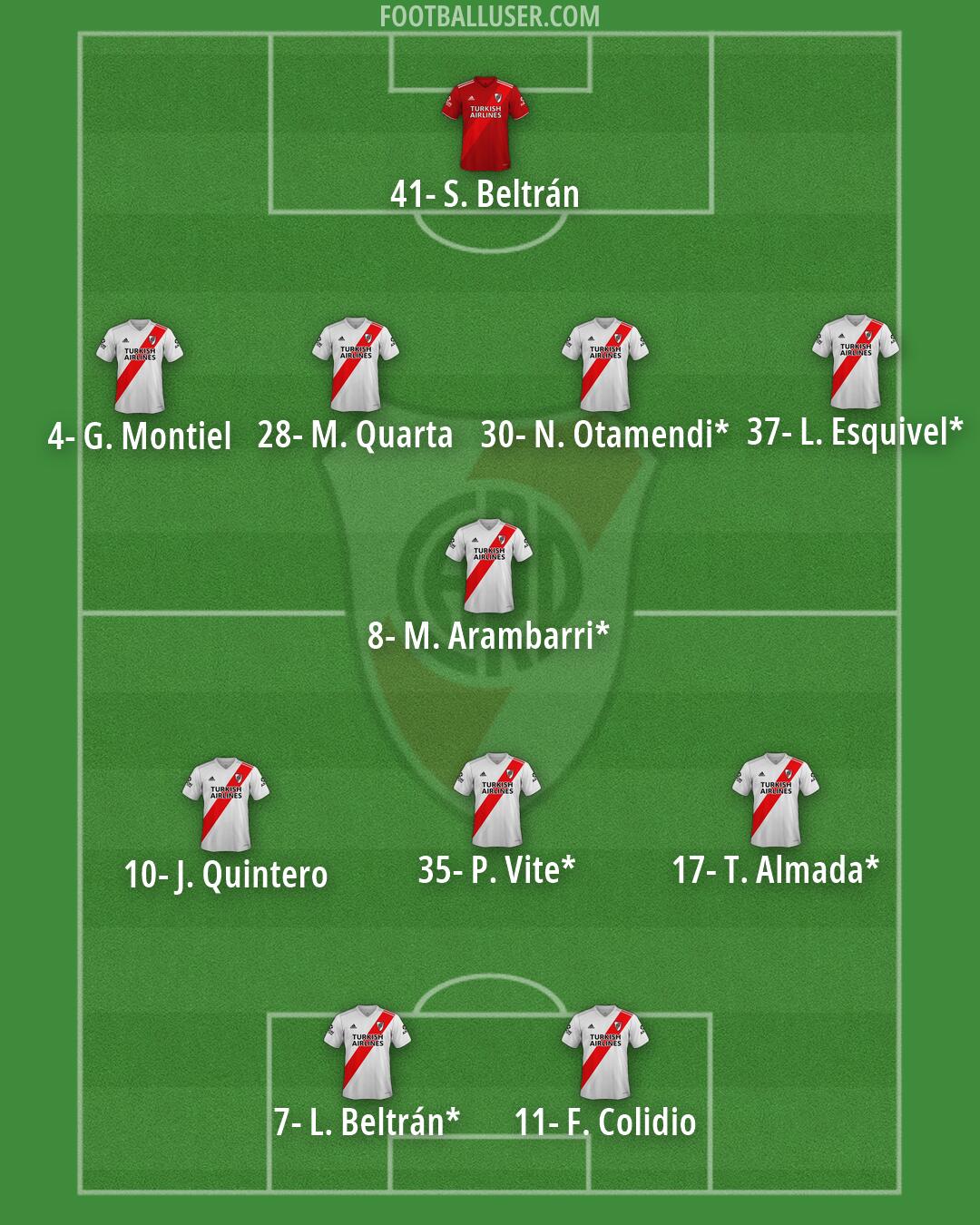

River Football Formation
 July 3, 2026


Starting Lineup
41- S. Beltrán4- G. Montiel
28- M. Quarta
30- N. Otamendi*
37- L. Esquivel*
8- M. Arambarri*
7- L. Beltrán*
11- F. Colidio
10- J. Quintero
17- T. Almada*
35- P. Vite*
River focuses on a direct and vertical style of play through a 5-3-2 formation. This lineup relies on quick transitions and physical presence to overwhelm opponents. The team aims to win the ball in central areas and move it rapidly toward the forwards to catch the opposition out of position.
S. Beltrán stands between the posts to organize the defense. The back line consists of a back three composed of M. Arambarri, N. Otamendi, and M. Quarta. Otamendi provides aerial strength and leadership while Quarta acts as a ball playing defender to start attacks. The wide defenders, G. Montiel as the right wing back and L. Esquivel as the left wing back, push high to provide width. These players are tasked to overlap the midfield and deliver crosses into the box. The defensive unit maintains a compact shape to deny the turn to attackers.
A three-man midfield controls the center of the pitch. P. Vite acts as the anchor to shield the defense and win the second ball. J. Quintero operates as the creative link, looking to play through the lines and find the forwards with his passing range. T. Almada plays on the right side of the trio to carry the ball forward and drive into the half spaces. This midfield unit connects the defense to the attack by recycling possession and finding runners.
The attack features two forwards playing in a partnership. F. Colidio plays as the left striker, often looking to run in behind the defense. L. Beltrán operates as the right striker, acting as a focal point to hold up the ball and bring others into play. They press the opposition back line to force a long ball. The movement of the wing backs creates space for these two to isolate defenders in one on one situations. River uses these combinations to attack in transition.
One major tactical advantage is the ability to provide width through the wing backs while maintaining a strong central presence. This creates wide overloads that stretch the defense. Another strength is the compactness when defending, which makes it hard for opponents to find gaps between the lines. The team can also switch play quickly to catch the opposition on the break.
This 5-3-2 formation is built for teams that want to be defensively solid while remaining dangerous on the counter. It is best suited for matches against opponents that dominate possession but struggle with pace in behind.