Arsenal Football Formation
 July 4, 2026


Starting Lineup
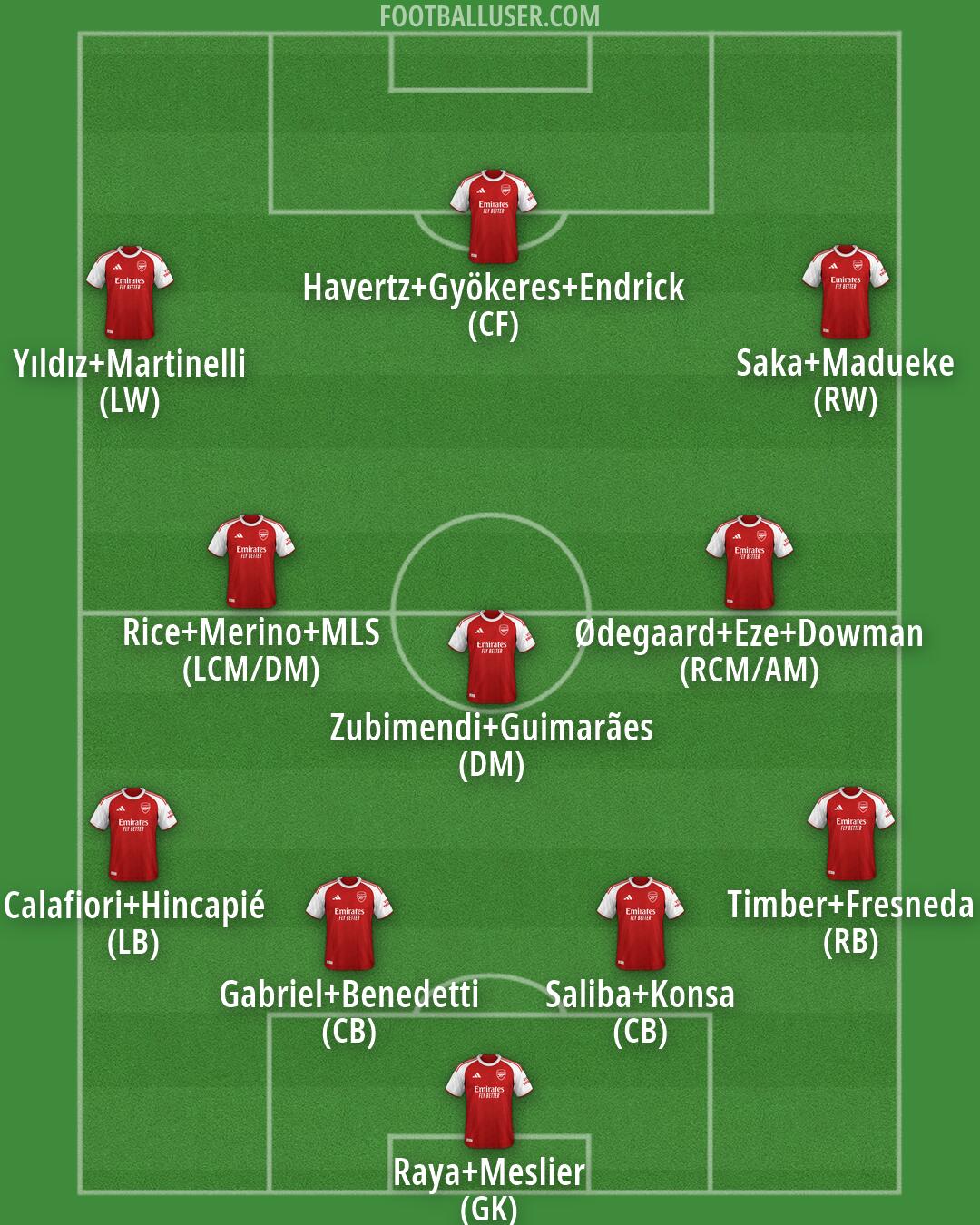
Raya+Meslier (GK) · Calafiori+Hincapié (LB) · Gabriel+Benedetti (CB) · Timber+Fresneda (RB) · Zubimendi+Guimarães (DM) · Rice+Merino+MLS (LCM/DM) · Ødegaard+Eze+Dowman (RCM/AM) · Saka+Madueke (RW) · Yıldız+Martinelli (LW) · Havertz+Gyökeres+Endrick (CF) · Saliba+Konsa (CB)Arsenal looks to control the game through high pressing and heavy ball retention in a 4-3-3. This formation is built to dominate territory and use high positioning to win the ball back quickly. The Gunners want to use their technical quality to dictate the tempo and squeeze the space in the opposition half.
David Raya acts as the goalkeeper to start the build up. The back line functions as a flat back four with Saliba acting as a ball playing defender while Gabriel provides aerial strength and covers the left side. Calafiori operates as a left back who can tuck inside to help the midfield, while Timber provides stability at right back. This defensive unit stays high to compress the pitch and uses the offside trap to manage long balls.
In the middle of the park, Zubimendi sits as a single pivot to shield the defence and recycle possession. Rice operates as a left sided eight who can carry the ball forward, while Ødegaard plays as the creative engine from the right side of the midfield three. These players connect the defensive line to the front line by playing through the lines and finding teammates in advanced positions. The midfield trio works to press in a mid block when the ball is lost.
The attacking unit uses three players across the front to stretch the defence. Saka plays on the right wing and looks to cut inside to create chances, while Martinelli stays wide on the left to provide width. Havertz leads the line as a striker who can drop into the hole to link up play with the midfielders. This front line is designed to create runs in behind and isolate wide players in one on one situations during transitions.
One major strength of this Arsenal lineup is the ability to press high in coordinated waves to force errors. The team also creates numerical superiority in midfield when the full backs push up to support the central players. This allows the side to pin the last defender and control the rhythm of the match.
This 4-3-3 is a dominant setup designed for teams that want to control the ball and dictate play. It is best suited for matches against sides that sit deep and struggle to handle high intensity pressing.