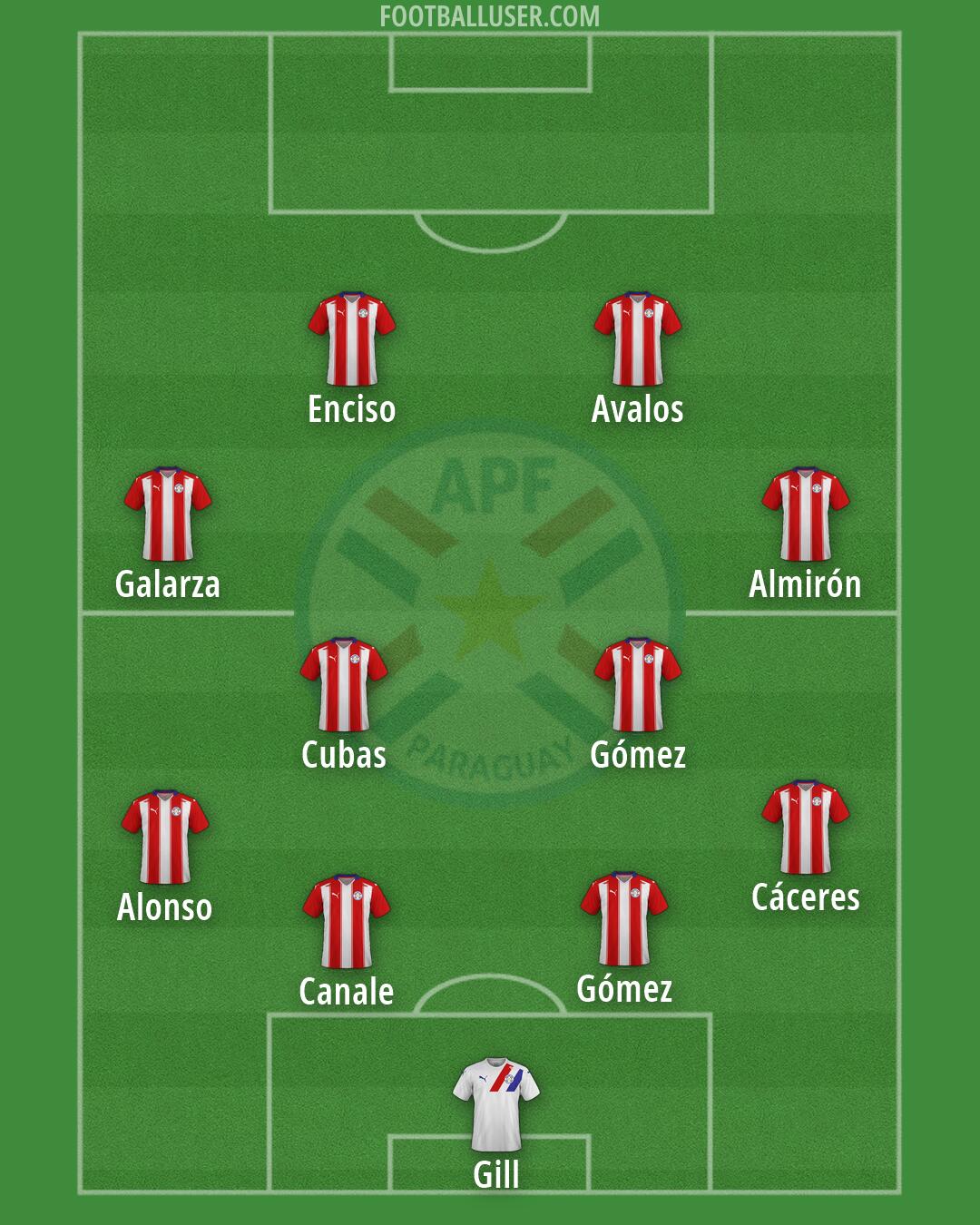

Paraguay National Football Team Formation
 July 4, 2026


Starting Lineup
Gill · Cáceres · Gómez · Canale · Alonso · Gómez · Cubas · Galarza · Almirón · Enciso · AvalosParaguay focuses on a compact defensive unit and quick transitions using a 4-4-2. This formation is built to sit deep and hit opponents on the break. The team prioritizes defensive stability over possession, looking to win the ball and move it forward rapidly to the strikers to catch the defense off guard.
Gill guards the goal as the lone goalkeeper. The defense operates as a flat back four with Cáceres at right back and Alonso at left back. In the middle, Gómez and Canale form the central pairing. Gómez is dominant in the air to clear the lines, while Canale provides cover to protect the space behind the defense. They work together to hold a narrow defensive block and win the second ball in front of the box.
The midfield consists of a double pivot and two wide players. Gómez and Cubas play in the center to shield the defense and intercept passes. Gómez acts as a deep-lying playmaker to recycle possession, while Cubas works to break the line with his driving runs. On the flanks, Almirón and Galarza provide the width. Almirón uses his dribbling to cut inside and create chances, while Galarza helps to connect the defensive and attacking lines.
The attack uses two forwards in a partnership to stretch the defense. Enciso plays as a mobile striker with great technical ability to link up play between the lines. He often drops deep to find the feet of the striker. Avalos acts as the target man, looking to win the header and hold up the ball. The front line presses the opposition back line to force a long ball, allowing the wingers to get to the byline and deliver early crosses.
This 4-4-2 provides significant tactical advantages, such as compactness when defending in a mid-block. By keeping the lines close together, Paraguay makes it hard for opponents to play through the lines. The team also benefits from the speed of transition, using the mobility of Enciso and the directness of the wingers to catch teams out on the break.
This formation is a reliable way to stay defensively solid while remaining a threat on the break. It is best suited for matches against high-possession teams that struggle to defend against rapid counters.