
Germany National Football Team Formation
 July 5, 2026


Starting Lineup
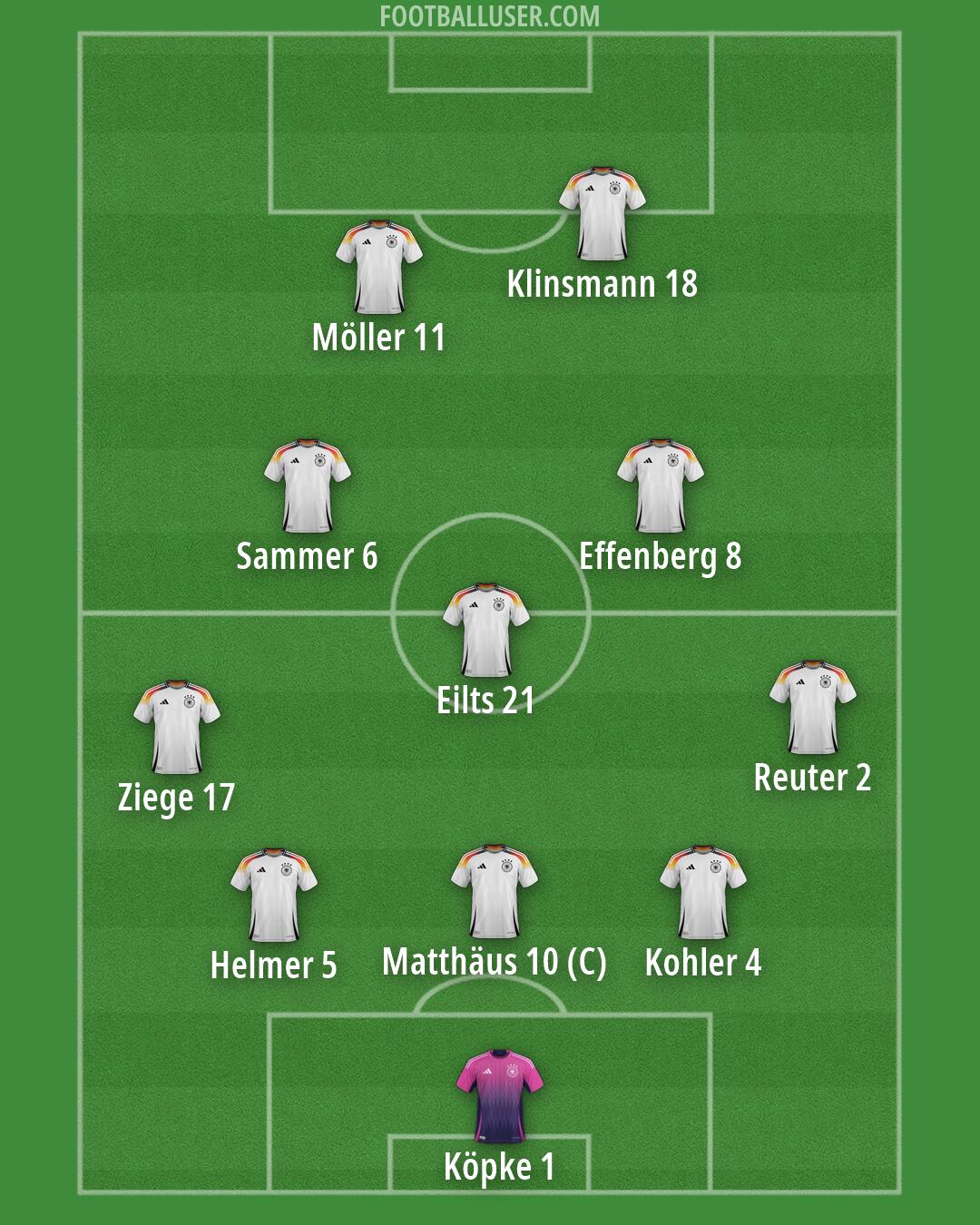
Matthäus 10 (C) · Köpke 1 · Helmer 5 · Kohler 4 · Ziege 17 · Klinsmann 18 · Möller 11 · Eilts 21 · Reuter 2 · Sammer 6 · Effenberg 8Germany relies on a high press and quick transitions using a 3-5-2 formation. This lineup is built to squeeze the space in the middle of the pitch and overwhelm opponents with central numbers. The team looks to win the ball back high up the pitch and move the ball forward rapidly to exploit any gaps left in the opposition back line.
Köpke guards the goal while the back three maintains a high line to keep the team compact. Matthäus 10 (C), serving as the captain, leads the defensive unit from the center, acting as a dominant presence who can step up into midfield. Kohler provides cover on the right side of the central trio, while Helmer holds the left side to ensure the defensive unit stays tight. The defenders work together to set the offside trap and ensure they do not get caught by long balls.
The midfield is a busy area where Germany tries to control the tempo. Eilts works to connect the defensive and attacking lines, often dropping deep to receive the ball and recycle possession. Ziege and Reuter sit in a double pivot to shield the defense and win the second ball. Sammer operates as a left attacking midfielder with great ability to carry the ball forward, while Effenberg plays on the right to provide presence and drive the team through the thirds. This group of five allows the team to compress the midfield and deny the turn to opposing playmakers.
In the attacking phase, the team utilizes two forwards in a partnership to stretch the defense. Klinsmann plays as a striker who is known for his clinical finishing and movement in behind, while Möller works alongside him to link up play between the lines. The attacking unit is designed to create runs in behind and exploit the space created by the wide midfielders. They press from the front to force a long ball from the opposition, allowing the midfield to intercept and launch immediate attacks.
One major advantage of this formation is the ability to create numerical superiority in the middle of the pitch. By having five players in the central zone, Germany can easily win the ball back and transition quickly. Another strength is the flexibility to shift between a mid-block and a high press, making it difficult for opponents to find passing lanes. The presence of Sammer and Effenberg allows the team to dominate the half-spaces during the attacking phase.
The German lineup is a powerhouse built for dominating the center of the pitch and punishing teams on the break. It is best suited for matches against opponents who try to play out from the back or leave gaps between their midfield and defensive lines.