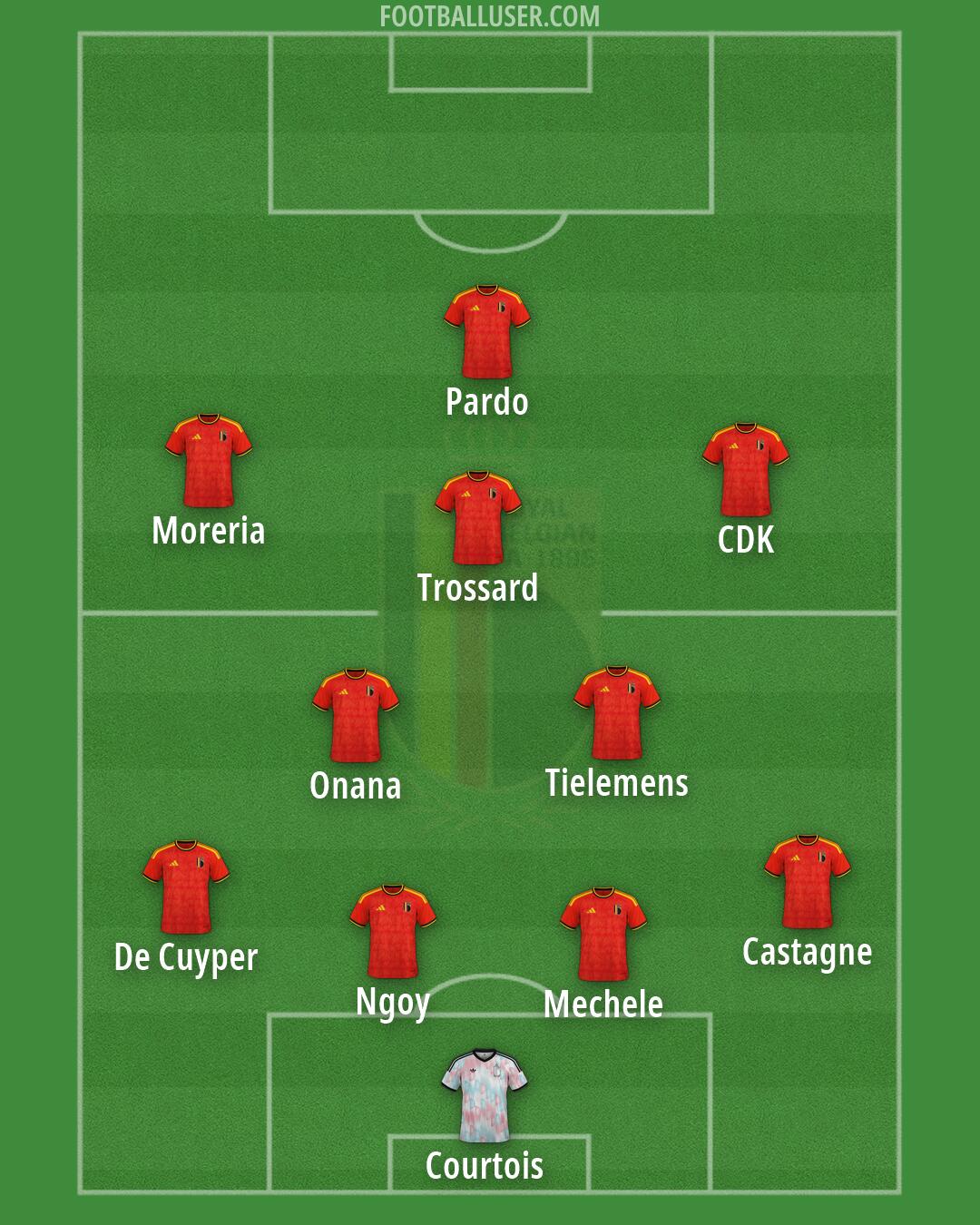

Belgium National Football Team Formation
 July 6, 2026


Starting Lineup
Pardo · Trossard · Moreria · CDK · Tielemens · Onana · Mechele · Ngoy · De Cuyper · Castagne · CourtoisPrioritizing a heavy verticality to catch opponents out, Belgium operates in a 4-2-4 formation. This lineup aims to overwhelm the opposition by committing many players forward to pressure the ball high and strike quickly on the transition. The Red Devils want to create chaos in the final third through high numbers and direct movements.
Thibaut Courtois stands between the posts to provide a massive presence and shot stopping ability. In front of him, a flat back four provides the foundation. Castagne operates as the right back to provide width and defensive cover, while De Cuyper plays as the left back to push up the flank. The central pairing of Mechele and Ngoy focuses on being dominant in the air and winning the second ball. They must hold the line and cover the space behind when the full backs push up, ensuring the defensive unit stays compact even when the team is pushed forward.
The midfield works as a double pivot to manage the transition from defense to attack. Tielemans operates as a deep lying playmaker with a massive passing range to switch play and find the front four. Onana works alongside him to shield the defense and drive forward with the ball to connect the lines. This pairing must be disciplined to avoid leaving the center backs exposed, as they are the only two players sitting in front of the back four. They are responsible for recycling possession and catching runners as they enter the middle third.
Attacking the opposition requires a high level of intensity from the front four. Moreria and CDK act as wide wingers who stay wide to stretch the defense. Moreria looks to cut inside to create chances, while CDK uses his pace to get to the byline. Trossard and Pardo operate as two forwards in a partnership, with Trossard often looking to find the feet of the striker or make runs in behind. They press the opposition back line aggressively to force a long ball and win it back high up the pitch.
One major advantage of this Belgium formation is the ability to hit in behind on the transition with four players already in advanced positions. The team can also create wide overloads when the full backs join the wingers, making it difficult for the opposition to defend the flanks. This creates significant pressure on the opposition wide defenders and forces them into difficult one on one situations.
The Red Devils use this high risk formation to pin the last defender and dominate the final third. It is a lineup best suited for matches where the team needs to break down a low block or exploit a tired defense through sheer attacking volume.