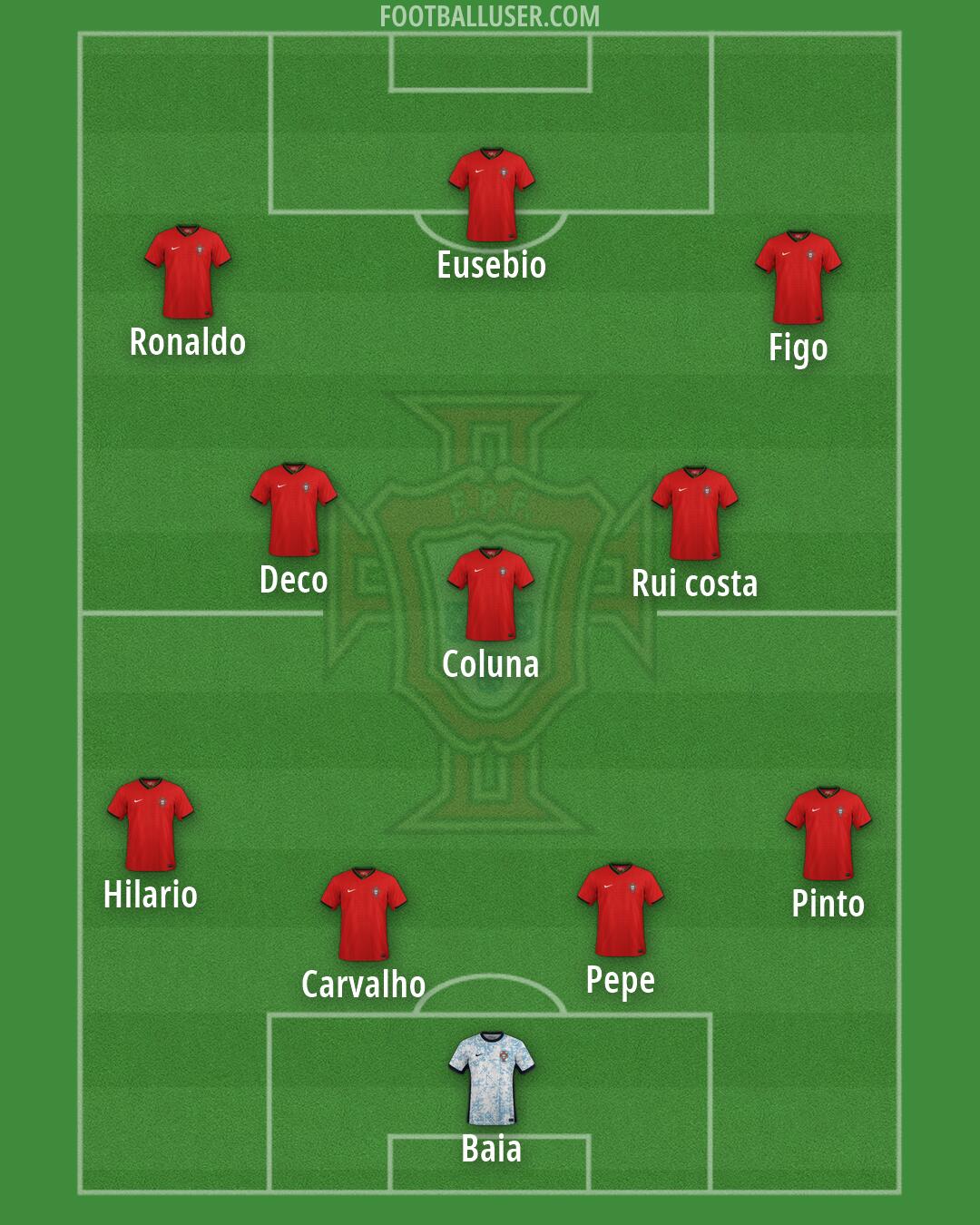

Portugal National Football Team Formation
 July 7, 2026


Starting Lineup
Baia · Pinto · Pepe · Carvalho · Hilario · Coluna · Rui costa · Deco · Figo · Eusebio · RonaldoPortugal looks to control games through a heavy emphasis on technical quality and direct attacking intent in this 4-3-3. The lineup is built to dominate the ball and use creative talent to break the opposition. By maintaining high levels of control in the middle, the team seeks to dictate the tempo of every match.
Baia stands between the posts to organize the back line. The defensive unit operates as a flat back four with Pinto providing width on the right. Hilario sits on the left, while Pepe acts as a dominant force in the air and provides physical presence alongside Carvalho. Pepe and Carvalho work to cover space and win the second ball, ensuring the team stays compact when the opponent tries to play through the lines.
The midfield relies on a single pivot system to control the center of the pitch. Coluna sits in front of the defense to shield the back four and recycle possession. Rui Costa and Deco operate in the half spaces to link the defense to the attack. Rui Costa uses his vision to play through the lines, while Deco works to create from deep and find the forwards. This trio helps Portugal control the tempo and manage the transition between phases.
Attacking moves revolve around a potent front three. Eusebio acts as the central focal point, capable of playing with his back to goal or making runs in behind. Figo stays wide on the right to stretch the defense, while Ronaldo cuts inside from the left to find goal scoring opportunities. The forwards press from the front to force a long ball from the opposition, creating chances for the team to win the ball high up the pitch.
This formation offers great control through numerical strength in the central areas. The ability of the wide players to pull wide or cut inside creates constant movement that is difficult to mark. Portugal can also use the individual quality of the attacking unit to hit in behind on the transition if the opposition commits too many men forward.
The 4-3-3 formation is built to dominate possession and create chances through technical superiority. It is best suited for games where the team needs to break down a deep defensive block.