
Brazil National Football Team Formation
 July 7, 2026
 Sangumo


Starting Lineup
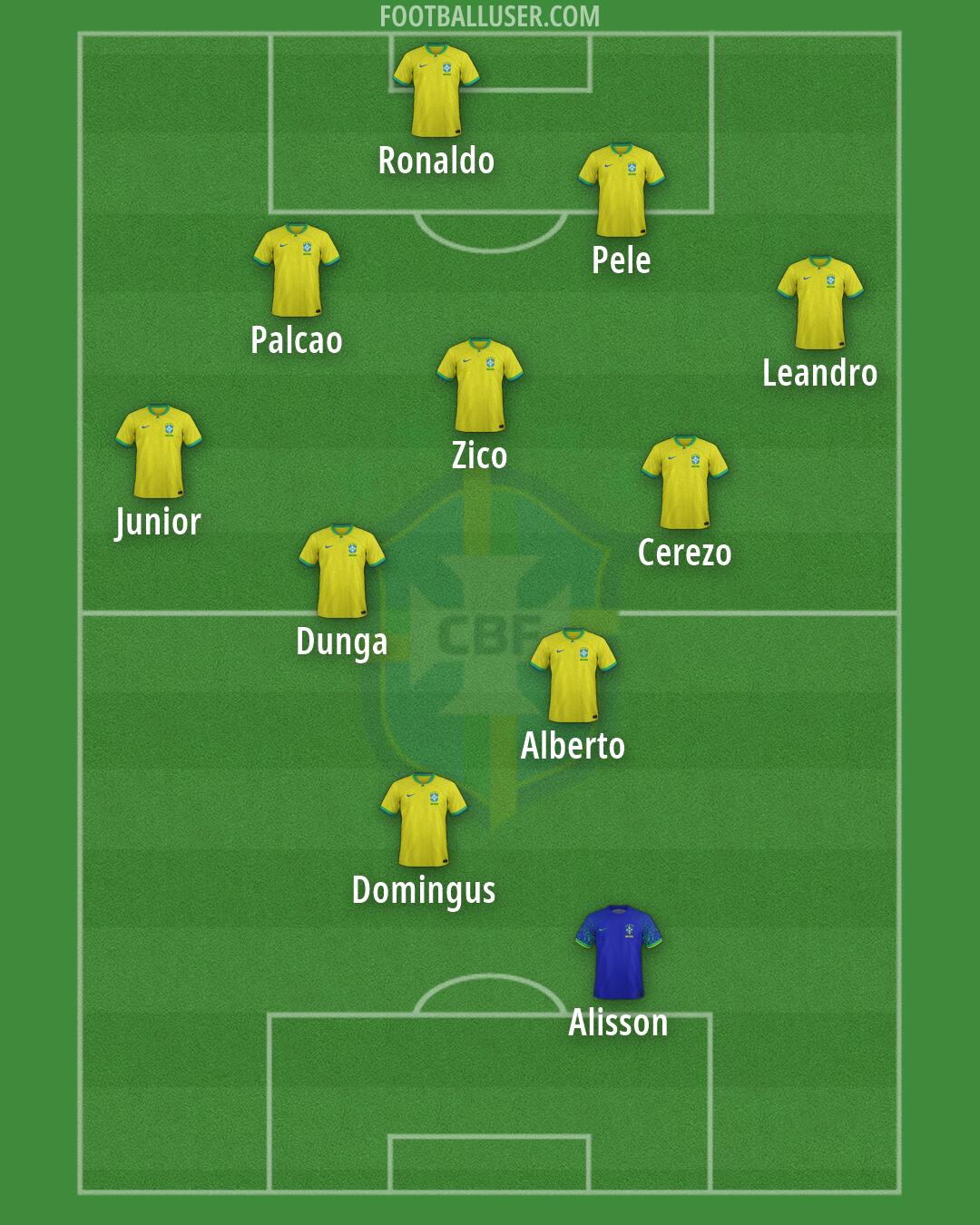
Alisson · Leandro · Alberto · Domingus · Junior · Cerezo · Zico · Pele · Ronaldo · Dunga · PalcaoBrazil looks to overwhelm the opposition through relentless verticality and high numbers in the final third. This aggressive 2-4-4 formation is built to play a high pressing game that seeks to win the ball back high up the pitch and strike immediately. By sacrificing defensive depth, the Seleção aims to create constant chaos in the opponent's defensive line.
Alisson guards the goal, acting as a sweeper to cover the space behind the high defensive line. The back two of Domingus and Alberto must remain extremely disciplined, often acting as ball playing defenders to start attacks. Because there are only two central defenders, they must hold the line while being ready to step up to squeeze the space. The duo needs to be dominant in the air and quick to recover if the opposition hits in behind on the transition.
The midfield unit functions as the engine of the Brazil lineup. Dunga sits in front of the defenders to shield the back line and break up play. Beside him, Cerezo and Junior operate as two central midfielders who connect the defensive and attacking lines. Cerezo and Junior help to recycle possession and carry the ball forward to support the press. Zico operates as an attacking ten, playing in the hole to find pockets of space and play through the lines to the forwards.
In the final third, the attack is incredibly potent with four players across the front. Pele and Ronaldo act as a two forwards partnership, with Pele often finding the feet of the striker or dropping deeper to link play. Ronaldo uses his pace to run in behind while Pele uses his vision to split the defence with a through ball. On the flanks, Leandro and Palcao act as wide wingers who stretch the defence. Leandro and Palcao often cut inside to create central overloads, allowing the team to attack in combinations.
This formation offers massive numerical superiority in the attacking half. The combination of Zico playing behind two strikers and two wide attackers creates a heavy weight of numbers that is hard to track. Brazil can also use wide overloads when the midfielders push high to support the wingers. The primary advantage is the ability to press in coordinated waves, forcing the opponent into mistakes near their own goal.
This highly aggressive formation is designed to dominate possession and punish teams through sheer offensive volume. It is best suited for games where Brazil needs to break down a deep low block through constant pressure.