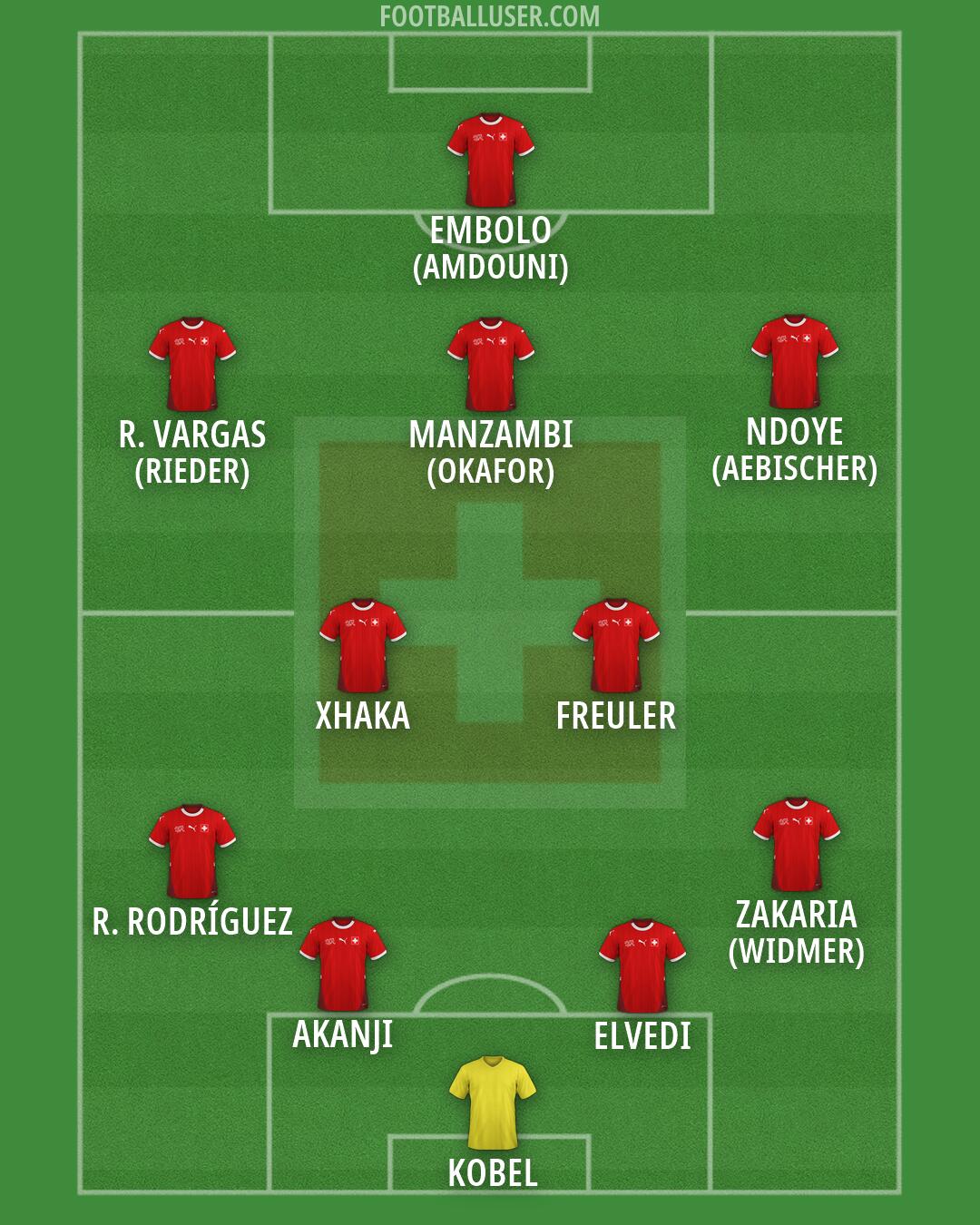

Switzerland National Football Team Formation
 July 7, 2026


Starting Lineup
ZAKARIA (WIDMER) · ELVEDI · AKANJI · R. RODRÍGUEZ · FREULER · XHAKA · NDOYE (AEBISCHER) · MANZAMBI (OKAFOR) · R. VARGAS (RIEDER) · EMBOLO (AMDOUNI) · KOBELSwitzerland seeks to play a high press and quick vertical football using a 4-2-4. This formation is built to stretch the opposition and win the ball high up the pitch to catch defenders out of position. The lineup focuses on heavy offensive pressure and rapid transitions to exploit space behind the opponent.
Kobel operates between the posts to command the area and sweep behind the high defensive line. The back line functions as a flat back four where Zakaria acts as a defensive wing back to provide cover on the right. Akanji and Elvedi work as central defenders, with Akanji using his aerial strength and Elvedi covering the space behind him. R. Rodríguez stays wide on the left to provide width before tracking back to help the defensive unit.
The midfield relies on a double pivot to manage the center of the pitch. Xhaka, the captain, drops deep to receive the ball and plays through the lines with his renowned passing range. Beside him, Freuler works to press aggressively and win the second ball to keep the momentum going. This pairing connects the defensive unit to the front four by recycling possession and finding the attackers.
Switzerland uses four attackers to pin the last defender and create chaos. Embolo and Manzambi act as a two forwards partnership, with Embolo using his strength to hold up the ball and Manzambi looking for runs in behind. R. Vargas and Ndoye operate as wide attackers, with R. Vargas cutting inside to create threats in the half spaces. This front line is designed to attack in combinations and isolate wide players in one on one situations.
This lineup offers a massive numerical advantage in the final third and provides the ability to press high in coordinated waves. The 4-2-4 formation allows Switzerland to create wide overloads when the full backs push forward. The speed of transition becomes a major threat when the double pivot can immediately find the four players ahead of them.
This aggressive formation is designed for teams that want to dominate the attacking third and force the opponent into mistakes. It is best suited for games where the team needs to break down a low block through sheer offensive volume.