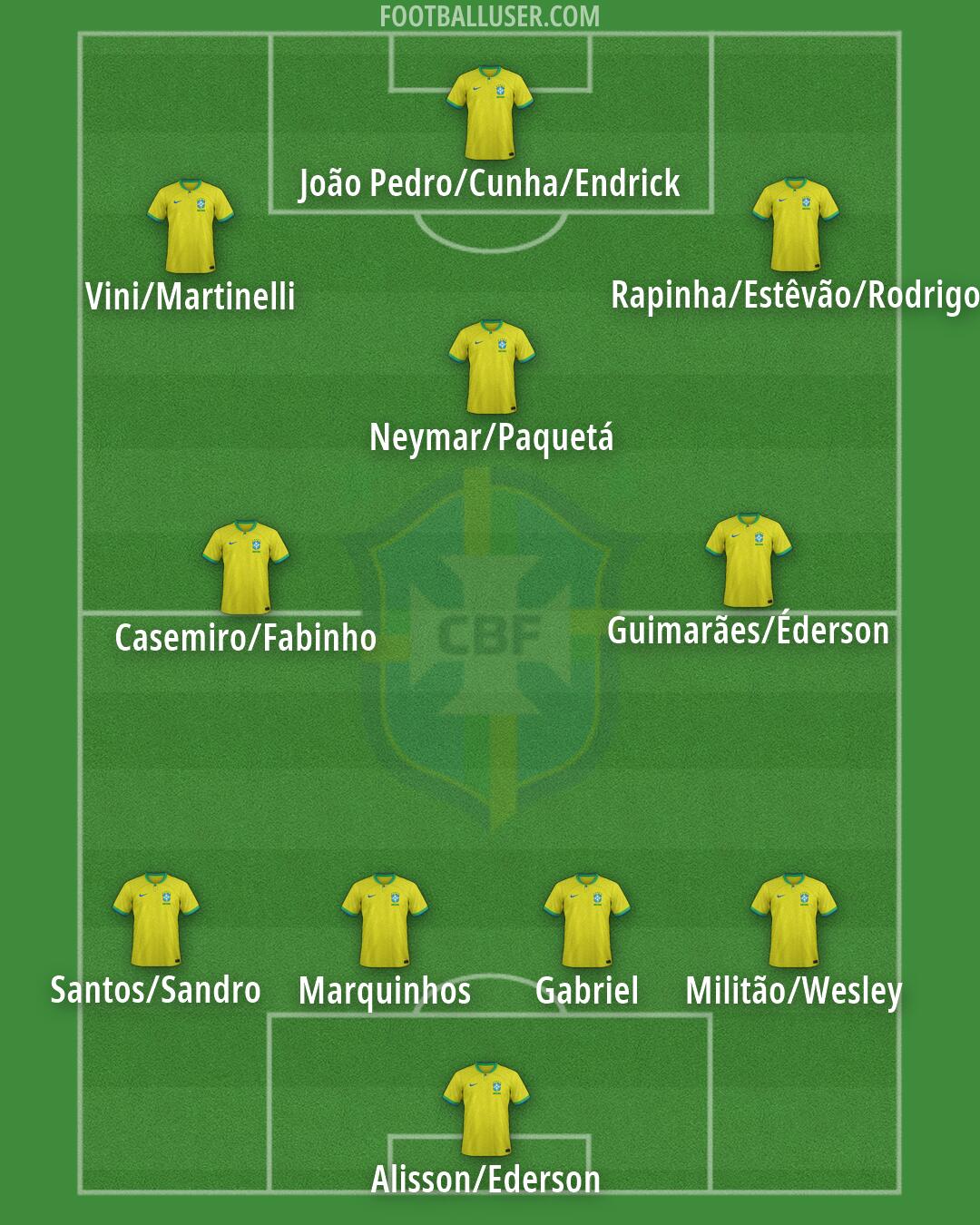

Brazil National Football Team Formation
 July 8, 2026
 Rudra Mallick


Starting Lineup
Vini/Martinelli · Rapinha/Estêvão/Rodrigo · João Pedro/Cunha/Endrick · Alisson/Ederson · Marquinhos · Militão/Wesley · Gabriel · Neymar/Paquetá · Santos/Sandro · Guimarães/Éderson · Casemiro/FabinhoBrazil seeks to control the game through a high press and quick vertical transitions, utilizing a 4-3-3 formation. This lineup focuses on winning the ball back high up the pitch to catch the opposition out of position. By using this setup, the Seleção aims to stretch the defence and create multiple scoring opportunities through rapid ball movement and attacking combinations.
Alisson provides a reliable presence between the posts, acting as a sweeper behind a high line. The back line operates as a flat back four where Marquinhos and Gabriel defend centrally, with Marquinhos often stepping into midfield to disrupt play. On the flanks, Militão or Wesley occupy the right side to offer defensive solidity, while Santos or Sandro push up as attacking full backs to provide width. The defensive unit must hold the line and keep the team compact to prevent being hit in behind on the transition.
The midfield operates with a three-man midfield with a carrier to link the lines. Casemiro or Fabinho sits as a single pivot to shield the defence and win the second ball. Guimarães or Éderson acts as the engine, driving forward with the ball to progress through the thirds. Neymar or Paquetá plays as an attacking ten behind the striker, looking to find the feet of the striker or play through the lines to create chances. This trio works to press in a mid-block and recycle possession to keep the pressure on the opponent.
In the final third, Brazil employs three attackers across the front to pin the last defender. Vini or Martinelli plays as an inverted winger on the left to cut inside and threaten the goal, while Rapinha, Estêvão, or Rodrigo occupies the right wing to stretch the pitch. João Pedro, Cunha, or Endrick leads the line as a pressing centre-forward to force long balls from the opposition. The attack relies on runs in behind and wide overloads to create openings for the forwards to strike.
A major tactical strength of this Brazil lineup is the ability to press high in coordinated waves, forcing the opponent into mistakes. The team also benefits from the speed of transition when the midfield wins the ball, allowing the wide players to attack space quickly. This creates significant pressure on the opposition back line through constant movement and verticality.
This 4-3-3 formation is built to dominate games through aggressive ball winning and rapid attacking shifts. It is best suited for facing opponents that struggle to play out from the back or leave large spaces behind their defensive line.