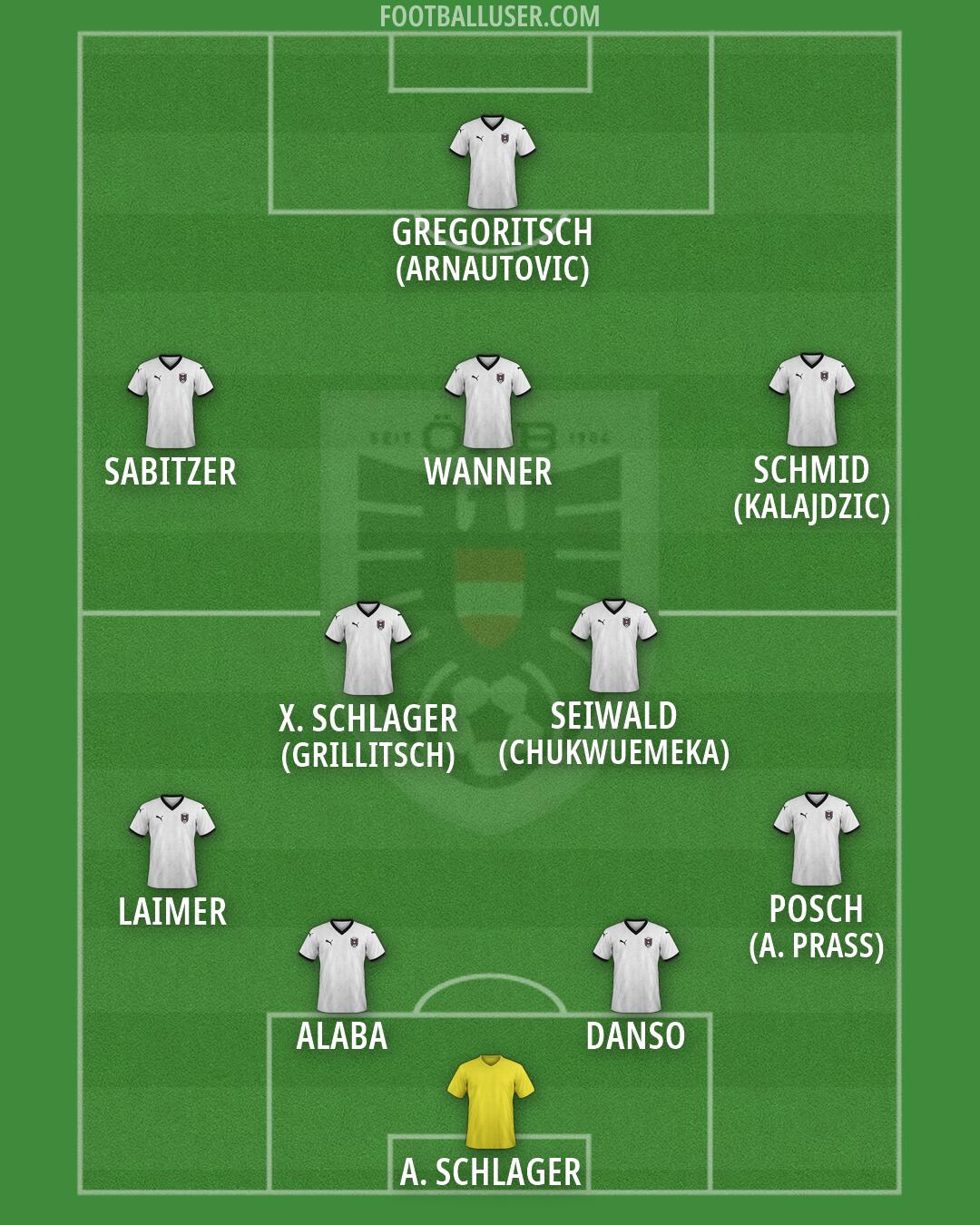

Austria National Football Team Formation
 July 9, 2026


Starting Lineup
POSCH (A. PRASS) · DANSO · ALABA · LAIMER · SEIWALD (CHUKWUEMEKA) · X. SCHLAGER (GRILLITSCH) · SCHMID (KALAJDZIC) · WANNER · SABITZER · GREGORITSCH (ARNAUTOVIC) · A. SCHLAGERAustria focuses on a heavy high press and rapid verticality to catch opponents off guard. This identity is expressed through a 4-2-4 formation. The team aims to win the ball back high up the pitch and immediately hit in behind on the transition. By staying aggressive, Die Roten force the opposition into mistakes and quick turnovers.
A. Schlager operates between the posts to organize the defense. The back line uses a flat back four to maintain a high line and squeeze the space. Danso and Alaba lead the central pairing, with Danso providing aerial strength and Alaba using his passing range to play out from the back. Laimer and Posch act as the wide defenders, with Laimer tasked to track back and cover the left flank, while Posch pushes up to provide width.
A double pivot holds the center of the pitch to provide balance. X. Schlager and Seiwald work as the two central midfielders to control the middle. X. Schlager works to deny the pivot of the opposition and intercept passes, while Seiwald looks to carry the ball forward to link the defensive unit with the attack. They must stay compact to prevent the opposition from playing through the lines.
The attacking lineup uses four players to stretch the opposition defense. Gregoritsch and Wanner play as a forward partnership in the center, with Gregoritsch acting as a pressing centre-forward to lead the hunt. On the flanks, Sabitzer plays as an inverted winger on the left to cut inside and use his passing range to create, while Schmid stays wide on the right to spread wide. This movement allows the team to deliver early crosses or find the feet of the striker in tight spaces.
This formation offers significant tactical advantages, such as the ability to press high in coordinated waves. The presence of four attackers allows the team to pin the last defender and force a long ball from the opposition. Additionally, the speed of transition is a key strength, as the team can break quickly once the midfield wins the second ball. The ability to create wide overloads when Posch and Laimer overlap the winger adds another layer of pressure.
Austria uses this 4-2-4 formation to dominate games through sheer intensity and directness. It is best suited for matches against teams that struggle to play short from the back under heavy pressure.