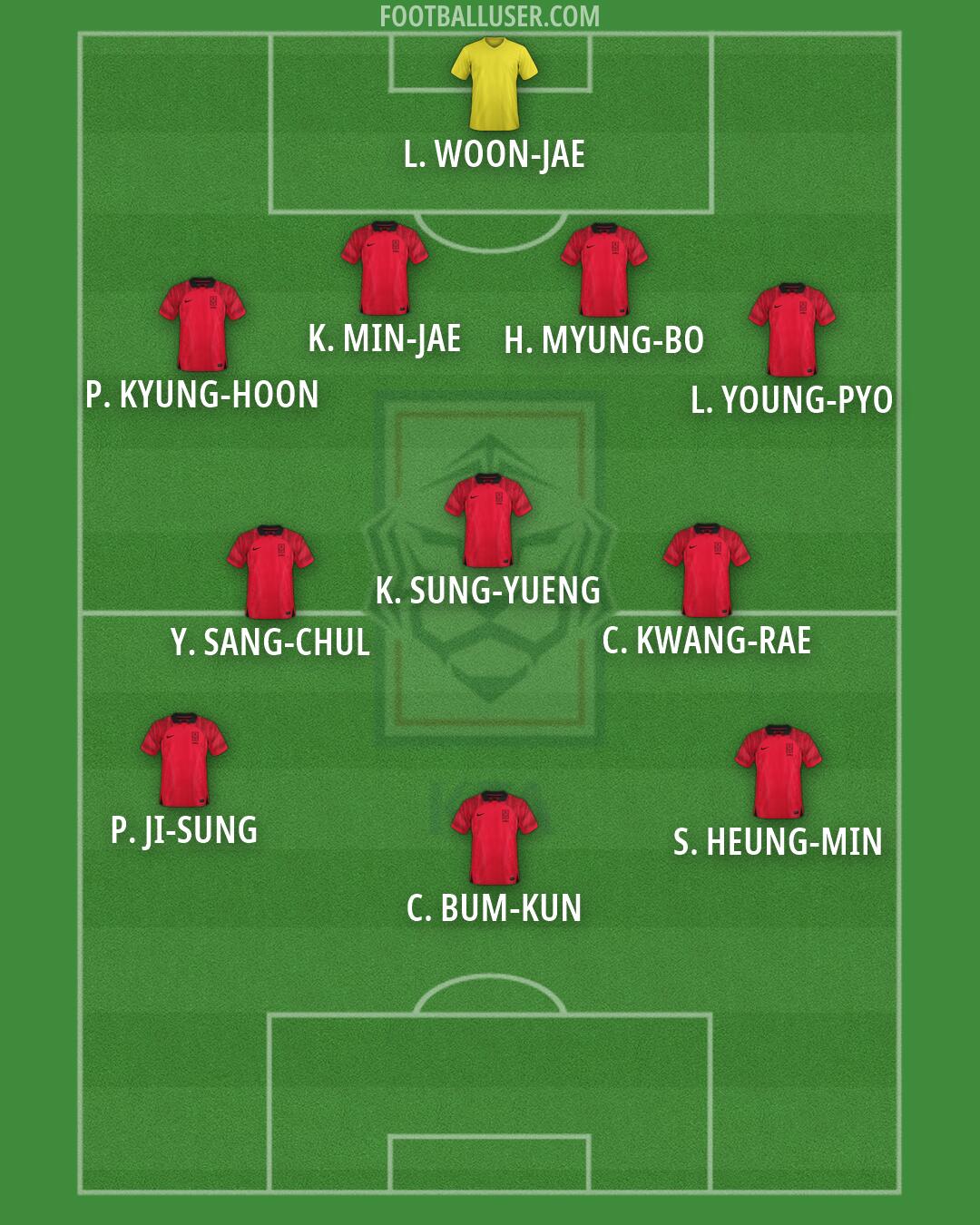

South Korea National Football Team Formation
 July 10, 2026


Starting Lineup
K. MIN-JAE · H. MYUNG-BO · P. KYUNG-HOON · L. YOUNG-PYO · K. SUNG-YUENG · Y. SANG-CHUL · C. KWANG-RAE · P. JI-SUNG · S. HEUNG-MIN · C. BUM-KUN · L. WOON-JAESouth Korea aims to win the ball high up the pitch and play through the lines with a 4-3-3. This formation is built to play a high press while remaining direct in transition to catch opponents out of position. The team relies on quick movement to move the ball from the defensive third into the attacking third.
L. WOON-JAE acts as the last line of defense in goal. The back line operates as a flat back four that can step up to squeeze the space. K. MIN-JAE is dominant in the air and uses his strength to win the second ball, while H. MYUNG-BO provides cover alongside him. The full backs, P. KYUNG-HOON and L. YOUNG-PYO, are expected to push high to provide width. They will overlap to support the wingers, leaving the two central defenders to defend zonally and handle any long balls played over the top.
The midfield functions as a three-man midfield with a carrier and a ball winner. C. KWANG-RAE acts as a pivot to shield the defense and recycle possession. Y. SANG-CHUL and K. SUNG-YUENG work to connect the defensive and attacking lines. One of these players will look to drop between the centre-backs to receive the ball and play short from the back. They must also press aggressively in a mid-block to force a long ball from the opposition.
The attacking line uses three attackers across the front to stretch the defence. S. HEUNG-MIN operates as an inverted winger on the left, looking to cut inside and shoot with his left foot. On the right, P. JI-SUNG works to pull wide and then find space to make runs in behind. C. BUM-KUN operates as a pressing centre-forward to pin the last defender and hold up the ball for the oncoming midfielders. This attacking unit seeks to create combinations in tight spaces to split the defence with a through ball.
South Korea gains a significant advantage through the ability to press high in coordinated waves, making it difficult for opponents to build from the back. The team also creates wide overloads from overlapping full backs that isolate the opposition wingers. These movements allow the attackers to receive the ball on the half-turn and attack the far post.
This 4-3-3 formation is built for a high intensity game that relies on quick transitions. It is best suited for matches against teams that struggle to play out from the back under pressure.