
Mexico National Football Team Formation
 July 18, 2026


Starting Lineup
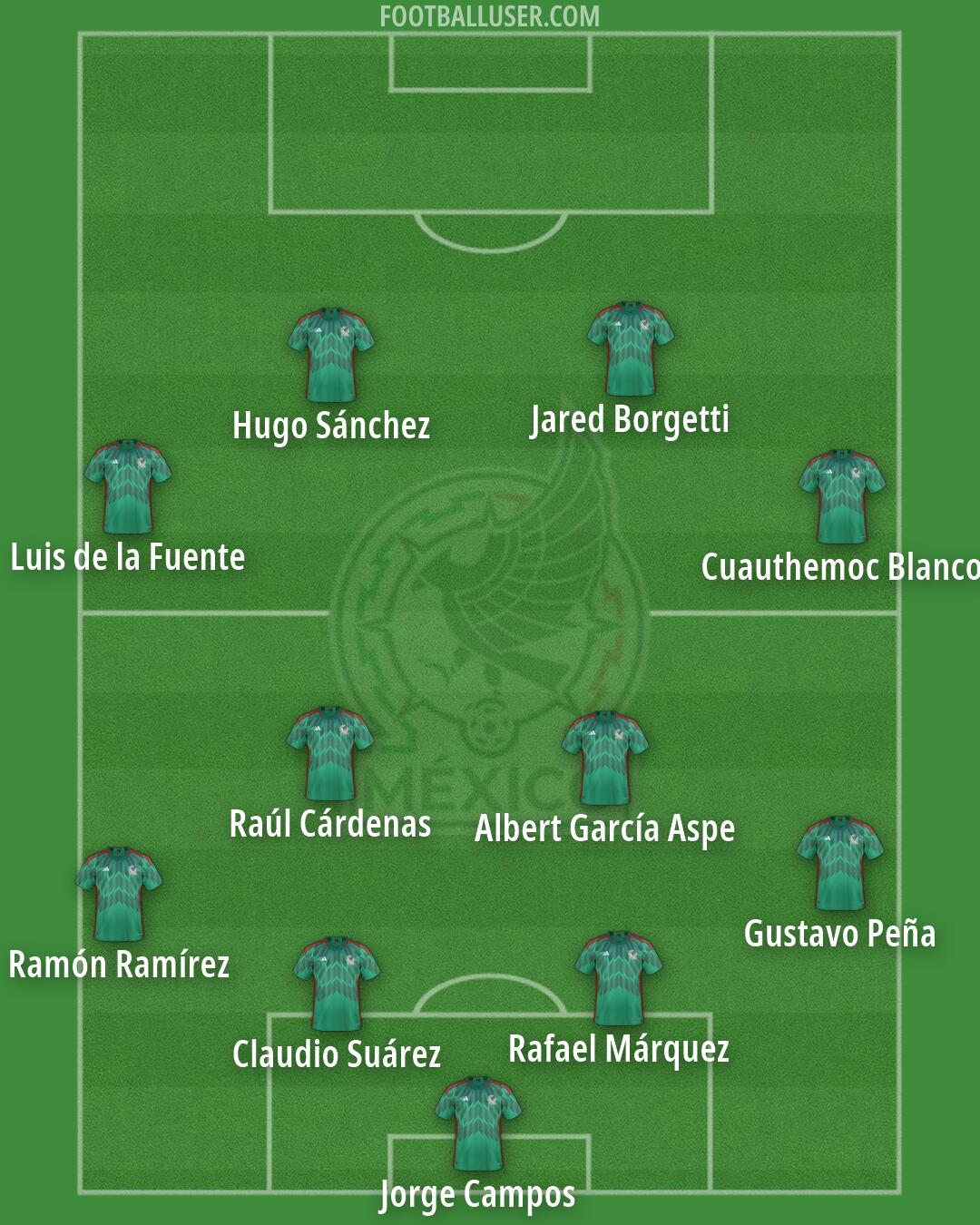
Jorge Campos · Gustavo Peña · Ramón Ramírez · Rafael Márquez · Claudio Suárez · Raúl Cárdenas · Albert García Aspe · Cuauthemoc Blanco · Luis de la Fuente · Jared Borgetti · Hugo SánchezMexico plays a highly vertical game with a 4-2-4 formation. This lineup aims to overwhelm the opposition by committing massive numbers forward to create constant goal threats. The team focuses on attacking transitions and keeping the ball in the final third to pin the opposition back.
Jorge Campos operates between the posts as a goalkeeper with notable shot stopping abilities and a tendency to play as a sweeper. The back line sits as a flat four with Gustavo Peña and Ramón Ramírez providing width at the flanks. Claudio Suárez and Rafael Márquez hold the center, with Márquez using his passing range and reading of the game to command the line. The defensive unit must stay compact to avoid being caught by long balls while looking to win the second ball quickly.
A double pivot provides the only central presence in the middle of the pitch. Albert García Aspe and Raúl Cárdenas work to shield the defence and try to win back possession high up the pitch. These two players must cover huge amounts of ground to connect the back four with the front four. They are responsible for recycling possession and making sure they do not get bypassed by the opposition's central midfielders.
The front line is heavy with goal scoring threats, using two central strikers in a partnership. Hugo Sánchez provides clinical finishing and aerial strength alongside Jared Borgetti, who relies on his aerial ability to win headers in the box. Cuauthemoc Blanco and Luis de la Fuente operate on the flanks, with Blanco using his ball control to cut inside and create chances. This formation forces the opposition to defend deep, creating runs in behind and allowing the wingers to deliver crosses for the two strikers.
This 4-2-4 formation offers significant advantages in terms of attacking numbers. Mexico can create immediate pressure in the final third, often finding themselves with a numerical superiority against a standard four man defence. The speed of transition is a key weapon, as the team can move from a defensive block to a full attacking wave in seconds. By spreading wide with the wingers, the team can also isolate wide defenders in one on one situations.
This lineup prioritizes offensive dominance through a heavy front four and a dedicated central duo. It is most effective against teams that sit deep in a low block and struggle to deal with constant pressure.