
Hungary National Football Team Formation
 July 18, 2026


Starting Lineup
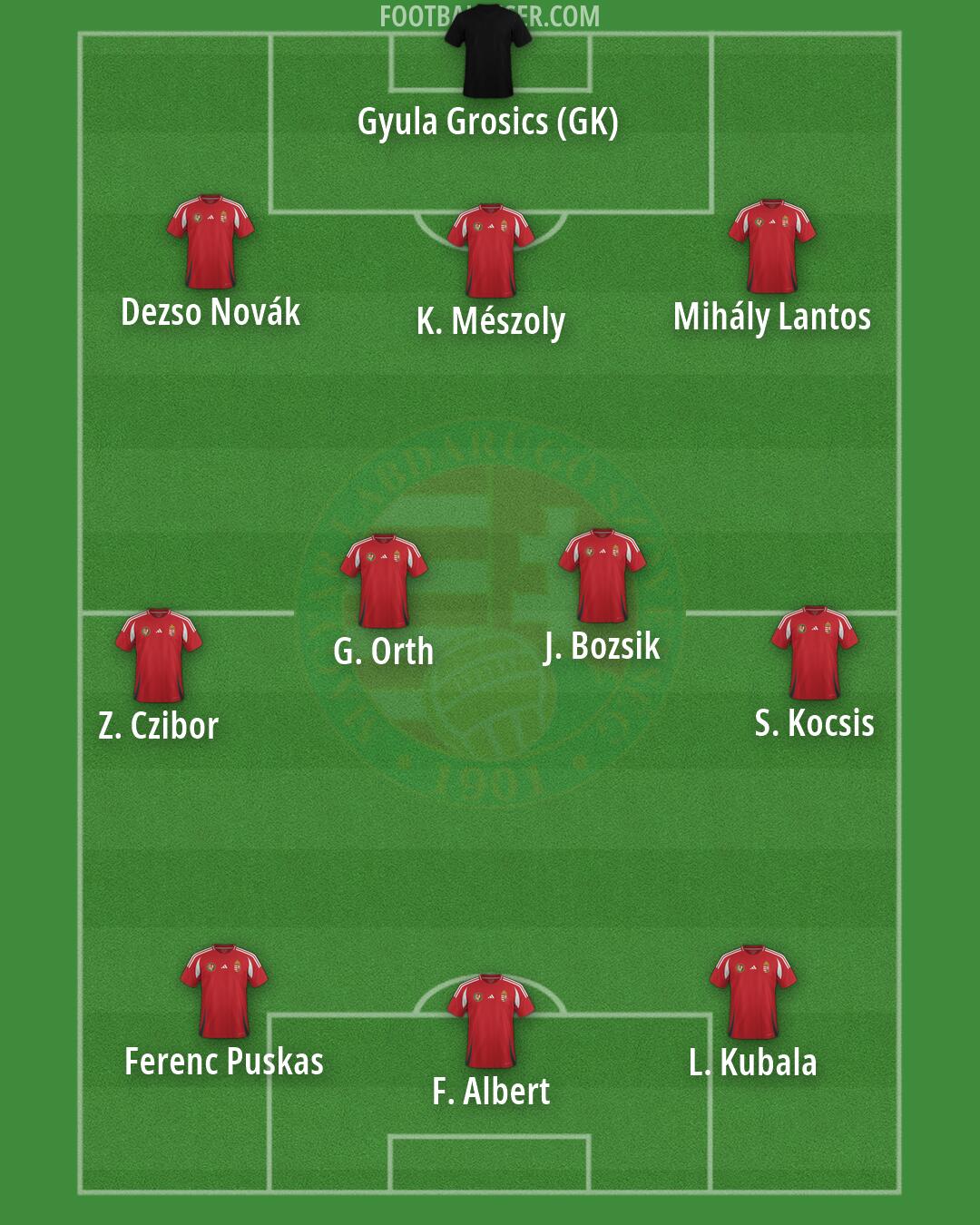
Gyula Grosics (GK) · Dezso Novák · K. Mészoly · Mihály Lantos · Z. Czibor · G. Orth · J. Bozsik · S. Kocsis · Ferenc Puskas · F. Albert · L. KubalaHungary focuses on high pressing and verticality through a 3-4-3 formation. This lineup is built to attack with speed and combine in tight spaces to overwhelm the opposition back line. The team uses this formation to pin the last defender and create constant pressure in the final third through aggressive movements.
Gyula Grosics operates between the posts to act as a sweeping goalkeeper. The back three consists of K. Mészoly, Mihály Lantos, and Dezso Novák. Mészoly holds the central position to clear the lines and win headers, while Lantos and Novák act as wide centre-backs to cover the spaces behind the midfield. These defenders work to play out from the back and squeeze the space between the defensive and midfield lines.
The midfield functions with a four man unit that connects the defense to the attack. J. Bozsik acts as a carrier to drive forward with the ball and progress through the thirds, while G. Orth provides support to win the second ball in the middle. S. Kocsis and Z. Czibor play as wide midfielders who provide width and track back to support the defense. This grouping allows Hungary to control the center of the pitch and recycle possession when needed.
In the attacking phase, Hungary utilizes three attackers to stretch the defence. Ferenc Puskas plays as an inverted winger on the right to cut inside and use his legendary left foot, while L. Kubala operates on the left to create chances. F. Albert acts as a pressing centre-forward to lead the line and find the feet of the striker. The front line looks to hit in behind on the transition and use quick one-two combinations to break the line.
A primary strength of this Hungary lineup is the ability to press high in coordinated waves to win it back high up the pitch. The wide players and attacking trio work together to force a long ball from the opponent. Another advantage is the numerical superiority in the half spaces, which allows players like Ferenc Puskas and L. Kubala to isolate wide players in one on one situations.
This 3-4-3 formation is designed for a team that wants to dominate through offensive pressure and rapid transitions. It is best suited for matches against opponents who sit deep and struggle to deal with constant attacking movement.