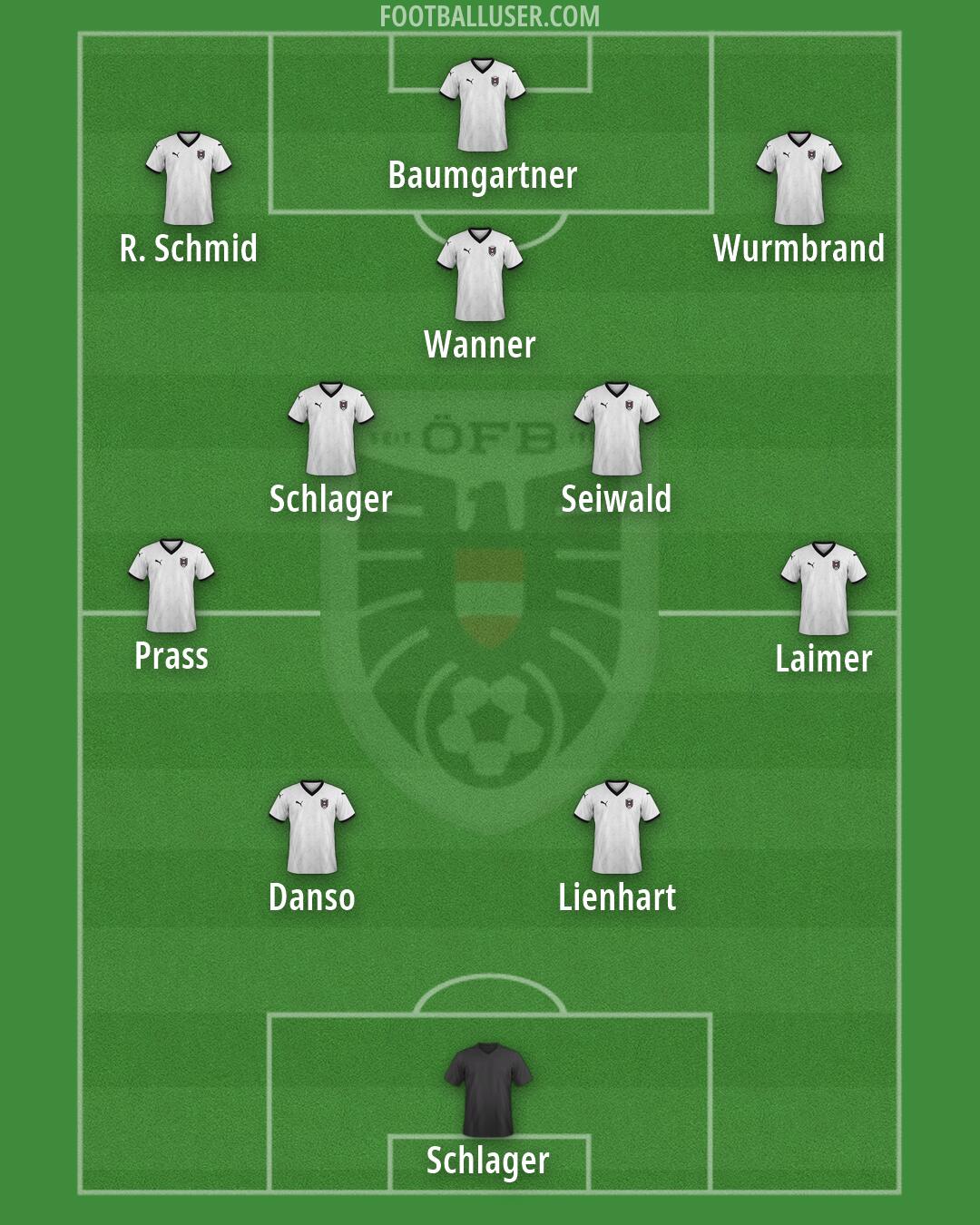

Austria National Football Team Formation
 July 20, 2026


Starting Lineup
Prass · Laimer · Danso · Lienhart · Baumgartner · Wanner · R. Schmid · Wurmbrand · Schlager · Seiwald · SchlagerAustria plays a highly vertical style of football using a 2-5-3 formation. The team focuses on winning the ball high up the pitch and moving forward with great pace to exploit gaps in the opposition. This lineup is built to dominate the central zones and apply heavy pressure to disrupt the opponent.
Schlager operates as the goalkeeper to start the build up from the back. The defensive unit consists of a back two made up of Lienhart and Danso. Lienhart acts as a ball playing defender who can pass through the lines, while Danso is dominant in the air and provides cover for his partner. Because of the high line, they must often step up to catch opponents offside or drop into a low block if the press is bypassed. This pair relies on the midfield to squeeze the space in front of them.
The midfield consists of a five man unit that controls the center of the pitch. Laimer and Prass form a double pivot to shield the defense and win the second ball. Seiwald and Schlager play as two inverted eights who help to connect the defensive and attacking lines. Seiwald is able to carry the ball forward to drive into the half spaces, while Schlager works to recycle possession and switch play. Wanner operates as an attacking ten behind the striker to provide creativity. This midfield group works together to trigger a press and win it back high up the pitch.
The attacking line uses three players to stretch the defense. Baumgartner works as a pressing centre-forward to pin the last defender and lead the hunt from the front. R. Schmid and Wurmbrand play as wide wingers who look to cut inside to cause trouble in the channels. R. Schmid often looks to receive on the half-turn and play through the lines, while Wurmbrand can pull wide to spread the defense. The team moves in combinations to hit in behind on the transition or deliver early crosses into the box.
One major strength of this Austria formation is the numerical superiority in midfield. Having five players in the center allows them to compress the midfield and dominate the ball. Another advantage is the ability to press high in coordinated waves to force a long ball from the opponent. This lineup also provides great speed of transition, allowing the team to go direct once the ball is recovered.
This 2-5-3 formation relies on a heavy central presence to overwhelm the opposition. It is best suited for matches where the team can use high pressure to dictate the tempo of the game.