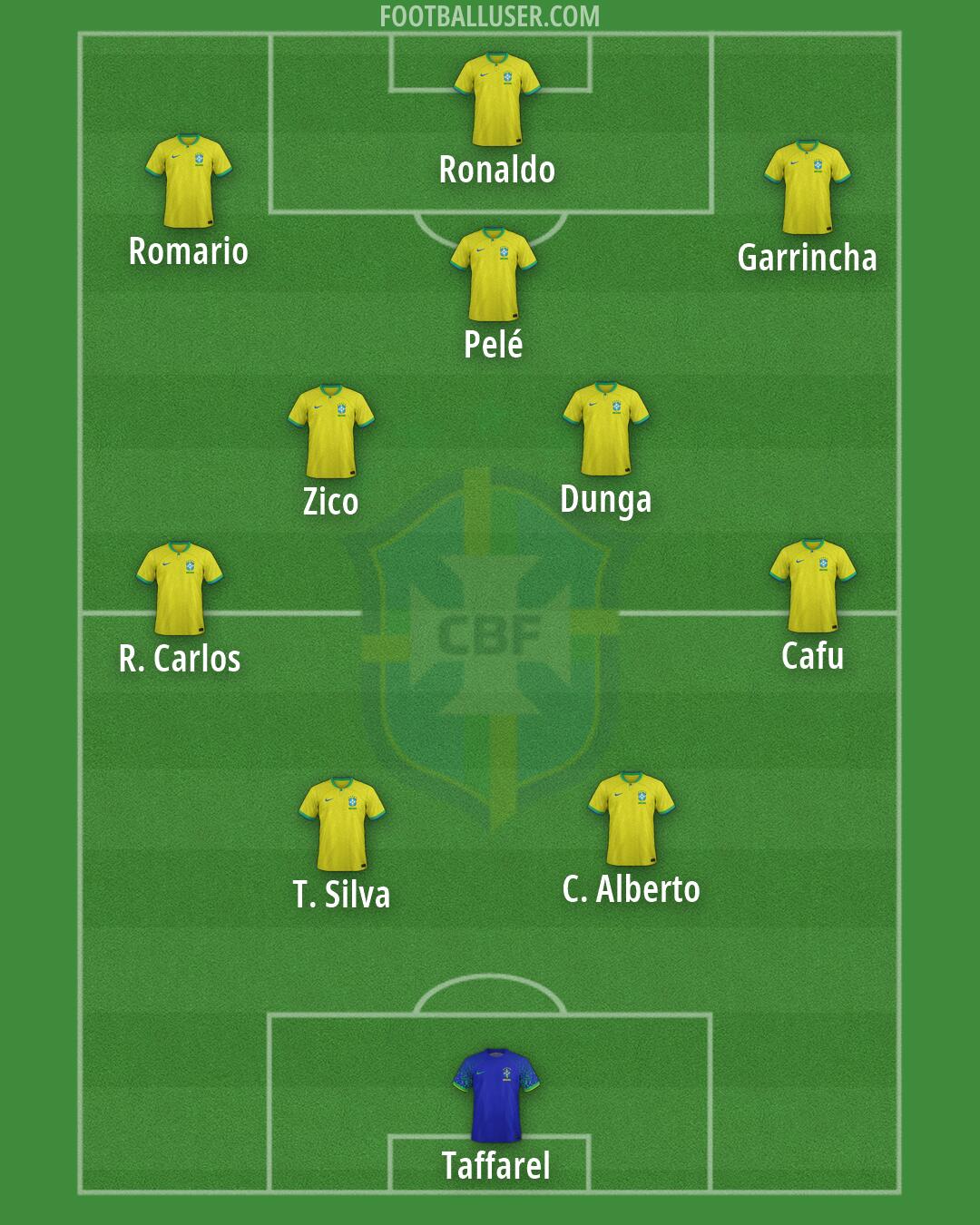

Brazil National Football Team Formation
 July 26, 2026


Starting Lineup
Ronaldo · Romario · Pelé · Garrincha · Zico · Dunga · R. Carlos · Cafu · T. Silva · C. Alberto · TaffarelBrazil relies on an attacking identity built around a 2-5-3 formation. This lineup aims to dominate the pitch by overloading the central areas and forcing the opposition to defend deep. The goal is to win the ball high up the pitch and use the skill of the forwards to break the lines constantly.
Taffarel stands between the posts to protect the goal. The defensive unit consists of a very narrow back two with T. Silva and C. Alberto acting as the central defenders. They must play a high line to squeeze the space and cover the wide areas when the midfield pushes up. T. Silva acts as a ball playing defender to start attacks, while C. Alberto must be ready to step up and intercept passes. Because there are only two in the back, they often have to defend man to man or cover large gaps in transition.
The midfield acts as the engine room for Brazil. Dunga sits in a deep role to shield the defence and win the second ball. Next to him, Cafu and R. Carlos provide width from central positions, essentially acting as wide midfielders who can push forward. Zico operates in the half spaces to create from deep and find the feet of the strikers. Pelé plays as an attacking ten behind the front three, using his vision and dribbling to play through the lines. This five man midfield helps to compress the midfield and allow the team to recycle possession effectively.
In the final third, Brazil uses three attackers to stretch the defence. Garrincha stays wide on the right to isolate defenders one on one, using his dribbling to pull defenders out of position. Romario plays on the left and looks to cut inside to find space in the box. Ronaldo leads the line as the main striker, using his pace to run in behind the last defender. These three combine in tight spaces to create chances through quick one twos and layoffs.
This formation offers immense attacking power through numerical superiority in the central zones. By having five players in the middle, Brazil can dominate the ball and control the tempo of the game. Another advantage is the ability to transition at pace. When the team wins the ball, the distance between the midfield and the front three is small, allowing them to hit in behind on the transition before the opposition can set the offside trap.
The 2-5-3 formation is a high risk lineup that prioritizes goal scoring over defensive solidity. It is best suited for matches where Brazil needs to break down a low block or when they face opponents who cannot punish them on the counter at pace.