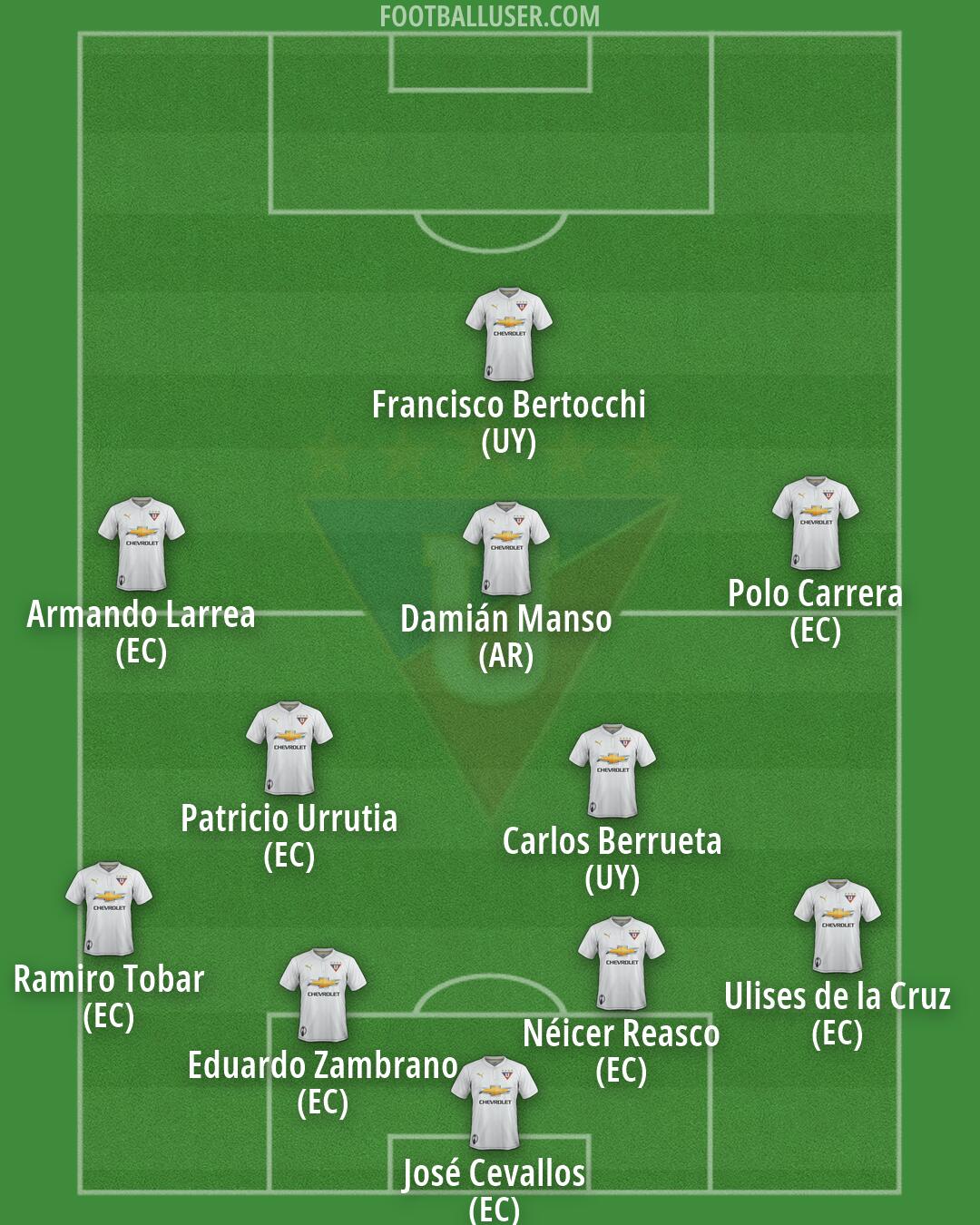

Liga de Quito Football Formation
 July 26, 2026


Starting Lineup
José Cevallos (🇪🇨) · Ulises de la Cruz (🇪🇨) · Néicer Reasco (🇪🇨) · Eduardo Zambrano (🇪🇨) · Ramiro Tobar (🇪🇨) · Patricio Urrutia (🇪🇨) · Carlos Berrueta (🇺🇾) · Polo Carrera (🇪🇨) · Damián Manso (🇦🇷) · Francisco Bertocchi (🇺🇾) · Armando Larrea (🇪🇨)Liga de Quito aims to play a direct and vertical style of football to catch opponents off guard. This 4-2-4 formation is built to overwhelm the opposition through sheer attacking numbers and high intensity in the final third.
José Cevallos guards the goal while the defensive unit stays organized to manage transitions. The back four consists of Ramiro Tobar and Eduardo Zambrano on the left side with Néicer Reasco and Ulises de la Cruz on the right. Tobar and Reasco act as the central defenders, with Reasco providing strength in the air. Ulises de la Cruz pushes forward to provide width while Tobar works to cover the space behind the advancing midfielders. The unit works to keep the line high to squeeze the space for the opposition.
In the middle of the pitch, the team operates with a double pivot to provide stability. Patricio Urrutia and Carlos Berrueta occupy the central roles to control the tempo and link the defense to the attack. Urrutia works to win the second ball and shield the back four, while Berrueta looks to carry the ball forward and find the forwards. These two players are responsible for recycling possession and ensuring the team does not get caught out when the full backs push up.
The attacking lineup is extremely aggressive, featuring four players positioned high up the pitch. Armando Larrea and Polo Carrera act as wide wingers who stretch the defense by hugging the touchline. Damián Manso and Francisco Bertocchi operate as the central forwards, working in a partnership to attack the box. Manso often looks to link up play between the lines, while Bertocchi focuses on runs in behind the defense. This front four aims to press the opposition back line heavily to force errors and quick turnovers.
Liga de Quito gains a significant advantage from the numerical superiority they create in the attacking third. By pushing four players forward, they can isolate defenders in one on one situations. The speed of transition is a key strength, as the double pivot can quickly find the wide players or the central duo to break quickly. This creates constant pressure on the opposition goalkeeper and defense.
This 4-2-4 formation is a high risk, high reward lineup that prioritizes offensive output. It is best suited for matches where the team needs to score goals against a side that sits deep in a low block.