Arsenal Football Formation
 July 28, 2026


Starting Lineup
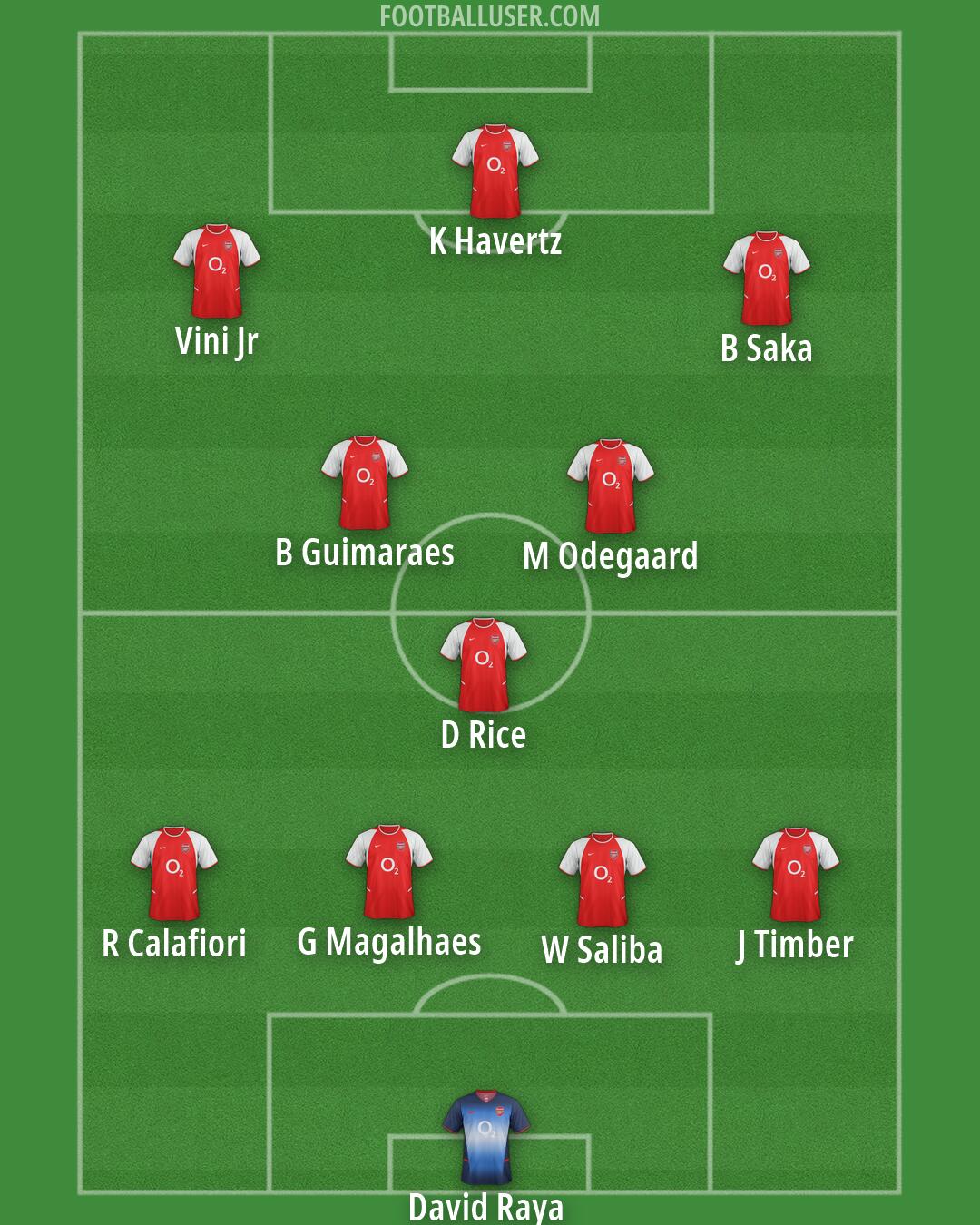
David Raya · J Timber · W Saliba · G Magalhaes · R Calafiori · D Rice · M Odegaard · B Guimaraes · B Saka · K Havertz · Vini JrArsenal aims to dominate through a high press and aggressive ball recovery using a 4-3-3 formation. This lineup is built to play a vertical style of football that seeks to break lines through quick passing and rapid movement. The team wants to win the ball back high up the pitch to catch the opposition out of position.
David Raya operates in goal to help play out from the back. The defensive unit uses a back four that can push up to set the offside trap and play a high line. W Saliba and G Magalhaes function as the central defenders, with W Saliba often acting as a ball playing defender to progress through the thirds while G Magalhaes provides strength in the air. J Timber acts as a right back who can overlap the winger, whereas R Calafiori plays as a left back to provide cover and maintain the line. The unit works together to maintain a compact defensive line when they need to sit deep.
The midfield is built around a single pivot to control the center of the pitch. D Rice occupies the defensive role to shield the defence and win the second ball. M Odegaard plays in the right half-space to create and link the lines, while B Guimaraes plays on the left to carry the ball forward and drive into space. These players work to press in a mid-block to win possession back and quickly recycle possession to the wide areas. This midfield trio provides the connection between the defenders and the front three.
Arsenal uses three attackers to stretch the opposition. K Havertz plays as a pressing centre-forward to pin the last defender and find the feet of his teammates. B Saka operates as a right winger who likes to cut inside to create chances, and Vini Jr plays as a left winger to pull wide and take defenders on. The attack is designed to create runs in behind and deliver crosses from wide positions. When the team loses the ball, they press from the front to force a long ball and win it back quickly.
One key advantage of this formation is the ability to press high in coordinated waves to squeeze the space. This creates many opportunities to hit in behind on the transition. Another strength is the ability to create wide overloads when J Timber and R Calafiori push up to support the wingers. This allows the team to win numerical superiority in wide areas and deliver early crosses into the box.
This 4-3-3 formation is designed for high intensity and aggressive ball winning. It is best suited for matches against teams that try to play short from the back.