Custom Team Football Formation
 July 29, 2026


Starting Lineup
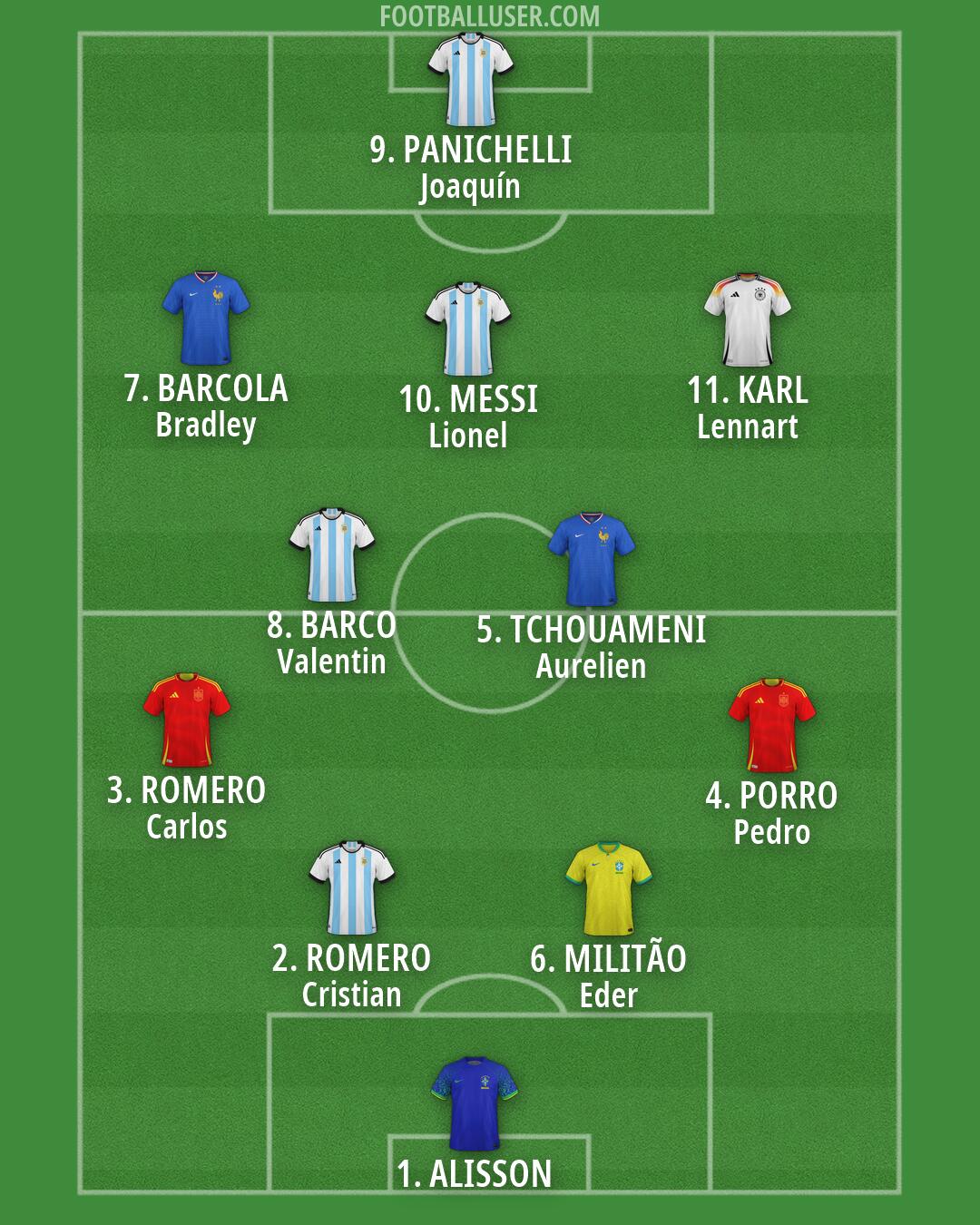
1. ALISSON (Brazil)6. MILITÃO (Eder) (Brazil)
4. PORRO (Pedro) (Spain)
8. BARCO (Valentin) (Argentina)
2. ROMERO (Cristian) (Argentina)
10. MESSI (Lionel) (Argentina)
3. ROMERO (Carlos) (Spain)
5. TCHOUAMENI (Aurelien) (France)
7. BARCOLA (Bradley) (France)
9. PANICHELLI (Joaquín) (Argentina)
11. KARL (Lennart) (Germany)
This team focuses on a heavy high press and quick transitions using a 4-5-1. The goal is to win the ball high up the pitch and strike before the opposition can settle. This formation is built to control the middle of the park while maintaining enough numbers to defend against counter attacks.
Alisson acts as a sweeping goalkeeper to cover the space behind the defensive line. The back four functions as a flat back four with Porro acting as an attacking full back on the right to provide width. Romero and Militao operate as the central pair, with Militao using his pace to cover ground and Romero providing aerial strength. On the left, Romero provides defensive stability to allow the midfield to push forward. The whole unit works to squeeze the space and keep the defensive line high.
A three-man midfield with a double pivot provides the engine for this lineup. Tchouameni sits as the primary shield to protect the centre backs, while Barco plays as the second pivot to help recycle possession. Messi operates in the central role to connect the lines and play through the lines with his vision and passing range. Karl and Barcola occupy the half spaces, with Barcola using his pace to drive forward and Karl making late runs into the box to support the attack. This midfield group works to compress the midfield when out of possession.
The attacking play relies on a lone striker, Panichelli, who acts as a pressing centre forward to force long balls from the opposition. Because the team uses a 4-5-1, the width comes from the midfielders and full backs rather than pure wingers. Messi and Barcola often look to cut inside to create central overloads. The intention is to find the feet of the striker or use quick combinations to hit in behind on the transition. Panichelli must hold up the ball to allow the midfielders to arrive late into the box.
This formation offers significant tactical advantages through its ability to press high in coordinated waves. By having five midfielders, the team can create numerical superiority in the middle of the pitch to dominate the ball. Another strength is the speed of transition, as the quick movement of Barcola and Messi allows the team to break quickly once the ball is won.
This 4-5-1 lineup is designed for a team that wants to dictate the tempo through intense pressing. It is best suited for games against opponents who try to build play slowly from the back.