Custom Team Football Formation
 July 29, 2026


Starting Lineup
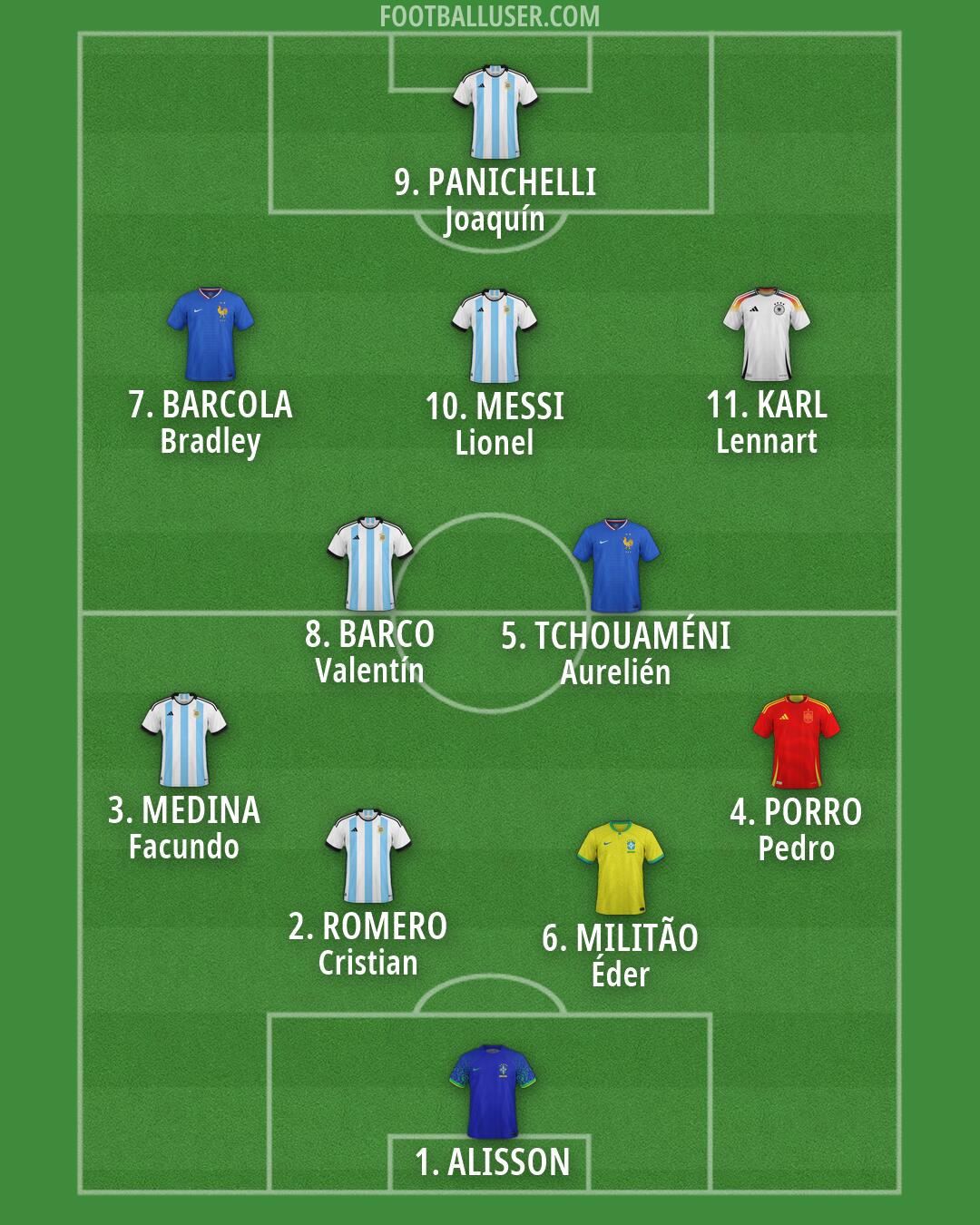
9. PANICHELLI (Joaquín) (Argentina)10. MESSI (Lionel) (Argentina)
3. MEDINA (Facundo) (Argentina)
2. ROMERO (Cristian) (Argentina)
8. BARCO (Valentín) (Argentina)
6. MILITÃO (Éder) (Brazil)
1. ALISSON (Brazil)
4. PORRO (Pedro) (Spain)
5. TCHOUAMÉNI (Aurelién) (France)
7. BARCOLA (Bradley) (France)
11. KARL (Lennart) (Germany)
This lineup aims to dominate through direct verticality and high pressure, utilizing a 4-2-4 formation. The intention is to pin the opposition back and use heavy numbers in the final third to create constant chaos. By pushing the lines high, the team looks to win the ball back quickly and strike before the opponent can organize a defensive block.
Alisson acts as the last line of defense, often playing as a sweeper behind a high line to manage long balls. The back four consists of a central pairing where Militao uses his recovery speed to cover space while Romero focuses on winning the header and physical duels. On the flanks, Porro acts as an attacking full back to provide width, while Medina maintains the line to prevent being caught out on the break. This unit must stay compact to prevent opponents from playing through the middle.
The midfield relies on a double pivot to provide a platform for the attack. Tchouameni acts as the primary shield, sitting deep to intercept passes and win the second ball. Barco operates alongside him, working to connect the defensive line with the heavy front four. This pair must be disciplined to prevent being bypassed, as they are the only players sitting between the defense and the massive attacking line. They focus on recycling possession and finding the forwards as soon as they turn.
The attacking front is built on extreme width and central threat. Barcola operates as an inverted winger on the left to cut inside and threaten the goal, while Karl stays wide on the right to stretch the defense. In the center, Messi plays as a creative force who drops deep to find the feet of the strikers, while Panichelli acts as a pressing centre forward to harass the opposition defenders. This combination of players seeks to create many runs in behind and exploit one on one situations through quick transitions.
The main advantage of this 4-2-4 formation is the ability to create massive wide overloads when the full backs join the wingers. There is also a significant strength in the ability to press high in coordinated waves, making it difficult for the opponent to play out from the back. By flooding the attacking third, the team can isolate wide players and force errors in the opposition defensive third.
This lineup is built for aggressive, high tempo football that prioritizes quick strikes. It is best suited for games where the opponent struggles to handle intense pressure and high physical demands.