Bristol City Football Formation
 July 29, 2026


Starting Lineup
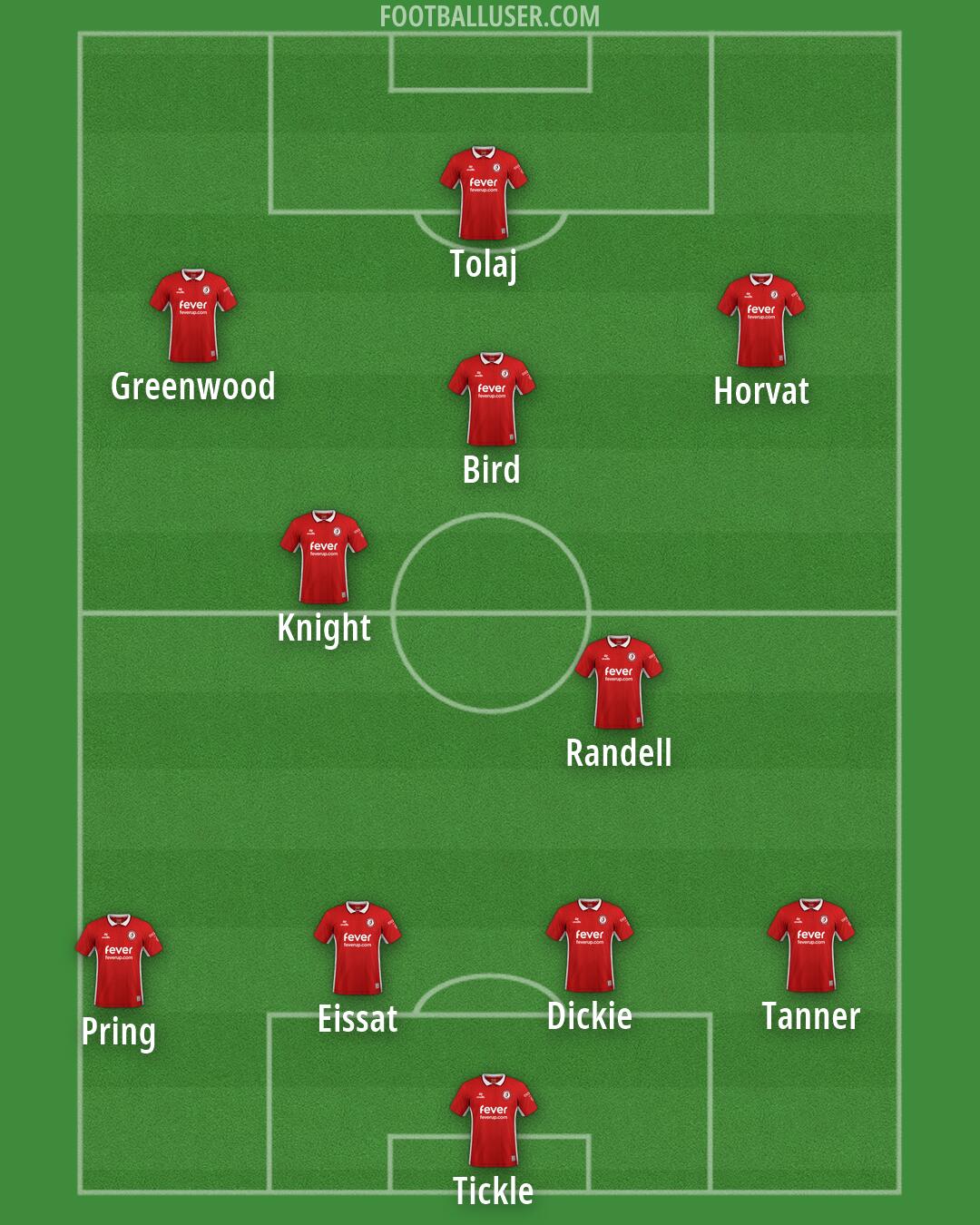
Tickle · Greenwood · Knight · Randell · Eissat · Dickie · Tanner · Tolaj · Horvat · Pring · BirdBristol City aims to play with high intensity and directness using a 4-2-4 formation. This lineup is built to stretch the opposition and exploit space through quick transitions. By playing with four attackers, the team intends to pin the back line of the opponent and create constant vertical threats.
Tickle starts between the posts to command the area. The defensive unit operates as a flat back four to maintain compactness. Tanner acts as the right back, while Pring occupies the left back position. In the heart of the defence, Dickie and Eissat work together as the two central defenders. Dickie is tasked with winning the headers and clearing the lines, while Eissat provides cover to sweep behind the line. The full backs must track back quickly to prevent wide overloads when the team loses the ball.
The midfield relies on a double pivot to manage the center of the pitch. Randell and Knight form this pairing, acting as the engine room to connect the defence to the attack. Randell works to shield the defence and win the second ball, while Knight looks to carry the ball forward to link the play. They must be disciplined to avoid being bypassed by central runners, as they are the only two players occupying the middle third. Their main job is to recycle possession and quickly find the attackers once the ball is won back.
In the final third, Bristol City uses two forwards in a partnership to lead the press. Bird and Tolaj lead the line as the two centre forwards, working to pressure the opposition centre backs. On the flanks, Horvat and Greenwood operate as wide wingers. Horvat stays wide to stretch the defence, while Greenwood is more inclined to cut inside and find space between the lines. This front four is designed to attack in combinations, looking to deliver crosses or play one-twos to catch defenders out of position.
A major strength of this formation is the ability to create immediate threats in transition. With four players high up the pitch, Bristol City can hit in behind on the transition before the opponent can set their defensive block. The team also benefits from the wide overloads created when Pring or Tanner push forward to support the wingers. This creates a high level of pressure that can force many turnovers in the opposition half.
The 4-2-4 formation provides a high-octane attacking presence that forces opponents to defend deep. It is most effective when facing teams that struggle to handle direct play and rapid wide movements.