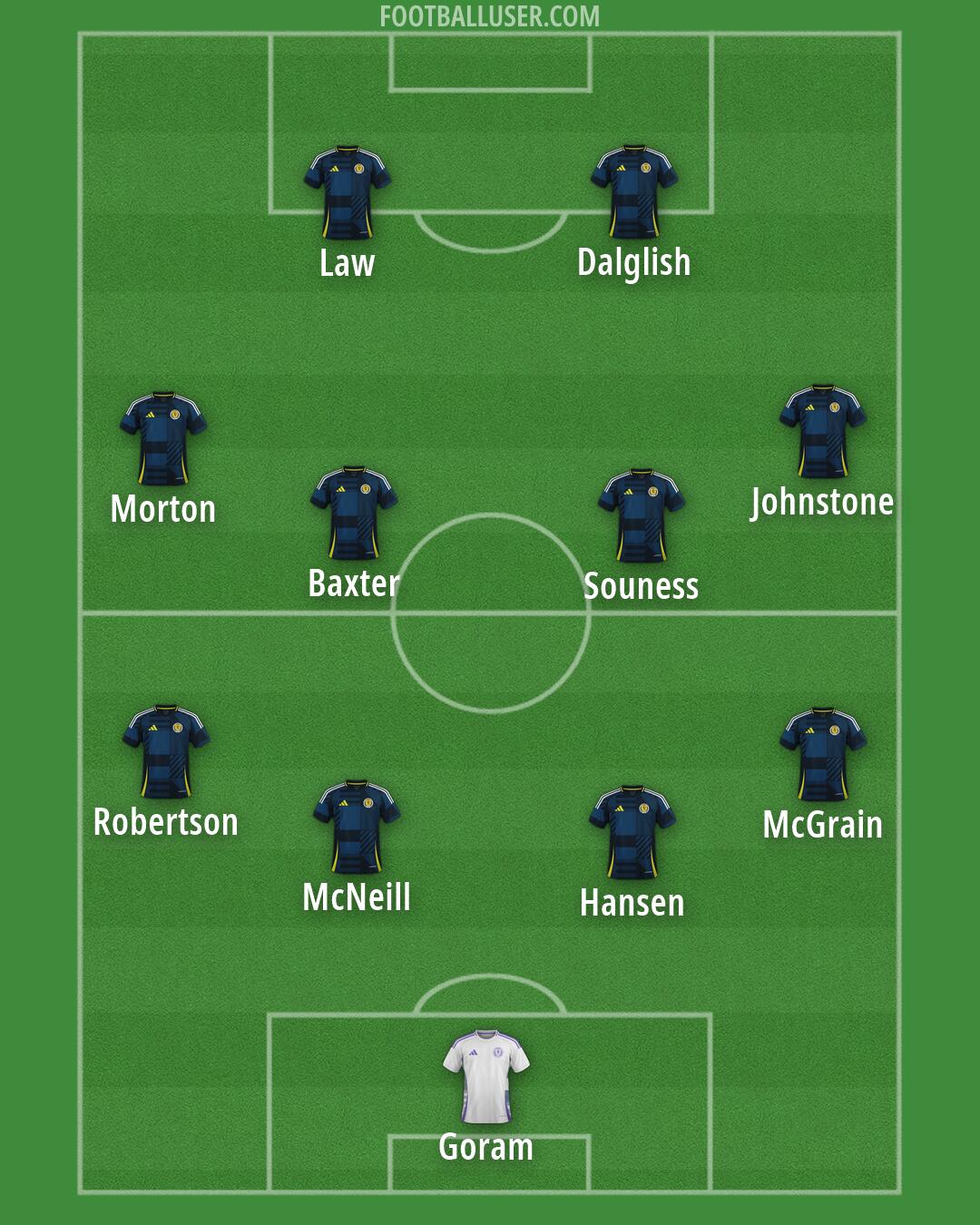
Scotland National Football Team Formation
 Today, August 1, 2026


Starting Lineup
Goram · McGrain · Hansen · McNeill · Robertson · Johnstone · Souness · Baxter · Morton · Dalglish · LawScotland focuses on a direct and vertical way of playing through a 4-4-2 formation. This lineup aims to win the second ball and move the play quickly from the back to the front. The goal is to use the width of the pitch to stretch the opposition and create chances for the two strikers.
Goram sits between the posts to command the area. The defensive line operates as a flat back four with McGrain and Robertson providing depth on the flanks. McGrain works as an overlapping full back to support the right side, while Robertson pushes up to deliver crosses from the left. In the middle, Hansen and McNeill defend zonally, with Hansen using his aerial strength to clear the lines and McNeill acting as a covering defender to pick up runners.
The midfield consists of two central players and two wide midfielders to maintain a compact shape. Souness acts as the engine in the middle, driving forward with the ball and using his passing range to find teammates. Baxter works alongside him to connect the defensive and attacking lines. On the flanks, Morton and Johnstone occupy the wide areas to track back and protect the full backs. Souness often presses aggressively to win the ball high up the pitch, helping Scotland regain possession quickly.
The attack relies on a partnership of two forwards who work in close combinations. Dalglish plays as a second striker in the hole, dropping into midfield to receive on the half-turn and link up play. Law acts as the main presence upfront, looking to find the feet of the striker or make runs in behind the defense. They use the width provided by Morton and Johnstone to create space in the middle, often looking to hit in behind on the transition to catch the opposition out of position.
This formation offers several tactical advantages for the Scottish national team. The 4-4-2 allows for great compactness when defending in a mid-block, making it hard for opponents to play through the center. There is also a high potential for wide overloads when McGrain and Robertson overlap the wingers. This creates situations where the team can quickly switch play to an isolated winger in a one on one situation.
Scotland uses this 4-4-2 to remain hard to beat while remaining dangerous on the break. It is a formation best suited for games against technically superior sides where winning second balls and quick transitions are vital.