Liverpool Football Formation
 Today, August 6, 2026
 sco****@hotmail.com


Starting Lineup
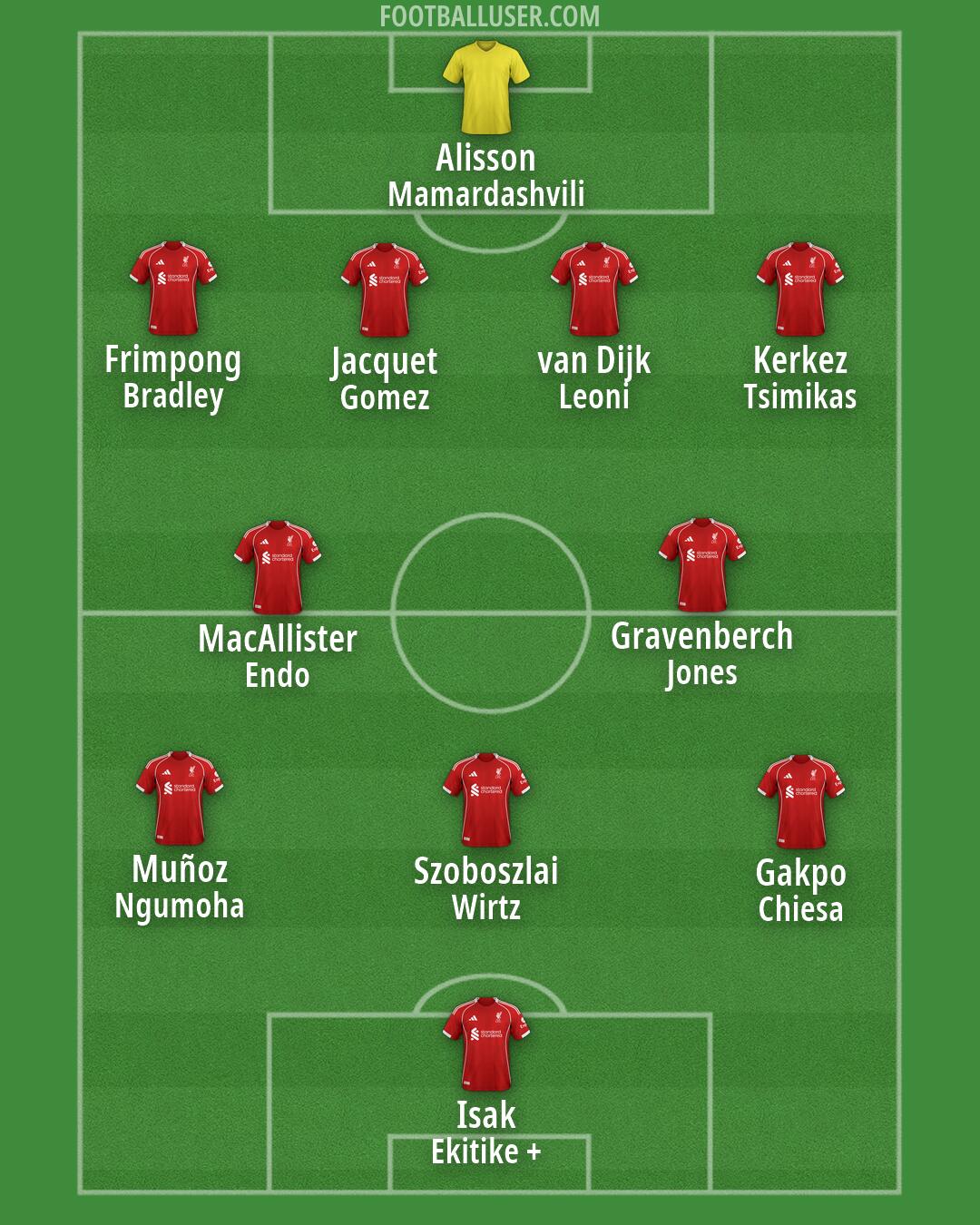
Alisson (Mamardashvili) · Jacquet (Gomez) · van Dijk (Leoni) · Frimpong (Bradley) · Kerkez (Tsimikas) · MacAllister (Endo) · Gravenberch (Jones) · Szoboszlai (Wirtz) · Muñoz (Ngumoha) · Gakpo (Chiesa) · Isak (Ekitike +)Liverpool focuses on winning the ball high up the pitch and playing with high intensity through a 4-5-1. This formation is built to press aggressively and use quick vertical transitions to catch opponents off guard. The Liverpool lineup aims to squeeze the space in the middle of the park to force turnovers before moving the ball rapidly toward the goal.
Alisson acts as the last line of defense, often acting as a sweeper behind a high line to collect long balls. The back four features van Dijk and Jacquet as central defenders, with van Dijk using his aerial strength and reading of the game to command the area. Frimpong operates as an attacking full back to provide width on the right, while Kerkez pushes up on the left to support the midfield. This unit must stay compact to avoid being caught out when the team commits bodies forward.
In the middle of the pitch, Liverpool employs a five man midfield to control the tempo and crowd the central zones. Gravenberch and MacAllister form a double pivot to shield the defense, with Gravenberch using his ball carrying ability to progress through the thirds. Muñoz and Gakpo occupy the half spaces to link the midfield to the attack, while Szoboszlai operates as a central engine to press aggressively and arrive late into the box. This group works to win the second ball and quickly recycle possession once it is recovered.
The attacking structure relies on Isak as a lone striker who holds up the ball to bring others into play. Isak is tasked to press the opposition back line and make runs in behind to stretch the defense. Because the midfielders like Szoboszlai and Gakpo push high, the team creates many combinations in the final third. The width comes from Frimpong and Kerkez, who overlap the midfielders to deliver crosses into the box.
One major advantage of this formation is the ability to press high in coordinated waves, making it difficult for opponents to play out from the back. The presence of five players in the middle creates numerical superiority in central areas, allowing the team to dominate possession when needed. This setup also offers speed of transition, as the midfielders are positioned to spring forward the moment the ball is won.
This 4-5-1 formation relies on high energy and heavy pressing to disrupt the opponent. It is best suited for games where the team needs to stifle a creative midfield and strike quickly on the break.