
River Football Formation
 Today, August 7, 2026


Starting Lineup
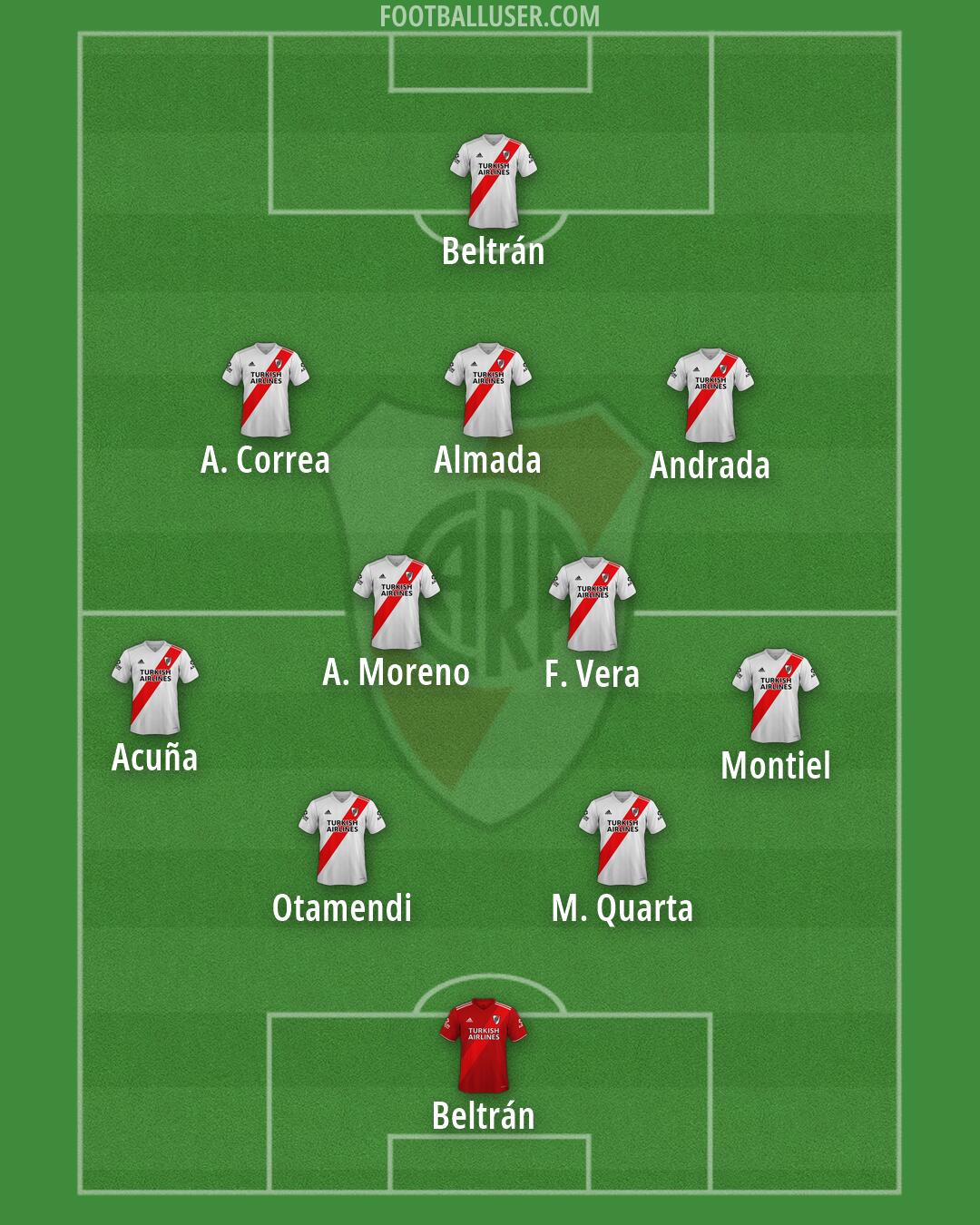
Beltrán · Otamendi · M. Quarta · Acuña · Montiel · A. Moreno · Almada · A. Correa · Beltrán · Andrada · F. VeraRiver favors a heavy verticality to catch opponents out through sheer numbers in the final third, operating in a 2-4-4 formation. This lineup focuses on rapid transitions and overwhelming the opponent once the ball is recovered. The intention is to force errors in the opposition half by keeping the play high up the pitch and using wide areas to stretch the defense.
Beltrán stays on the line to provide the foundation for the back line. The defensive unit consists of a pair of central defenders, Otamendi and M. Quarta, who act as the last line of defense. Otamendi brings aerial strength and leadership to the back, while M. Quarta focuses on covering space behind the high line. Because there are only two defenders, they must stay compact and communicate constantly to prevent being split by direct passes.
In front of the defense, the midfield works in a flat four to control the center and provide width. F. Vera and A. Moreno act as the central pairing to control the tempo and win the second ball. F. Vera works to protect the center, while A. Moreno connects the defense to the attack by carrying the ball forward. On the flanks, Montiel and Acuña operate as wide midfielders who provide width. Montiel pushes up to help the attack, while Acuña uses his energy to support both sides of the pitch.
The attacking force is built around four players who press from the front to trigger a press. Almada and Beltrán operate as a central partnership, with Almada looking to find space between the lines and Beltrán acting as a focal point to hold up the ball. On the wings, Andrada and A. Correa act as wide attackers who cut inside to create central overloads. This front four is designed to pin the last defender and create chaos through quick combinations and runs in behind.
One major advantage of this River lineup is the ability to create massive wide overloads when Montiel and Acuña join the forwards. The team can also achieve numerical superiority in the attacking third, making it very difficult for a standard back four to mark everyone. By squeezing the space in the middle, the team can force the opposition to play wide and then win the ball back high up the pitch.
This formation is built to overwhelm teams that sit in a mid-block and struggle with rapid vertical movement. It is best suited for games where River can exploit gaps left by an advancing opponent through quick transitions.