Man City Football Formation
 Today, August 7, 2026


Starting Lineup
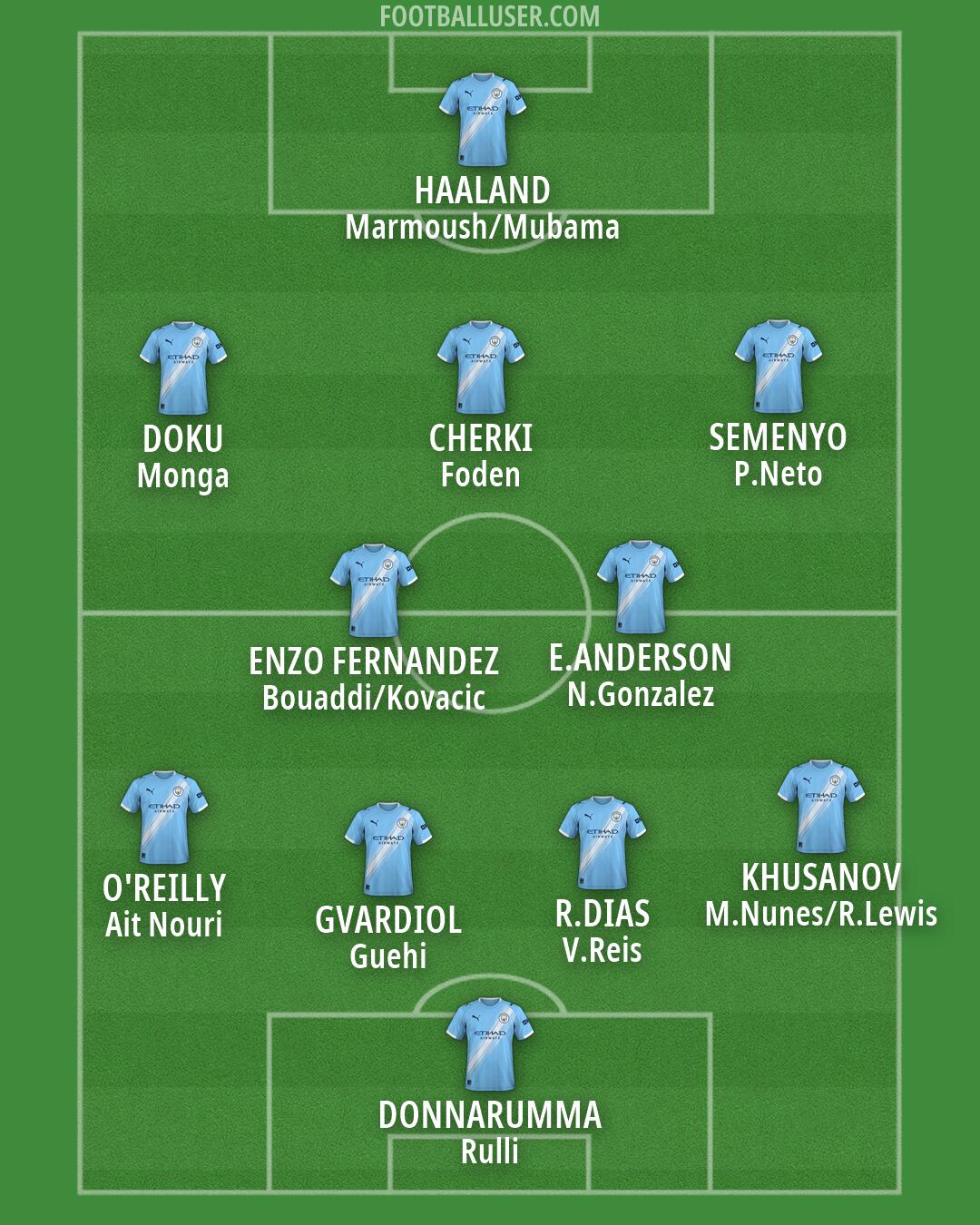
DONNARUMMA (Rulli) · KHUSANOV (M.Nunes/R.Lewis) · R.DIAS (V.Reis) · GVARDIOL (Guehi) · O'REILLY (Ait Nouri) · E.ANDERSON (N.Gonzalez) · ENZO FERNANDEZ (Bouaddi/Kovacic) · CHERKI (Foden) · SEMENYO (P.Neto) · DOKU (Monga) · HAALAND (Marmoush/Mubama)Man City relies on a high press and heavy possession to control games, utilizing a 4-5-1 formation. This lineup is built to squeeze the pitch and dominate the ball in the middle third. The team seeks to pin the opposition back through constant ball movement and rapid transitions to catch defenders out of position.
Donnarumma acts as the goalkeeper, looking to distribute the ball quickly to start attacks. The defensive unit operates with a flat back four that maintains a high line to keep the team compact. Ruben Dias serves as a dominant centre back who wins the header and leads the line, while Gvardiol provides cover and can step into midfield when needed. Khusanov plays as a defensive wing back to hold the right side, while O'Reilly pushes up the left to provide width. This back line works together to keep the distance between the defenders and the midfield very small.
The midfield works as a five man unit to dominate the center of the pitch. Enzo Fernandez operates as a deep lying playmaker, looking to switch play and find the feet of the strikers. E. Anderson provides a shield for the defense, making sure to track back and protect the center backs. In the more advanced roles, Doku uses his dribbling style to drive forward with the ball, while Cherki and Semenyo operate in the half spaces to connect the lines. This group of five ensures that Man City can always recycle possession and find a way through the middle.
In the final third, Haaland operates as a lone striker and a pressing centre forward. He stays central to pin the last defender and waits to receive service in the box. The wide players like Doku and Semenyo look to cut inside to create overloads or deliver a cross on the run. The aim is to use the movement of the midfielders to draw defenders out of place, creating space for Haaland to run in behind. When the team loses the ball, the front line works to trigger a press and win it back high up the pitch.
One major advantage for Man City is the ability to create numerical superiority in midfield, making it hard for opponents to hold their shape. The lineup also offers great speed of transition, especially when Doku or Semenyo can carry the ball forward quickly. The coordination of the press in waves allows the team to win the second ball frequently in the opposition half.
This 4-5-1 formation focuses on controlling the tempo through ball retention and aggressive ball winning. It is best suited for games against teams that sit deep and defend in a low block.