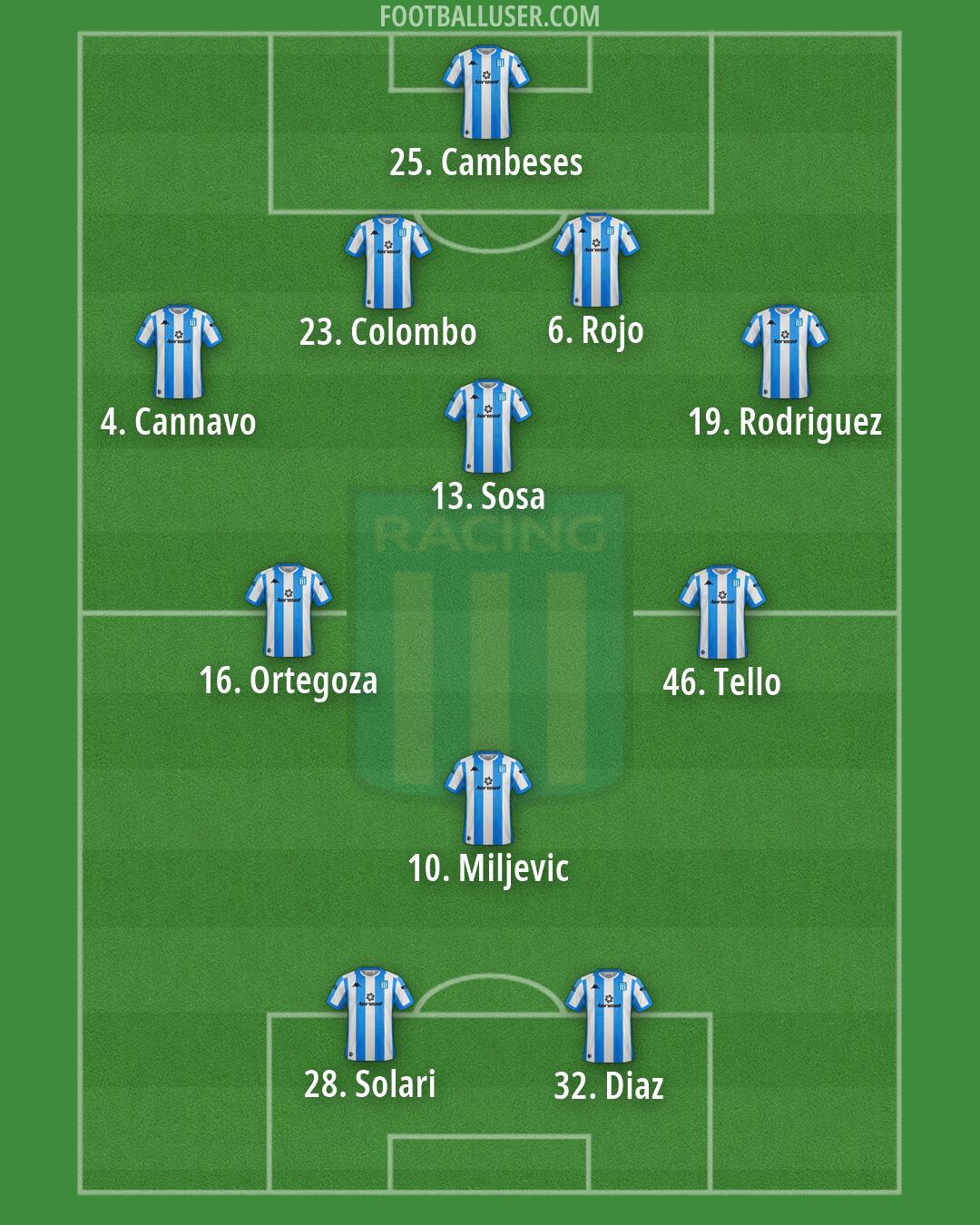

Racing Club Football Formation
 August 7, 2026


Starting Lineup
25. Cambeses4. Cannavo
19. Rodriguez
23. Colombo
6. Rojo
13. Sosa
16. Ortegoza
46. Tello
10. Miljevic
28. Solari
32. Diaz
Racing Club relies on a solid defensive foundation and quick verticality, utilizing a 5-3-2 formation. This lineup focuses on being hard to beat while looking to catch opponents out through rapid transitions. The team wants to stay compact and use the width of the pitch to stretch opposing back lines during attacks.
Cambeses plays between the posts to organize the defensive unit. The back five functions as a narrow defensive block when the opposition has the ball. Sosa and Colombo act as the central pillars, with Sosa providing aerial strength and Colombo covering the space behind. Rojo operates as a wide centre-back to help bridge the gap between the defense and the wingbacks. Cannavo and Rodriguez act as attacking wing backs, tasked with providing all the width on their respective flanks. They must track back quickly to maintain the five man line when the team drops into a mid block.
The midfield consists of a three man midfield with a carrier and creative roles. Ortegoza works to shield the defense and wins the second ball to keep play moving. Tello connects the defensive and attacking lines by carrying the ball forward into the half spaces. Miljevic plays as an attacking ten behind the two strikers, looking to find pockets of space and play through the lines. This trio works to compress the midfield and deny the turn to opposing playmakers.
Racing Club uses two forwards in a partnership to lead the line. Diaz and Solari act as a dual threat, often playing with one player dropping slightly to link up play. They press the opposition back line to force a long ball and win possession high up the pitch. The movement of Cannavo and Rodriguez allows for overlaps from wide, which helps to create one on one situations for the wingers. This combination of central presence and wide support makes it hard for defenders to track all runners.
A major advantage for Racing Club is the ability to shift between a back five and a back three during transitions. This allows the team to stay compact when defending and then explode forward with numbers. The formation also creates wide overloads from the attacking wing backs, which can pin the last defender and create space for Miljevic.
The 5-3-2 formation provides Racing Club with a reliable platform for counter attacking football. It is best suited for games against teams that dominate possession and leave space behind their defensive line.