Liverpool Football Formation
 August 10, 2026


Starting Lineup
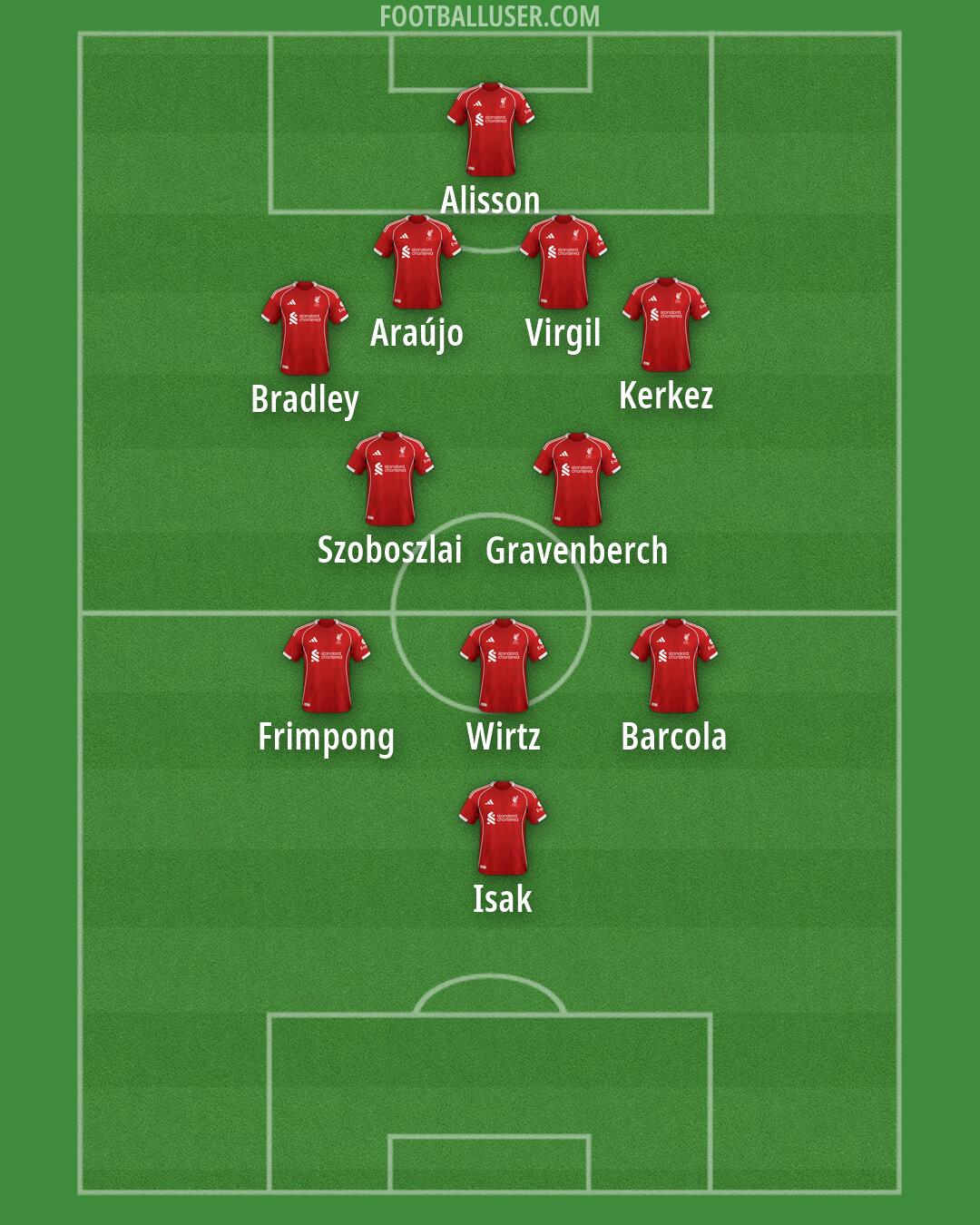
Araújo · Bradley · Virgil · Kerkez · Barcola · Frimpong · Wirtz · Szoboszlai · Isak · Gravenberch · AlissonLiverpool focuses on a heavy high press and quick transitions through a 5-4-1 formation. This lineup is built to squeeze the space in the opposition half and strike with immense verticality once the ball is won. The team aims to win it back high up the pitch to catch the opponent before they can set their defensive block.
Isak sits between the posts to command his area. The defensive unit works in a back five where Szoboszlai and Gravenberch act as the central defenders. Szoboszlai covers the left side while Gravenberch handles the right, with Wirtz acting as the central presence to sweep behind the line. On the flanks, Frimpong and Barcola operate as attacking wing backs, ready to push high and provide width. They must track back quickly to form a narrow defensive block when Liverpool loses possession.
The midfield functions as a flat four designed to control the center of the pitch. Bradley and Kerkez operate on the left and right sides to help spread the play. In the center, Virgil and Araújo act as a double pivot to protect the back line. Virgil focuses on breaking the line with forward passes, while Araújo works to intercept plays and shield the defense. This pairing allows the team to recycle possession or immediately hit in behind on the transition.
Liverpool utilizes Alisson as a lone striker to lead the line. He works as a pressing centre-forward to disrupt the opposition build up and force a long ball. When the ball moves forward, Frimpong and Barcola overlap the winger to create numerical superiority in wide areas. Alisson looks to hold up the ball and lay it off to the advancing midfielders or runners from deep. The goal is to isolate wide players in one on one situations or deliver early crosses into the box.
This formation offers significant advantages through its ability to press high in coordinated waves. By using the wing backs and midfielders to squeeze the pitch, Liverpool creates compactness when defending. The speed of transition is a major threat as the team can shift from a defensive block to an attacking wave in seconds. This creates massive pressure on the opponent's back line through quick combinations.
Liverpool relies on an aggressive pressing identity to dominate territory. This 5-4-1 formation is best suited for matches against teams that struggle to play out from the back.