
Brazil National Football Team Formation
 August 10, 2026
 Jonas18


Starting Lineup
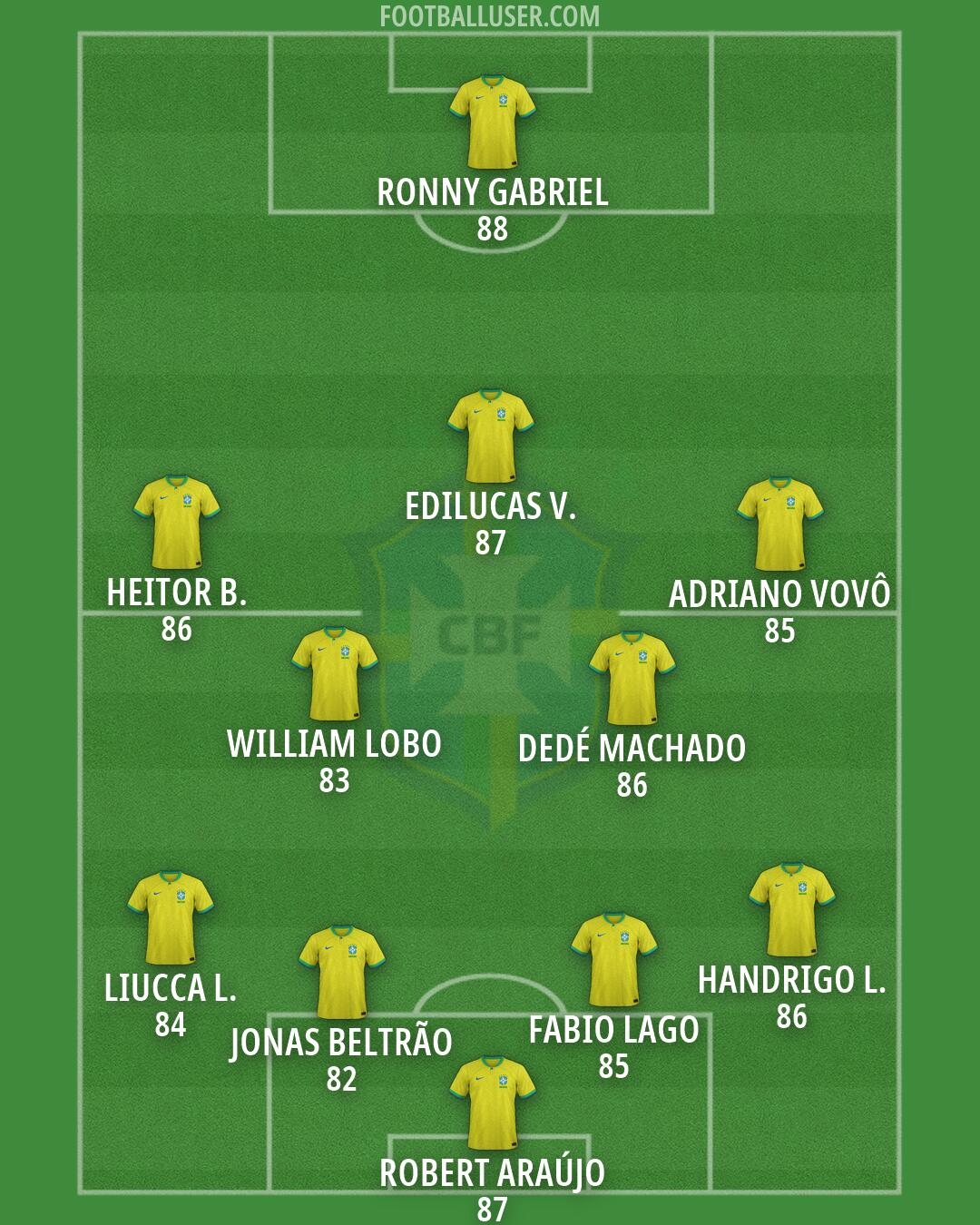
ROBERT ARAÚJO (87) · HANDRIGO L. (86) · FABIO LAGO (85) · JONAS BELTRÃO (82) · LIUCCA L. (84) · DEDÉ MACHADO (86) · WILLIAM LOBO (83) · ADRIANO VOVÔ (85) · EDILUCAS V. (87) · HEITOR B. (86) · RONNY GABRIEL (88)Brazil focuses on a compact defensive block and quick transitions using a 4-5-1. This lineup is built to sit deep and wait for the opponent to overcommit before hitting them in behind. The goal for Brazil is to squeeze the space in the middle and rely on directness once the ball is won.
Robert Araújo guards the goal as the last line of defense. The back four consists of Handrigo L. at right back and Liucca L. at left back, both tasked with tracking wide runners and protecting the flanks. In the center, Fabio Lago and Jonas Beltrão operate as a pairing to defend the box. Fabio Lago and Jonas Beltrão must stay close together to defend zonally and ensure no one gets between them. Handrigo L. and Liucca L. need to hold the line to prevent long balls from breaking the defense.
The midfield unit works in a dense block to control the center of the pitch. Dedé Machado and William Lobo form a double pivot to shield the defense and win the second ball. Ahead of them, Adriano Vovô and Heitor B. act as two central midfielders who must press in a mid-block to disrupt the opposition. Edilucas V. plays as an attacking ten behind the striker, looking to find pockets of space and link the midfield to the attack. Dedé Machado and William Lobo provide the steel needed to allow the others to push up.
In the attacking phase, Ronny Gabriel operates as a lone striker. He must work hard to press from the front and hold up the ball to bring the midfielders into play. When the team wins possession, the aim is to find Edilucas V. or the wide midfielders quickly. Ronny Gabriel often looks to run in behind the defenders to stretch the opposition. The team builds play by finding the feet of the striker or using the width provided by the midfielders to switch play.
This formation offers great compactness when defending, making it very difficult for opponents to play through the lines. Brazil can also use the speed of transition to catch teams out of position. By using the double pivot of Dedé Machado and William Lobo, the team maintains a solid base that allows the attacking ten to roam. This setup is also effective for isolating the lone striker in one on one situations against a tired defense.
Brazil relies on a disciplined defensive shape and rapid counter attacks. This lineup is best suited for facing teams that dominate possession and leave space behind their high line.