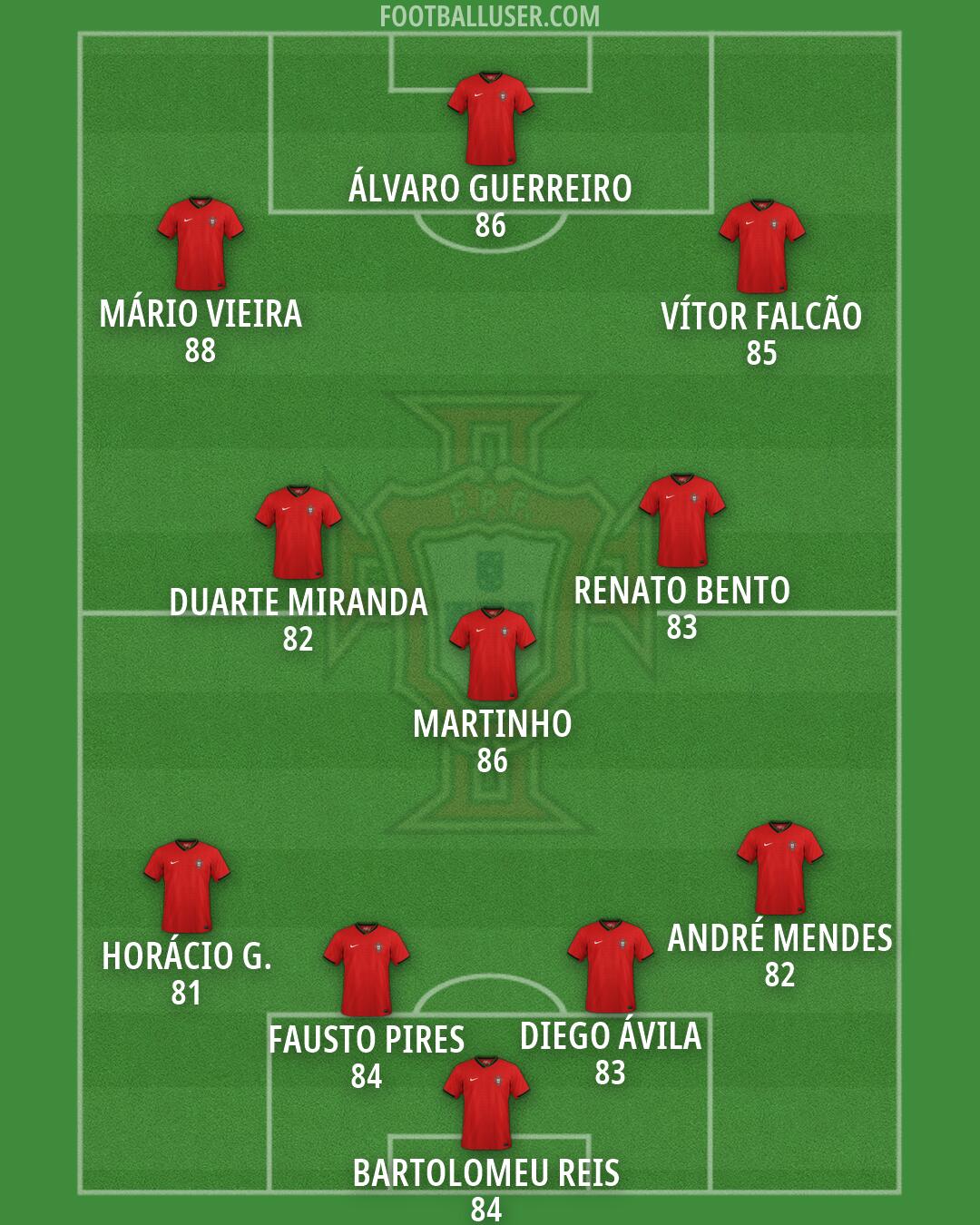

Portugal National Football Team Formation
 Today, August 11, 2026
 Jonas18


Starting Lineup
BARTOLOMEU REIS (84) · ANDRÉ MENDES (82) · FAUSTO PIRES (84) · DIEGO ÁVILA (83) · HORÁCIO G. (81) · MARTINHO (86) · RENATO BENTO (83) · DUARTE MIRANDA (82) · MÁRIO VIEIRA (88) · VÍTOR FALCÃO (85) · ÁLVARO GUERREIRO (86)Portugal focuses on a high press and aggressive verticality using a 4-3-3 formation. This lineup is built to win the ball high up the pitch and quickly transition into dangerous attacking movements. The goal is to squeeze the space in the opponent half and use rapid ball movement to split the defence.
BARTOLOMEU REIS stands between the posts to organize the defensive line. The back four operates as a zonal line to maintain compactness. ANDRÉ MENDES and HORÁCIO G. act as attacking full backs to provide width, while DIEGO ÁVILA and FAUSTO PIRES form the central pairing. DIEGO ÁVILA acts as a ball playing defender to start attacks, while FAUSTO PIRES focuses on covering the space behind the high line. The unit works together to push up and maintain a high line to keep the team compact.
A three man midfield controls the central areas to connect the defence and attack. MARTINHO plays as a single pivot to shield the defence and recycle possession. Beside him, DUARTE MIRANDA and RENATO BENTO operate as inverted eights who drive forward with the ball. DUARTE MIRANDA looks to progress through the thirds, while RENATO BENTO makes late runs into the box to add numbers to the attack. This trio works to win the second ball and ensure Portugal maintains control in the middle of the park.
The attacking unit uses three attackers across the front to stretch the opposition. ÁLVARO GUERREIRO acts as a pressing centre forward to force long balls from the opponent. On the flanks, MÁRIO VIEIRA and VÍTOR FALCÃO play as inverted wingers who cut inside to create central overloads. These players aim to get to the byline or find the feet of the striker. The front three work to press the opponent back line and create runs in behind through quick combinations.
Portugal offers significant tactical advantages through this formation. The team creates wide overloads when the full backs overlap the winger to pin the last defender. There is also a strong ability to press high in coordinated waves, making it difficult for opponents to play out from the back. The speed of transition allows the players to exploit gaps as soon as the ball is recovered.
This 4-3-3 formation relies on high energy to sustain pressure and dominate territory. It is best suited for games against teams that struggle to play under intense pressure or those that leave space behind their defensive line.