
Japan National Football Team Formation
 August 13, 2026


Starting Lineup
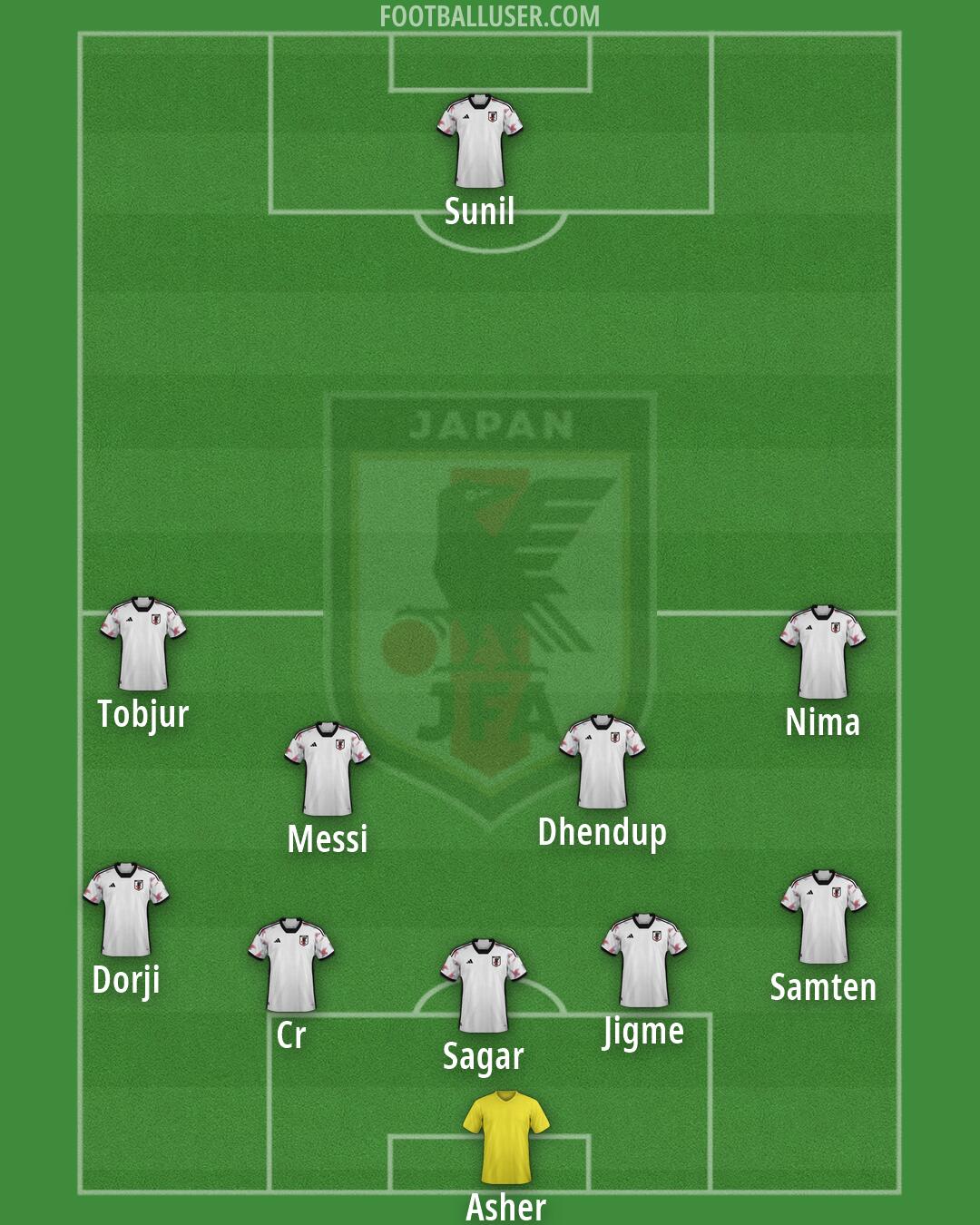
Asher · Dorji · Cr · Sagar · Jigme · Samten · Messi · Dhendup · Sunil · Nima · TobjurJapan aims to sit deep and rely on quick transitions, operating within a 5-4-1 formation. This lineup is built to remain compact and frustrate opponents by denying space between the lines. The team intends to absorb pressure and then hit the opposition in behind when they lose possession.
Asher sits between the posts to organize the defensive unit. The back line functions as a narrow defensive block featuring a back three consisting of Sagar, Cr, and Jigme. Sagar acts as the central anchor, while Cr and Jigme provide cover to either side. Samten operates as an attacking wing back on the right, looking to provide width, while Dorji plays as a left wing back to help push the team forward. This group works to stay tight and protect the central areas.
The midfield operates in a flat four to maintain a compact shape. Dhendup and Messi form the central pairing, with Messi tasked to connect the defensive and attacking lines while Dhendup works to shield the defence. On the flanks, Nima and Tobjur occupy the wide areas to help win the second ball and track back when the team loses the ball. This unit aims to squeeze the space in the middle to prevent opponents from playing through the lines.
Up front, Sunil acts as a lone striker. He is tasked to hold up the ball and wait for support from the midfield or the wing backs. The attacking structure relies on the wide players, Nima and Tobjur, to provide service. When Japan wins the ball, the goal is to find Sunil quickly or use the runs of the wing backs to create numbers in the final third. The forwards press the opposition back line to force a long ball and regain possession high up the pitch.
Japan offers significant tactical advantages through its defensive compactness. The five defenders and four midfielders make it very difficult for opponents to find gaps in the central zone. This setup allows for speed of transition once the ball is won, as the wide players can immediately exploit space. The team can also shift between a low block and a mid-block to control the tempo of the game.
This 5-4-1 formation is a resilient defensive lineup designed to absorb heavy pressure. It is best suited for matches against teams that dominate possession and struggle to break down a compact low block.