
Flamengo Football Formation
 August 14, 2026


Starting Lineup
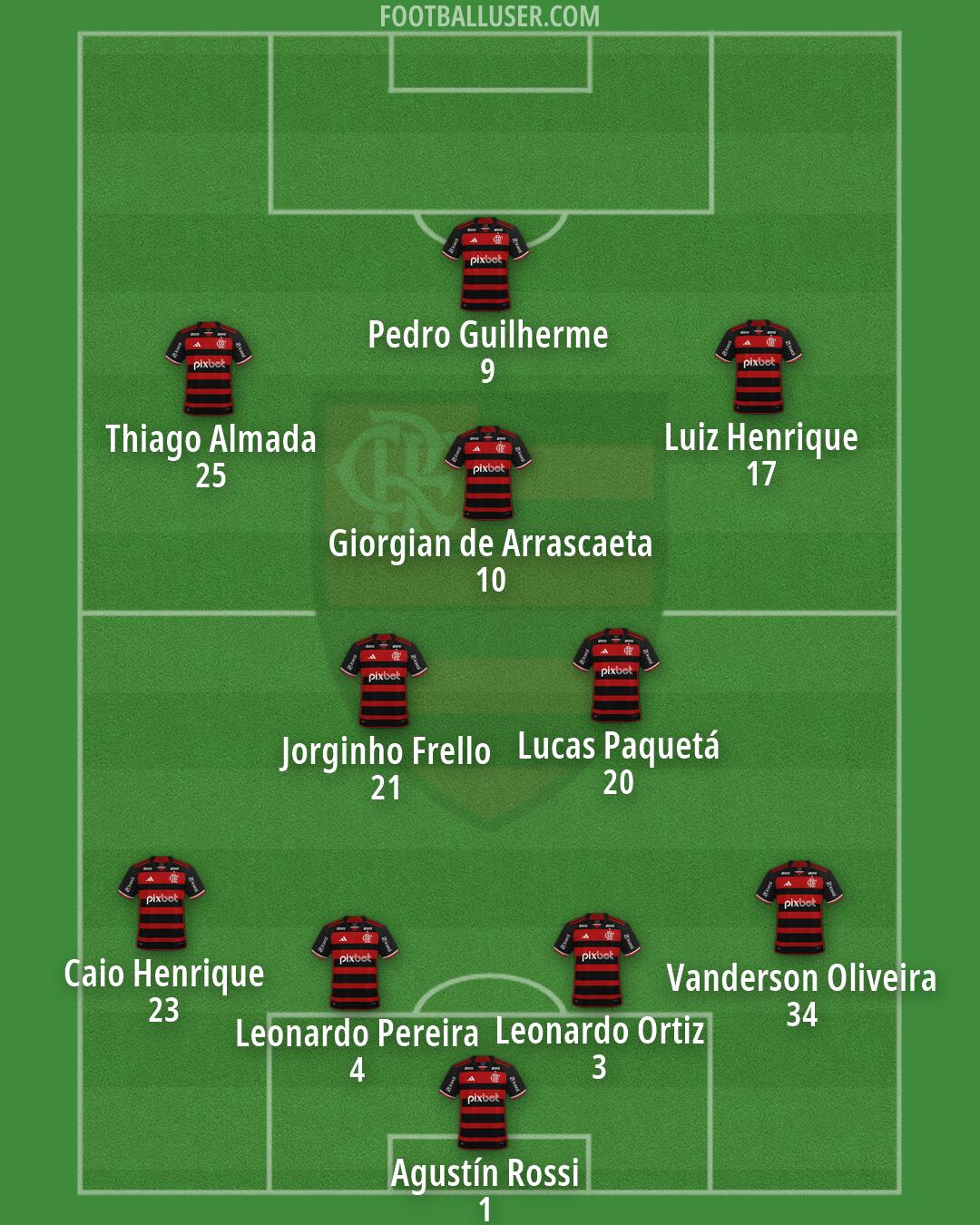
Giorgian de Arrascaeta (10) · Jorginho Frello (21) · Lucas Paquetá (20) · Pedro Guilherme (9) · Thiago Almada (25) · Luiz Henrique (17) · Leonardo Pereira (4) · Leonardo Ortiz (3) · Vanderson Oliveira (34) · Caio Henrique (23) · Agustín Rossi (1)Flamengo aims to control games through high pressing and direct attacking play in a 4-3-3. This lineup is built to dominate the ball in the final third while using aggressive ball recovery to stay on the front foot. By maintaining high energy, the team seeks to squeeze the space and force errors from the opponent.
Agustín Rossi acts as the last line of defense, working behind a flat back four. Vanderson Oliveira pushes up as an attacking full back to provide width, while Caio Henrique supports from the left. In the center, Leonardo Pereira and Leonardo Ortiz form the defensive core, with Leonardo Pereira acting as a ball playing defender to help play out from the back. The unit aims to hold the line and move together to maintain a high line.
The midfield uses a three-man midfield with a carrier to link the play. Jorginho Frello sits deeper to shield the defense and recycle possession, while Lucas Paquetá operates as an inverted eight who drives forward with the ball into the half-spaces. Giorgian de Arrascaeta plays as an attacking ten behind the striker, operating in the pockets to find the feet of the forwards. This trio works to compress the midfield and win the ball back high up the pitch.
The attack features three attackers across the front to stretch the defense. Luiz Henrique and Thiago Almada act as inverted wingers who cut inside to create goal scoring chances, often leaving space for full backs to overlap. Pedro Guilherme operates as a pressing centre-forward, leading the line by trying to pin the last defender and making runs in behind. The team uses combinations in the final third to split the defense with a through ball.
One major advantage for Flamengo is the ability to press high in coordinated waves, making it difficult for opponents to build from the back. The team also creates wide overloads when the full backs join the wingers, forcing the opposition to defend in much larger areas. This makes the transition from defense to attack very quick once the ball is recovered.
This 4-3-3 formation relies on heavy pressure and technical ability to break down opponents. It is best suited for matches against teams that try to play out from the back or struggle with high intensity.