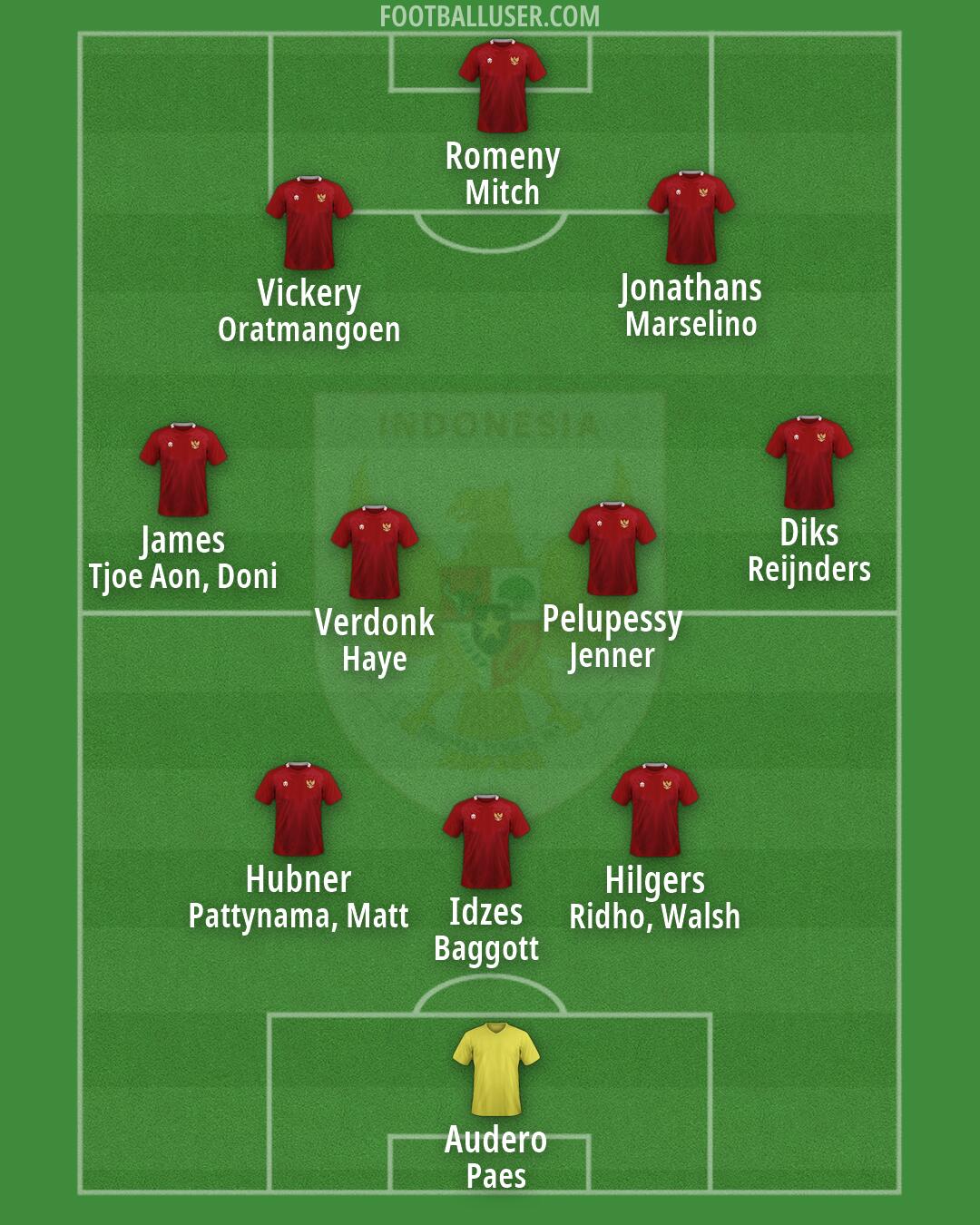

Indonesia National Football Team Formation
 August 17, 2026


Starting Lineup
Audero (Paes) · Hilgers (Ridho, Walsh) · Idzes (Baggott) · Hubner (Pattynama, Matt) · Verdonk (Haye) · Pelupessy (Jenner) · Diks (Reijnders) · James (Tjoe Aon, Doni) · Romeny (Mitch) · Jonathans (Marselino) · Vickery (Oratmangoen)Indonesia plays a high press game using a 3-4-3 formation. This lineup looks to win the ball high up the pitch and use rapid transitions to catch the opposition out of position. The team relies on aggressive movement and verticality to stretch the defence of the opponent.
Audero acts as the last line of defence in goal. The back line operates as a back three with Idzes, Hilgers, and Hubner. Hilgers and Hubner play as wide centre backs to cover the flanks, while Idzes holds the line in the center. This unit is designed to play out from the back to start attacks. When defending, the three centre backs can drop into a low block to deny space behind them or step up to squeeze the space.
The midfield uses a two-man central pairing with Verdonk and Pelupessy acting as the core. Verdonk and Pelupessy work to compress the midfield and win the second ball. They are supported by wide midfielders James and Diks who provide the width. James and Diks act as attacking wing backs, pushing high to overlap the front three while tracking back to support the defenders. This midfield unit connects the defensive line to the attack by recycling possession and playing through the lines.
In the final third, Indonesia uses three attackers. Romeny leads the line as a lone striker, looking to find the feet of the striker or run in behind the defence. Vickery and Jonathans play as wide attackers, with Vickery cutting inside from the left and Jonathans looking to get to the byline on the right. They press from the front to force a long ball from the opposition. The front three combine in tight spaces to create runs in behind or allow for cutbacks from the byline.
The tactical advantages of this Indonesia lineup include the ability to press high in coordinated waves and create wide overloads. Because James and Diks push so far forward, they often create two on one situations against the opposition full backs. The team also benefits from the speed of transition once the midfield trio wins the ball. This allows the front three to immediately attack the space left by a high defensive line.
This formation is built for a high tempo game that demands intense running. It is best suited for matches against teams that struggle to play out from the back under pressure.