Man City Football Formation
 August 18, 2026


Starting Lineup
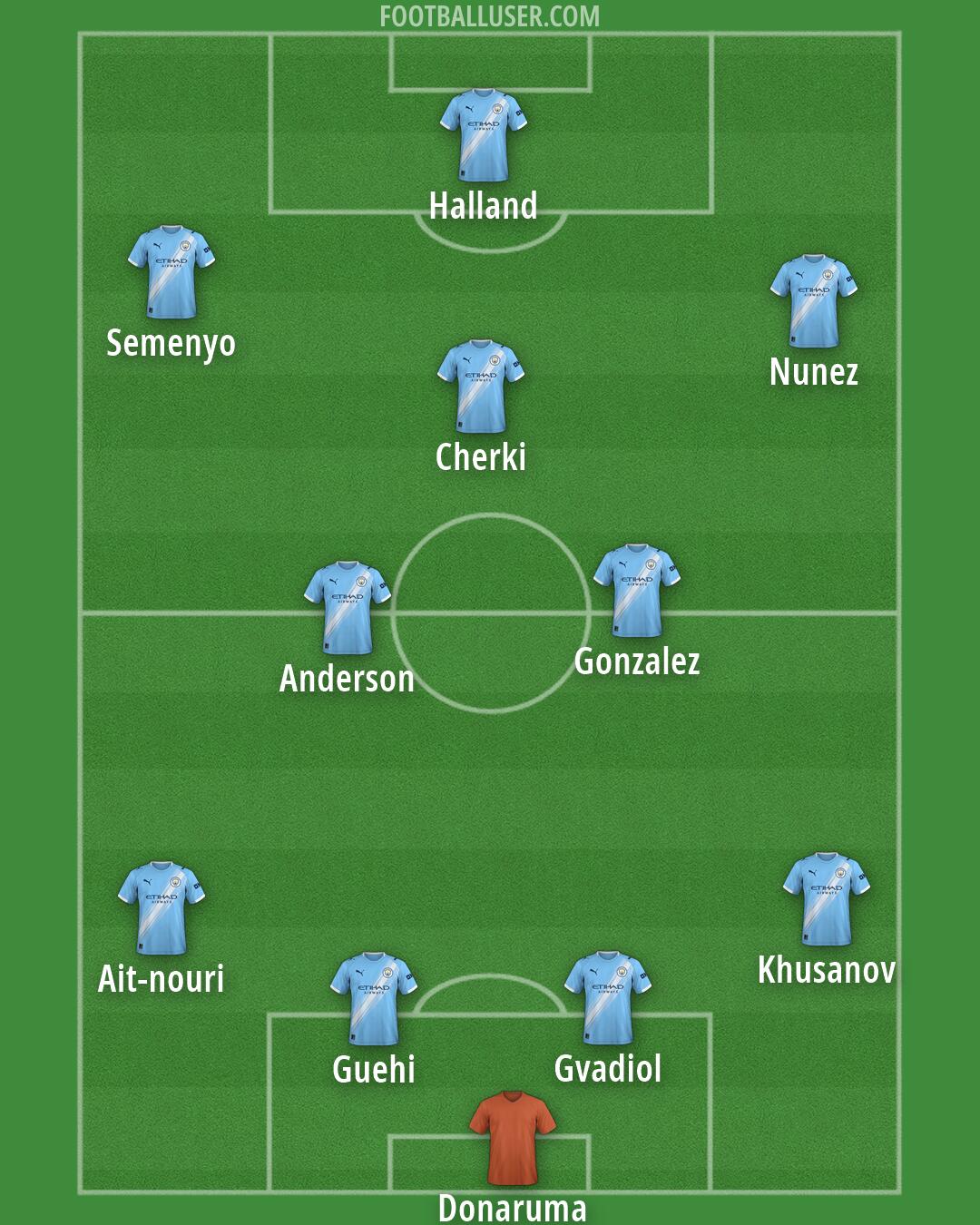
Halland · Semenyo · Nunez · Cherki · Khusanov · Guehi · Gvadiol · Ait-nouri · Gonzalez · Anderson · DonarumaMan City relies on a heavy high press and aggressive verticality to dominate games using a 4-3-3. This formation is built to squeeze the space in the opponent half and win the ball back high up the pitch. The team aims to use quick transitions to punish the opposition as soon as they lose possession.
Donaruma acts as the last line of defense, ready to sweep behind a high line if the defenders push up. The back line functions as a flat back four where Khusanov plays as a defensive wing back to provide cover on the right. Gvadiol works as a ball playing defender on the right side of the center, while Guehi holds the line as a dominant presence on the left. Ait-nouri plays as an attacking full back on the left, often looking to overlap the winger to provide width.
The midfield works as a three man midfield with a carrier role. Anderson operates to shield the defense and win the second ball, while Gonzalez looks to drive forward with the ball to link the lines. Cherki plays as an attacking ten behind the striker, finding pockets of space to play through the lines. This unit is designed to compress the midfield and deny the turn to the opposition pivot.
The front line uses three attackers across the front to stretch the defense. Semenyo plays as an inverted winger on the left to cut inside and create chaos, while Nunez stays wide on the right to isolate a one on one situation. Halland operates as a pressing centre forward who pins the last defender and looks to hit in behind on the transition. The team builds attacks by spreading wide to force a long ball from the opponent.
Man City gains a significant advantage through the ability to press high in coordinated waves with the front three. The team also creates wide overloads when Ait-nouri and Semenyo combine to pull the defense apart. This lineup allows the players to use their speed of transition to catch teams out of position.
This 4-3-3 formation is built for high intensity dominance and rapid attacking movements. It is best suited for games where the team needs to pin the opponent in their own half and exploit space behind a high defensive line.