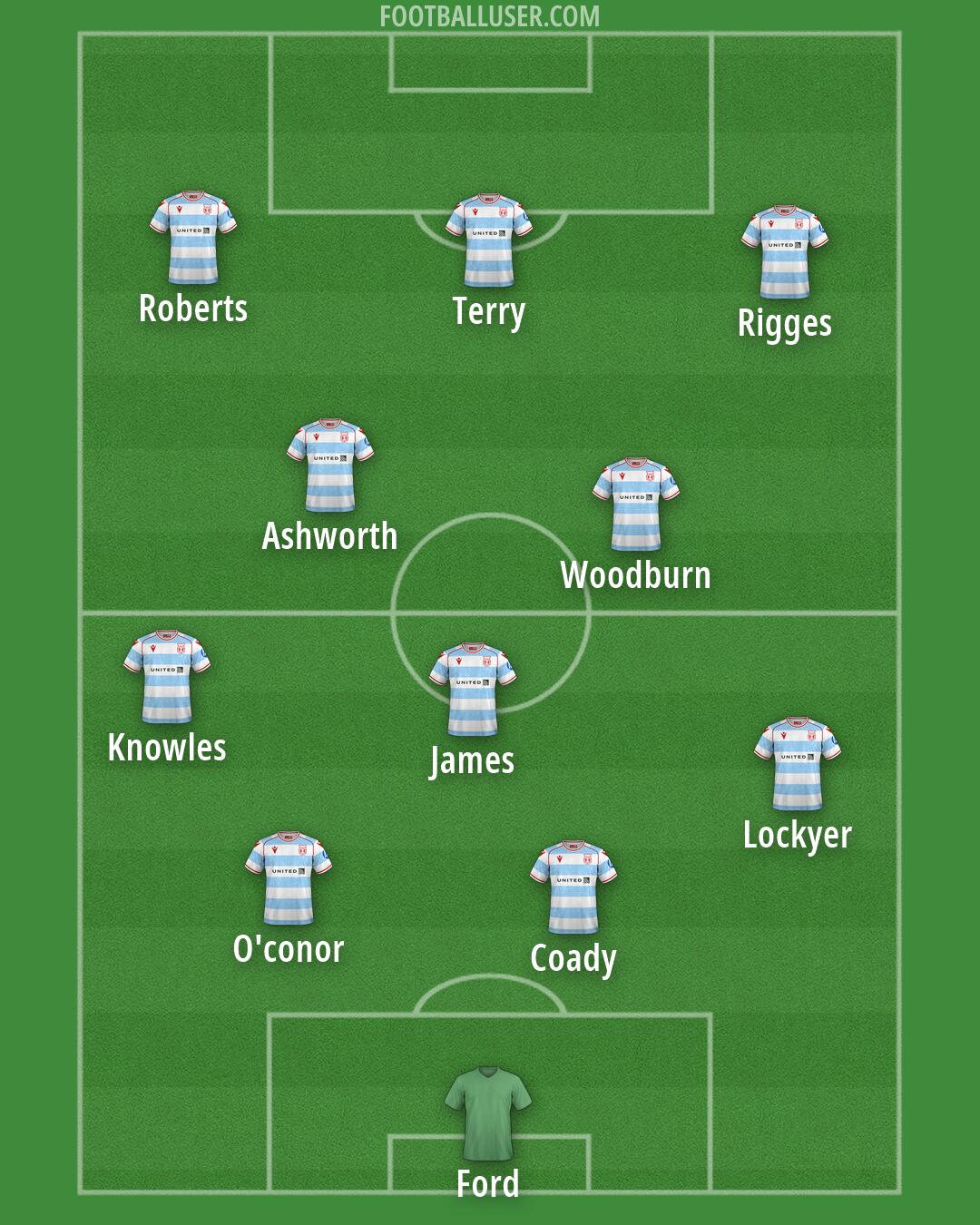
Wrexham Football Formation
 Today, August 19, 2026


Starting Lineup
Terry · Rigges · Woodburn · Ashworth · James · Knowles · O'conor · Coady · Lockyer · Roberts · FordWrexham seeks to control games through a high press and quick verticality using a 5-2-3. This formation is built to win the ball back high up the pitch and strike fast through wide areas. The lineup focuses on heavy pressure and rapid transitions to catch opponents off guard.
Ford stays between the posts to organize the back line. The defensive unit works as a back five where James acts as the central anchor. Coady plays as the right centre-back and O'conor occupies the left centre-back spot to provide a solid zonal line. Lockyer operates as the right wing back and Knowles plays as the left wing back, both tasked to push high and provide width. The defenders aim to win the second ball and defend zonally to maintain a compact block.
The midfield functions as a double pivot designed to control the center of the pitch. Woodburn and Ashworth work together to shield the defense and connect the back line to the attackers. Woodburn drives forward with the ball to link play while Ashworth works to intercept passes and compress the midfield. This pair must be ready to press aggressively to win the ball back in the middle third.
Wrexham utilizes three attackers across the front to stretch the defense. Terry plays as a lone striker and acts as a target man to hold up the ball. On the flanks, Rigges operates as the right winger and Roberts plays as the left winger. Both Rigges and Roberts hug the touchline to spread wide and create space in the middle. They look to hit in behind on the transition or cut inside to deliver early crosses into the box.
This formation offers significant width from the wing backs and the front three. Lockyer and Knowles provide wide overloads by overlapping the wingers to create numerical advantages. Wrexham also benefits from a high press in coordinated waves that can force a long ball from the opposition.
This 5-2-3 lineup is built for heavy pressing and rapid attacking transitions. It is best suited for matches against teams that struggle to play out from the back under pressure.