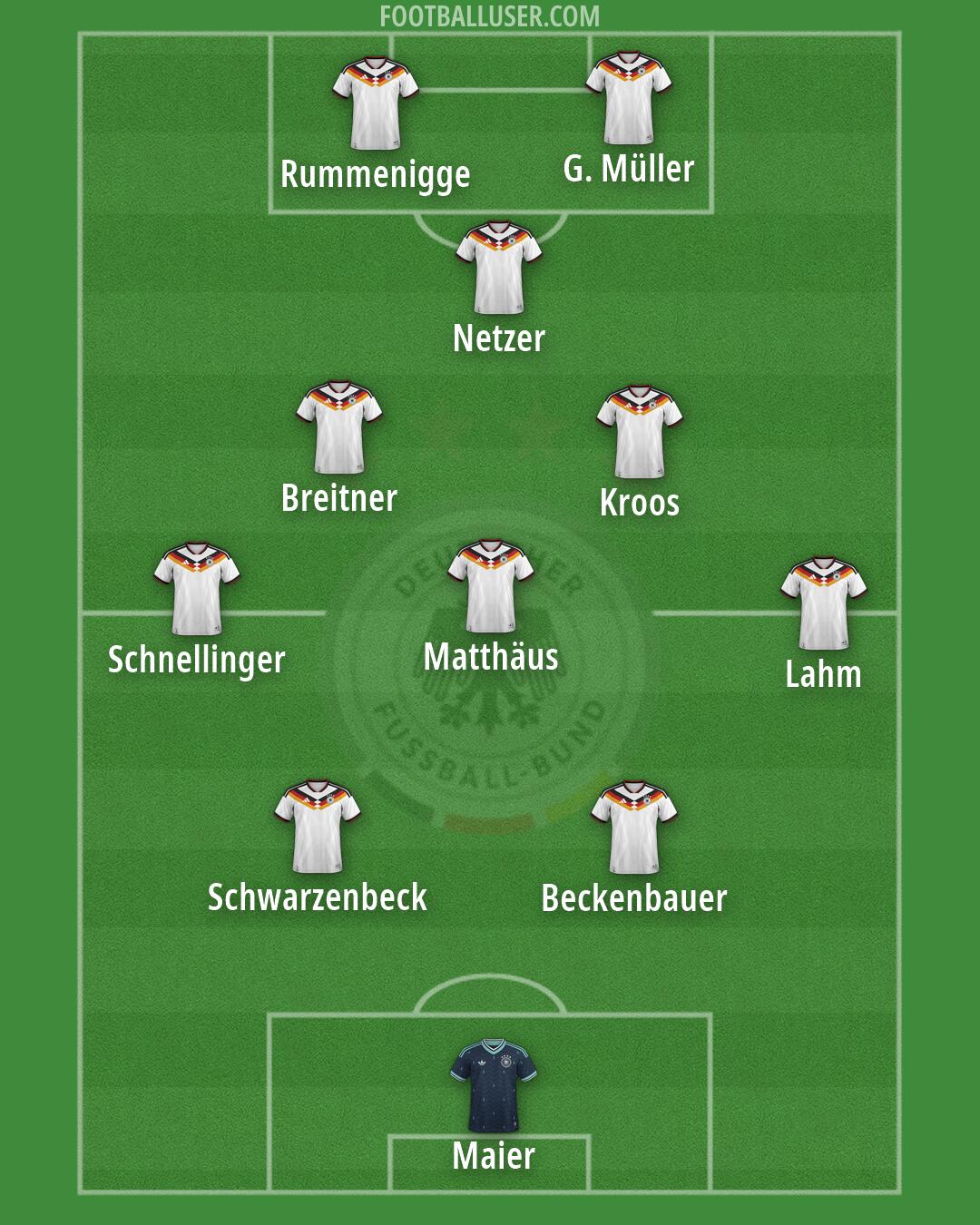

Germany National Football Team Formation
 Today, August 19, 2026


Starting Lineup
Schnellinger · Lahm · Schwarzenbeck · Beckenbauer · Breitner · Matthäus · Netzer · G. Müller · Rummenigge · Kroos · MaierGermany focuses on overwhelming control and extreme verticality through a 2-6-2 formation. This lineup is built to suffocate opponents in the middle of the pitch and create constant pressure through a massive central presence. The team aims to dominate every zone of the field by using a dense midfield to dictate the tempo and prepare attacks for the two strikers.
Maier operates between the posts to provide security for the small defensive unit. Beckenbauer leads the back line as a ball playing defender who can step into midfield to create extra passing lanes. Schwarzenbeck provides the defensive cover, acting as a dominant force to win the header and clear the lines when the team is caught out. This duo must hold the line and show the striker inside to keep the game manageable.
The midfield is a massive engine room designed to control the ball and bypass the opposition. Schnellinger and Lahm sit as a deep-lying pairing to shield the defense and recycle possession. Matthäus works as a carrier to drive forward with the ball and press aggressively to win the ball high up the pitch. Ahead of them, Kroos uses his passing range to find the feet of the striker, while Breitner and Netzer operate in the half-spaces to pull wide or arrive late into the box. This heavy midfield block ensures Germany can always find a way to progress through the thirds.
The attack relies on a lethal partnership of two forwards. Rummenigge operates as a pressing centre-forward who uses his pace to hit in behind on the transition. G. Müller acts as the clinical finisher, finding ways to arrive in the box and finish chances. The team builds play through the crowded midfield, using quick combinations to split the defense with a through ball. The two forwards work to pin the last defender, creating space for the attacking midfielders to run into.
Germany gains a huge advantage through numerical superiority in midfield, making it very hard for opponents to find passing lanes. The ability to press in a mid-block with six players allows them to win the second ball frequently. This formation also creates wide overloads when the attacking midfielders move into the channels, forcing the opposition to stretch the defense.
This 2-6-2 formation is a high risk, high reward system centered on absolute midfield dominance. It is best suited for matches where Germany needs to crush a weaker side through sustained pressure and central control.